From Visibility to Influence: How Michelle Murinda is Redefining Young Women’s Leadership in Zimbabwe
المصدر: UN Women
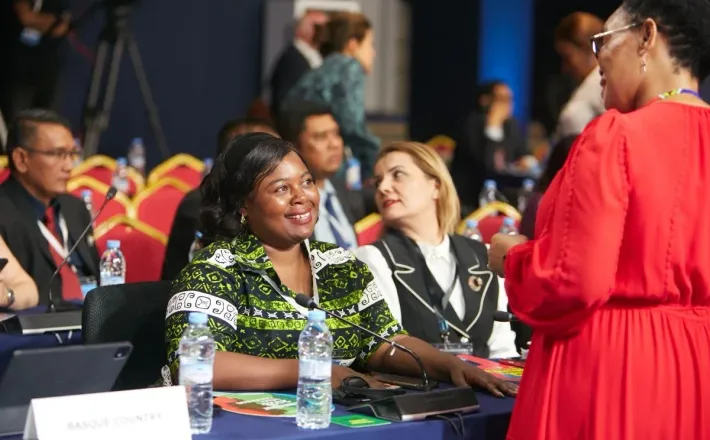
Chioniso Michelle Murinda is an elected councillor and Chair of the Chegutu District Council in Zimbabwe, where she leads on environmental governance, natural resource management and local development. Murinda joined the first-ever Women’s Assembly on 23 June 2026, hosted in the context of UCLG’s World Congress and Summit of Local and Regional Leaders in Tangier. Supported by WYDE Women’s Leadership, the Women’s Assembly marked a historic moment for women in local governance, creating a space for women leaders across generations and regions to collectively shape a more inclusive political future.
When Chioniso Michelle Murinda first entered local politics in Zimbabwe, she quickly realized that holding a leadership title was only the beginning. Real change, she says, comes not from occupying a seat at the table, but from ensuring that communities have a meaningful voice in the decisions that affect their lives.
An elected councillor and Chair of the Chegutu District Council, Murinda has already broken several barriers. She is the only councillor in Zimbabwe elected to chair two committees simultaneously: the Environment Committee and the Finance Committee. Her work spans natural resource governance, land management, agriculture, climate issues and local development across multiple districts.
Yet despite her achievements, Murinda believes the most important lesson she has learned is one she did not acquire in a classroom. “It's not enough to go to school,” she says. “There are many things that you would never find in any library, any university, any institution. There are the unspoken rules of leadership, which you can learn only from those who have walked that path before you.”
Behind her achievements lies another critical factor: mentorship. For Murinda, learning from women who had already navigated leadership spaces was instrumental in shaping her confidence, resilience and approach to public service.
For instance, through UN Women’s African Women Leaders Network capacity‑building programme, Murinda gained structured training in leadership, mentorship, and advocacy, along with access to regional peer networks and practical tools for community engagement. This investment strengthened her confidence, expanded her influence as a councillor and young female leader, and enabled her to mobilize resources, challenge stigma, and amplify youth voices in Zimbabwe’s governance and development spaces.
Furthermore, mentorship with senior leaders created the intergenerational solidarity necessary to strengthen women’s leadership. Rather than viewing younger and older generations as competitors, she argues that progress depends on collaboration and shared leadership. “We need each other. Only when senior women lead side-by-side with emerging women leaders you can have a whole of stakeholder approach,” Murinda says.
That belief was reinforced during the UCLG Women’s Assembly held in the context of the World Congress and Summit of Local and Regional Leaders in Tangier. Reflecting on the discussions with women leaders from around the world, Murinda highlighted a crucial shift in the conversation on women’s political representation: “We have fought to be in these spaces as women,” she says. “So, it's no longer about how many women are in the room, but what we do when we are in that space.” For her, representation alone is not enough. “Are we introducing new policies? Are we bringing reforms or are we just making the numbers?”
Soon after assuming office, Murinda observed that many local policies were designed from the top down, often without sufficient consultation with the communities most affected by environmental and agricultural challenges. In response, she launched Environmental Committees across 29 wards in her district, a first-of-its-kind initiative in the area. These committees bring community members amongst them many women, into local decision-making processes and help shape policies based on local needs and realities. Murinda explains that women, as primary caregivers and first responders to environmental and agricultural challenges within their households and communities, often possess valuable knowledge that is rarely harnessed in formal policymaking. Through these committees, Murinda offered channels for women’s voices to inform local governance while strengthening ownership of development initiatives.
The impact of these committees extends beyond policy outcomes. Murinda says that seeing a young woman chairing committees historically led by men has changed perceptions among many women and girls living in rural areas. It has demonstrated that leadership is not limited by age or gender, and that women can effectively lead in sectors that shape local economies and livelihoods.
“Visibility without influence is nothing.”
As more women enter political and leadership spaces, Murinda believes the focus must shift from representation alone to meaningful influence and transformative leadership. Her journey demonstrates that breaking barriers is only the first step. Lasting change happens when women use their positions to amplify community voices, shape policies and create opportunities for others to lead.
Asked what advice she would give to the next generation of young women leaders, she laughs before offering a simple message:
“There is never the right time to start. So start anyway!”
The Women’s Assembly was organized by United Cities and Local Governments (UCLG) which is an implementing partner of WYDE | Women’s Leadership, an initiative funded by the European Union and led by UN Women. WYDE | Women’s Leadership is a collaborative global effort aimed at advancing women’s full and effective political participation and decision-making at all levels, especially those most often left furthest behind.
Note: These publications aim to stimulate a constructive debate on key issues of interest for advancing gender equality and women’s empowerment. The views expressed by the individuals interviewed for the production of our editorial content do not necessarily reflect the official position of UN Women, United Nations system agencies nor of the European Union.

Hear from women leading change in the political space share their experiences and insights.

Explore a wide-range of audio-visual resources on key topics of gender equality.

Hear from a diverse list of panelists and guests as they reflect on critical issues pertaining Women in Politics.