UN Women hailed India's passage of the Women’s Reservation Bill on September 18 as a landmark moment for gender equality, especially in terms of women’s political leadership.
Advocacy and lobbying are activities that represent and promote the needs of specific groups in political and social arenas. One such group is women, who can collectively pressure their leaders for legislative reforms to protect and promote women’s rights and concerns. It is the goal of advocacy groups and lobbyists to ensure that both the public and politicians understand and support their cause, so that it gains strength and credibility. Securing rights and gains for women requires coalition-building, funding, civic education, awareness-raising and individuals willing to lead the way.
While the goals of advocacy and lobbying are similar, the processes are distinctly different. Advocacy involves gaining and exercising power to influence a political action. Employing methods such as demonstrations, public campaigns and civic education, advocacy can be the primary mission of international agencies and civil society organizations seeking to influence global and national decision makers. Women worldwide frequently organize themselves for advocacy purposes, drawing on their collective power to affect legislation, official policies and governmental programs. Lobbying, however, refers to influencing the government and its leaders. Lobbyists attempt to sway policy makers and legislators to address specific issues, often by introducing or revising legislation and policy. Lobbying activities may include private meetings with decision makers, public campaigns and demonstrations.
UN Women hailed India's passage of the Women’s Reservation Bill on September 18 as a landmark moment for gender equality, especially in terms of women’s political leadership.
Welcoming the introduction of the Women’s Reservation Bill which is aimed at providing 33% reservation to women in the Lok Sabha and the state assemblies, many women politicians from across South Goa said that voice of women will become more vocal as
Congress leader and former Bagalkote Zilla Panchayat President Veena Kashappanavar hailed the Women’s Reservation Bill introduced in the Lok Sabha on Tuesday, and said it will pave the way for more women to enter politics.
Women comprise 54% of Zimbabwe's population, but one can hardly tell from the country's new cabinet.
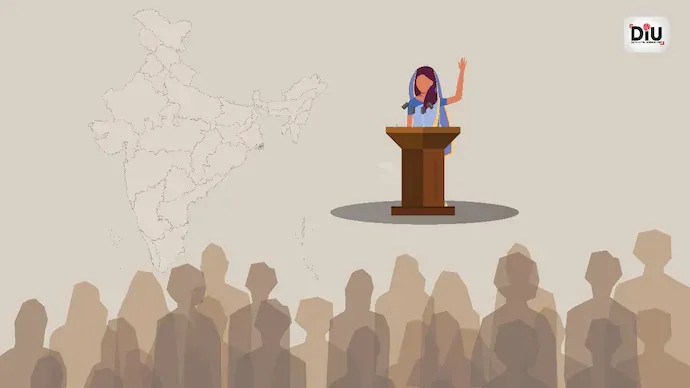
Since the days of monarchy in India, women have been kept away for state and administrative jobs. Women have been neglected in decision-making in the public and private spheres.
Violence against women in politics (VAWIP) is an urgent problem worldwide. At the time of this writing, U.S.
It’s great to hear that the Pakistan Peoples’ Party (PPP) has been actively promoting the inclusion of women and religious minorities within the party.
In the vast landscape of Mongolia, the traditional nomadic lifestyle is deeply rooted in the fabric of its culture.
For the first time in the history of independent India, the government is conducting a five-day-long special session of Parliament from September 18 to September 22.