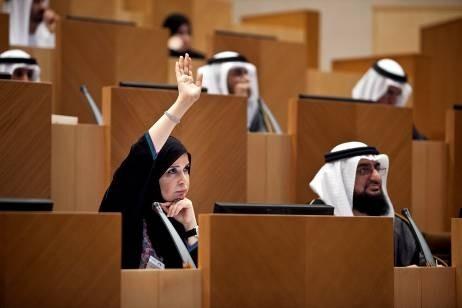
Parliaments and Representatives

Democracy and the equal participation of men and women in the political arena are closely intertwined. No parliament or any decision-making body can claim to be representative without the participation of both men and women. As stated in the Universal Declaration on Democracy adopted by the Inter-Parliamentary Union’s Member Parliaments in 1997, "The achievement of democracy presupposes a genuine partnership between men and women in the conduct of the affairs of society in which they work in equality and complementarity, drawing mutual enrichment from their differences."

Recent years have seen a steady increase in the number of women in parliament, though the world average of less than 22 percent remains far from the goal of parity between women and men. The election of women to the highest positions of state and government in several countries has also contributed to the changing face of politics.

While the road to election is a difficult one, the challenges for women do not stop there. Once women enter parliament or other bodies, they are faced with many new challenges. Parliament is traditionally a male-oriented domain where the rules and practices have been written by men. It is, therefore, an ongoing challenge to transform parliament into a gender-sensitive environment, to ensure that actions are gender-sensitive and to guarantee that gender is mainstreamed throughout the legislature.

Performances of Resistance: Women's Struggle for Political Power in Cambodia

Back
February 14, 2007

Performances of Resistance: Women's Struggle for Political Power in Cambodia

This paper explores how politically engaged Cambodian women build strategies and perform various types of resistance against the male domination of democratic arenas. It investigates possible ways to eliminate gendered hierarchies of power and how to alter the stereotypes of men and women.

This paper explores how politically engaged Cambodian women build strategies and perform various types of resistance against the male domination of democratic arenas. It investigates possible ways to eliminate gendered hierarchies of power and how to alter the stereotypes of men and women.

Parliamentary Development: Gender Perspective

Back
February 14, 2007

Parliamentary Development: Gender Perspective

This report argues that women in parliament can have a positive impact on the political process and strongly advocates for gender equality in parliament. It also includes a brief case study of women legislators in Rwanda.

This report argues that women in parliament can have a positive impact on the political process and strongly advocates for gender equality in parliament. It also includes a brief case study of women legislators in Rwanda.

Kenya Human Development Report 1999: Gender and Human Development

Back
February 14, 2007

Kenya Human Development Report 1999: Gender and Human Development

This report presents an overview of the state of human development in Kenya, focusing primarily on poverty and gender inequality.

This report presents an overview of the state of human development in Kenya, focusing primarily on poverty and gender inequality.

Gender Mainstreaming in Parliaments: International Best Practices

Back
February 13, 2007

Gender Mainstreaming in Parliaments: International Best Practices

This paper serves as a guideline for parliamentarians to facilitate the process of gender mainstreaming by providing examples of best practices employed by parliaments around the world.

This paper serves as a guideline for parliamentarians to facilitate the process of gender mainstreaming by providing examples of best practices employed by parliaments around the world.

UNDP's Quick Entry Points to Women's Empowerment and Gender Equality

Back
February 13, 2007

UNDP's Quick Entry Points to Women's Empowerment and Gender Equality

This training guide focuses on the human rights-based approach to development cooperation as a framework for women's empowerment and gender equality.

This training guide focuses on the human rights-based approach to development cooperation as a framework for women's empowerment and gender equality.

Conflict and a Gendered Parliamentary Response

Back
February 12, 2007

Conflict and a Gendered Parliamentary Response

This article advances the argument that parliaments confronting situations of crisis and recovery benefit from integrating a gender perspective into their core functions.

This article advances the argument that parliaments confronting situations of crisis and recovery benefit from integrating a gender perspective into their core functions.

Women's Participation in Decision-Making and Leadership: A Global Perspective

Back
February 12, 2007

Women's Participation in Decision-Making and Leadership: A Global Perspective

This paper was delivered at the Conference on Women in Decision-Making in Cooperatives held in Tagatay City, Philippines in May 1997.

This paper was delivered at the Conference on Women in Decision-Making in Cooperatives held in Tagatay City, Philippines in May 1997.

Partnerships for Gender Equality: The Role of Multilateral and Bilateral Agencies in Africa

Back
February 12, 2007

Partnerships for Gender Equality: The Role of Multilateral and Bilateral Agencies in Africa

This report documents the work of various multilateral and bilateral donors in Africa to meet the goals set forth during the Beijing +10 Conference.

This report documents the work of various multilateral and bilateral donors in Africa to meet the goals set forth during the Beijing +10 Conference.

Women in Power and Decision-Making in the Caribbean

Back
February 12, 2007

Women in Power and Decision-Making in the Caribbean

This paper examines the range of actions/strategies taken to advance the agenda of the Beijing Platform for Action in the Caribbean region.

This paper examines the range of actions/strategies taken to advance the agenda of the Beijing Platform for Action in the Caribbean region.