As Liz Truss becomes the UK’s next PM, here’s how women parliamentarians can gain ground in politics.
Democracy and the equal participation of men and women in the political arena are closely intertwined. No parliament or any decision-making body can claim to be representative without the participation of both men and women. As stated in the Universal Declaration on Democracy adopted by the Inter-Parliamentary Union’s Member Parliaments in 1997, "The achievement of democracy presupposes a genuine partnership between men and women in the conduct of the affairs of society in which they work in equality and complementarity, drawing mutual enrichment from their differences."
Recent years have seen a steady increase in the number of women in parliament, though the world average of less than 22 percent remains far from the goal of parity between women and men. The election of women to the highest positions of state and government in several countries has also contributed to the changing face of politics.
While the road to election is a difficult one, the challenges for women do not stop there. Once women enter parliament or other bodies, they are faced with many new challenges. Parliament is traditionally a male-oriented domain where the rules and practices have been written by men. It is, therefore, an ongoing challenge to transform parliament into a gender-sensitive environment, to ensure that actions are gender-sensitive and to guarantee that gender is mainstreamed throughout the legislature.
As Liz Truss becomes the UK’s next PM, here’s how women parliamentarians can gain ground in politics.
On a sweltering day in July, Yoshii Aya, still reeling from her bitter election defeat a few months prior, arrived in Kyoto with a stack of leftover business cards tailored for that bygone race.
Canadians want parties and governments to act on gender parity in politics.
It’s been 129 years since women won the right to vote, but as Aotearoa begins voting in this year’s local body elections it’s clear we still have a long way to go.
Country on target towards 50% female representation in Federal National Council.
Democratization is under pressure across the globe. Here are five major threats to democracy, and how to mitigate them.
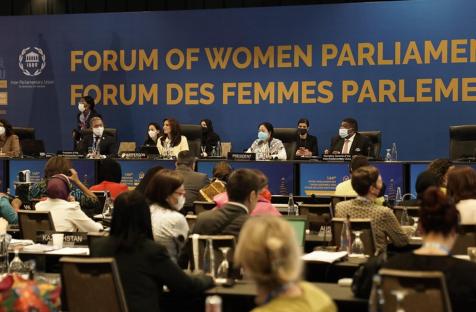
The 14th Summit of Women Speakers of Parliament (14SWSP), convened by the Inter-Parliamentary Union (IPU), in close cooperation with the Oliy Majlis (Supreme Assembly) of Uzbekistan, took place in-person, in Tashkent (Uzbekistan), from 8 to 9 September 2022.
For the first time, a Massachusetts election was dominated by women candidates, who won primaries in five out of six statewide races on Tuesday — an unprecedented showing in a state that had trailed in women’s political representation.
Senegal will break new ground Monday as West Africa's largest-ever proportion of women MPs take their seats in a newly elected legislature, stirring hopes of change in a country where patriarchal laws and attitudes are entrenched.