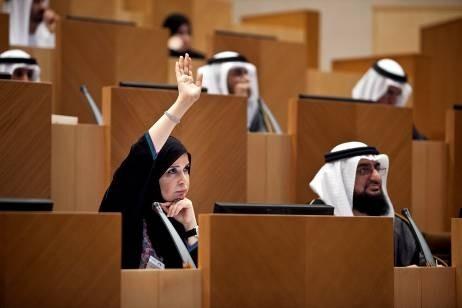
Parliaments and Representatives
Democracy and the equal participation of men and women in the political arena are closely intertwined. No parliament or any decision-making body can claim to be representative without the participation of both men and women. As stated in the Universal Declaration on Democracy adopted by the Inter-Parliamentary Union’s Member Parliaments in 1997, "The achievement of democracy presupposes a genuine partnership between men and women in the conduct of the affairs of society in which they work in equality and complementarity, drawing mutual enrichment from their differences."
Recent years have seen a steady increase in the number of women in parliament, though the world average of less than 22 percent remains far from the goal of parity between women and men. The election of women to the highest positions of state and government in several countries has also contributed to the changing face of politics.
While the road to election is a difficult one, the challenges for women do not stop there. Once women enter parliament or other bodies, they are faced with many new challenges. Parliament is traditionally a male-oriented domain where the rules and practices have been written by men. It is, therefore, an ongoing challenge to transform parliament into a gender-sensitive environment, to ensure that actions are gender-sensitive and to guarantee that gender is mainstreamed throughout the legislature.
Interviews
A Primer for Parliamentary Action: Gender-sensitive Responses to COVID-19
This Primer highlights practical ways Members of Parliament (MPs) and parliamentary staff can take action to ensure COVID-19 response and recovery decision-making address women’s needs.
Coronavirus has changed everything. Make sense of it all with the Waugh Zone, our evening politics briefing. Sign up now.
The Inter-Parliamentary Union condemns the imprisonment of 43 Members of Parliament around the world, saying they lack legal recourse to attain justice.
One of Africa’s youngest cabinet members to date is experiencing a baptism of fire.
Why do we still rarely see mothers, especially those with young children, represented in parliament?
The coronavirus pandemic deepens existing inequalities in our societies. It exposes an increasing number of women to gender-based violence.
Recent gains by women in the Ethiopian political landscape offer a chance to improve gender equality around the country and put an end to long-standing societal iniquities.
Survey finds that gender gaps in political interest reduce after women’s representation doubles in Uruguay
The below findings and graph are from the book Seeing Women, Strengthening Democracy: How Women in Politics Foster Connected Citizens, authored by Magda Hinojosa and Miki Caul Kittilson and released in 2020.
Pagination
- Previous page
- Page 171
- Next page