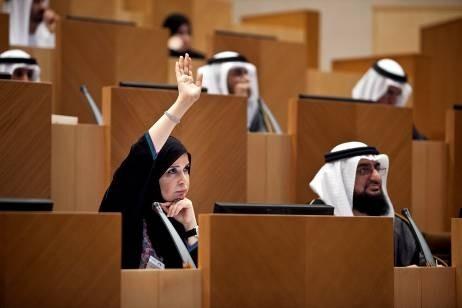
Parliaments and Representatives

Democracy and the equal participation of men and women in the political arena are closely intertwined. No parliament or any decision-making body can claim to be representative without the participation of both men and women. As stated in the Universal Declaration on Democracy adopted by the Inter-Parliamentary Union’s Member Parliaments in 1997, "The achievement of democracy presupposes a genuine partnership between men and women in the conduct of the affairs of society in which they work in equality and complementarity, drawing mutual enrichment from their differences."

Recent years have seen a steady increase in the number of women in parliament, though the world average of less than 22 percent remains far from the goal of parity between women and men. The election of women to the highest positions of state and government in several countries has also contributed to the changing face of politics.

While the road to election is a difficult one, the challenges for women do not stop there. Once women enter parliament or other bodies, they are faced with many new challenges. Parliament is traditionally a male-oriented domain where the rules and practices have been written by men. It is, therefore, an ongoing challenge to transform parliament into a gender-sensitive environment, to ensure that actions are gender-sensitive and to guarantee that gender is mainstreamed throughout the legislature.

July 18, 2014
Bharatiya Janata Party committed to give 33 per cent reservation to women: Saroj Pandey (India)

Charging the former Congress-led United Progressive Alliance government of "betraying women by not giving reservation to them in decision-making bodies", BJP today said it was committed to political empowerment o

July 17, 2014
Gender Quota key to enhance political participation of women

Afghan parliamentarian and women’s rights activist, Farkhunda Zahra Naderi, has said that the Gender Quota is key to enhance the political participation of women.

July 17, 2014
Serbia improves position of women in politics

Women are taking an increasingly active role as decision-makers in Serbian politics, but some bloggers say more steps should be taken to ensure greater participation at the highest levels of government.

July 17, 2014
Ready for the lists, say Uruguayan women
July 17, 2014
30 trained to contest elections

THIRTY Bahraini women are being trained to contest the upcoming parliamentary and municipal elections.

The four-phase programme, organised by the Supreme Council for Women (SCW), focuses on skills training, political empowerment of women, knowledge sharing and simulation activities.

July 17, 2014
Nine women to fight election, Bahrain

Nine Bahraini women have confirmed their candidacy for the upcoming parliament and municipal council elections.

However, they said they will reveal their election campaigns closer to the polls, which are expected to take place in November.

July 17, 2014
Nigeria: Low Number of Female Lawmakers Stalling Passage of Gender Bills

The National Institute of Legislative Studies (NILS) has identified the low number of women in Nigerian parliament as the reason for the failure of gender-based bills in the legislature, adding that it is unacceptable that only seven per cent of lawmakers are women.

July 17, 2014
Umno has failed to promote women in politics — Dyana Sofya

Apparently, some people feel that Datuk Seri Dr Wan Azizah Wan Ismail may not be a suitable candidate for the Selangor menteri besar post because she suffers from “uzur syarie” (menses).

July 13, 2014
Women in parliament: Britain has ‘real problem’ with lack of female MPs as report and cabinet reshuffle put gender in the spotlight

With the role of women in British politics again coming under the spotlight this week, MPs and former ministers have warned that there is a “real problem” with the issue of gender in Westminster.