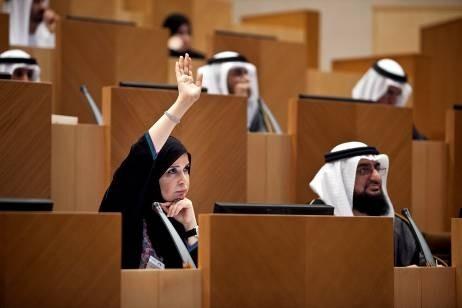
Nation-building processes cannot work and development goals cannot be achieved if women are denied meaningful political participation. To ensure this, Pakistan’s Parliament introduced in 2002 a 17 percent gender quota in all legislative houses.
Parliaments and Representatives
Democracy and the equal participation of men and women in the political arena are closely intertwined. No parliament or any decision-making body can claim to be representative without the participation of both men and women. As stated in the Universal Declaration on Democracy adopted by the Inter-Parliamentary Union’s Member Parliaments in 1997, "The achievement of democracy presupposes a genuine partnership between men and women in the conduct of the affairs of society in which they work in equality and complementarity, drawing mutual enrichment from their differences."
Recent years have seen a steady increase in the number of women in parliament, though the world average of less than 22 percent remains far from the goal of parity between women and men. The election of women to the highest positions of state and government in several countries has also contributed to the changing face of politics.
While the road to election is a difficult one, the challenges for women do not stop there. Once women enter parliament or other bodies, they are faced with many new challenges. Parliament is traditionally a male-oriented domain where the rules and practices have been written by men. It is, therefore, an ongoing challenge to transform parliament into a gender-sensitive environment, to ensure that actions are gender-sensitive and to guarantee that gender is mainstreamed throughout the legislature.
Training Modules to Increase Women's Political Participation
These new training materials take best practices and approaches from NDI's work around the world and make them into a set of tools to increase the quality of training programs for women as voters, advocates, elections officials, political party members, candidates and office holders.
Event
Practical Women's Leadership Power Tools to Advance Your Career
Are you considering your next career move? Want to advance faster in leadership or compensation? Puzzled by power politics in the office?
Practical Women's Leadership Power Tools to Advance Your Career
Are you considering your next career move? Want to advance faster in leadership or compensation? Puzzled by power politics in the office? Accelerate your career and uptick your leadership skills with this innovative, 9 practical women’s leadership “Power Tools” program entirely online.
On the occasion of the International Day of Action for Women's Health, European public health, health promotion and disease prevention, health professionals and women issues non-governmental organisations are calling for the newly elected European Parliament (EP), its Committees and political par
India's 16th General Election has been the most expensive exercise of its kind in the country's history. One estimate puts the figure at Rs 30,000 crore, a tad shy of the bill notched up in the 2012 US presidential polls.
Washington has been criticized for being under constant gridlock for the majority of the last five years. This gridlock leads many people to think cynically about our government. The issue of women holding political office is treated cynically as well.
Despite the increase in the number of female candidates in the parliamentary elections held throughout Indonesia on April 9, 2014, the country would likely fail to meet its target of increasing womens representation in the 560-seat Parliament for the 2014-2019 period.
The moment there was an inkling that Dyana Sofya would be DAP’s candidate for the Teluk Intan Parliamentary seat, a picture purportedly of her (it wasn’t) in a bikini was circulated on the internet.
Pagination
- Previous page
- Page 259
- Next page