Parliaments and Representatives

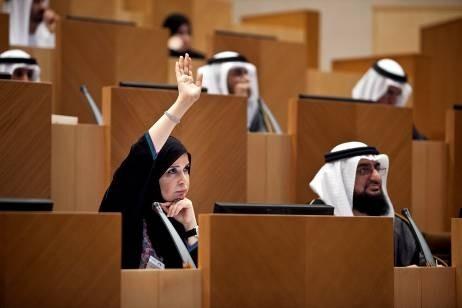
Democracy and the equal participation of men and women in the political arena are closely intertwined. No parliament or any decision-making body can claim to be representative without the participation of both men and women. As stated in the Universal Declaration on Democracy adopted by the Inter-Parliamentary Union’s Member Parliaments in 1997, "The achievement of democracy presupposes a genuine partnership between men and women in the conduct of the affairs of society in which they work in equality and complementarity, drawing mutual enrichment from their differences."

Recent years have seen a steady increase in the number of women in parliament, though the world average of less than 22 percent remains far from the goal of parity between women and men. The election of women to the highest positions of state and government in several countries has also contributed to the changing face of politics.

While the road to election is a difficult one, the challenges for women do not stop there. Once women enter parliament or other bodies, they are faced with many new challenges. Parliament is traditionally a male-oriented domain where the rules and practices have been written by men. It is, therefore, an ongoing challenge to transform parliament into a gender-sensitive environment, to ensure that actions are gender-sensitive and to guarantee that gender is mainstreamed throughout the legislature.

Electoral Gender Quota Systems and their Implementation in Europe

Back
May 22, 2014

Electoral Gender Quota Systems and their Implementation in Europe

The note is an updated version of the 2011 study Electoral Gender Quotas and Their Implementation in Europe (PE 408.309), and it maps the diffusion of electoral gender quotas in the 30 EU/EEA countries and evaluates the effectiveness of different quota types in different electora
May 19, 2014
Nigeria: Amaechi Tasks Women On Greater Participation in Politics

More participation of women in politics will go along way in making democracy in Nigeria an interesting game, even as it would help in stamping out corruption in the political system. This position was made by the Rivers State Governor, Rotimi Amaechi.

May 16, 2014
Push needed for more women in Vanuatu politics

The Vanuatu Council of Women says the government needs to come up with more strategies to push women's political representation in the country.

May 16, 2014
Low representation doesn't deter Indian women from voting

They might not be getting their due when it comes to representation in parliament, but women have increased their participation in the voting process by nearly 10 percent in this general election, even surpassing men in eight states.

May 16, 2014
Nigeria: Ogun - Fresh Perspectives On Women in Politics

First Lady of Ogun State, Mrs. Olufunso Amosun, recently put forward new perspectives on how to make women's voices heard and make their votes count in Nigeria's political process, ahead of the 2015 general elections.

May 16, 2014
Almost 60 candidates MEPs for the 2014 European elections endorse the EWL Manifesto! Get your candidate to endorse too!

You will find here the list of MEPs who have already endorsed EWL Manifesto. Let’s get much more until the European elections! Thanks for your support!

May 16, 2014
The 10 electoral appeals from the women’s movements in Belgium
 

Latin America: a pioneer in promoting women’s political participation

Back
May 15, 2014

Latin America: a pioneer in promoting women’s political participation

Progress and challenges for women politicians in the region

Progress and challenges for women politicians in the region

May 15, 2014
IPU recommends special measures in Egyptian electoral law to ensure representative parliament

IPU has recommended a comprehensive series of affirmative action and implementation measures aimed at ensuring a minimum-level representation of women and other under-represented groups in the next Egyptian parliament.