Parliaments and Representatives

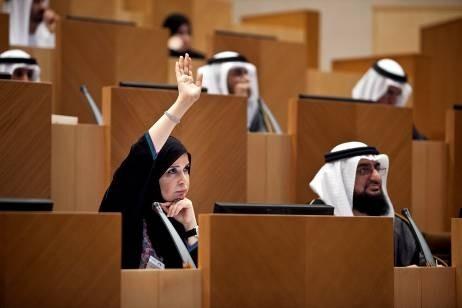
Democracy and the equal participation of men and women in the political arena are closely intertwined. No parliament or any decision-making body can claim to be representative without the participation of both men and women. As stated in the Universal Declaration on Democracy adopted by the Inter-Parliamentary Union’s Member Parliaments in 1997, "The achievement of democracy presupposes a genuine partnership between men and women in the conduct of the affairs of society in which they work in equality and complementarity, drawing mutual enrichment from their differences."

Recent years have seen a steady increase in the number of women in parliament, though the world average of less than 22 percent remains far from the goal of parity between women and men. The election of women to the highest positions of state and government in several countries has also contributed to the changing face of politics.

While the road to election is a difficult one, the challenges for women do not stop there. Once women enter parliament or other bodies, they are faced with many new challenges. Parliament is traditionally a male-oriented domain where the rules and practices have been written by men. It is, therefore, an ongoing challenge to transform parliament into a gender-sensitive environment, to ensure that actions are gender-sensitive and to guarantee that gender is mainstreamed throughout the legislature.

March 31, 2014
Senator Patty Murray on women in power

They called it the Year of the Woman. In 1992, four women were elected to the U.S.

March 30, 2014
Sen. Claire McCaskill gives advice to women in politics

Missouri Sen. Claire McCaskill shared her hard-earned advice and opinions about women in politics and leadership positions during a lecture on March 28, at Iowa State University.

March 30, 2014
Nation suffers because of underrepresentation of black women in politics

The gaping underrepresentation of women of color on the political stage deeply undermines the American ideal of democratic representation.

March 28, 2014
California's 'Close The Gap' Tour Is Demanding Gender Equality In Politics

California boasts two female senators.

We are the only state to advance women's reproductive rights in the last few years.

March 28, 2014
Parties Debate Role Of Hungarian Women In Politics, Life

Women make up just 9 per cent of Hungarian members of parliament. In this regard Hungary ranks 122nd out of 140 countries. Upcoming parliamentary elections have sparked public discussion of the role of women in politics, family life, and in the country as a whole.

March 28, 2014
Ghana needs Legislative Quota Seat system

Mrs Freda Prempeh, Member of Parliament (MP) for Tano North, at the weekend emphasised that a “Legislative Quota Seat” system is urgently required in Ghana’s electoral laws to consolidate the country’s fledging democracy.

March 28, 2014
Afghanistan's 69 women legislators reflect changing times, fight for rights

When they did venture beyond their four walls, they wafted through crowded markets covered from head to toe in the all-encompassing burqa.

March 28, 2014
We Need an Act of Congress to Get More Women In Congress, USA

One of the big headlines for the 2012 elections was the historic number of women elected to state and national offices. New Hampshire became the first state to elect an all women congressional delegation and a woman governor. The U.S.

March 28, 2014
NWCI puts 6 important questions to local and EP election candidates, Ireland

As the May 23 local and European elections draw nearer, the National Woman's Council of Ireland (NWCI) has formulated six key questions to tease out the ways in which potential candidates are committed to promoting gender equality in political arenas and across all aspects of Irish life.