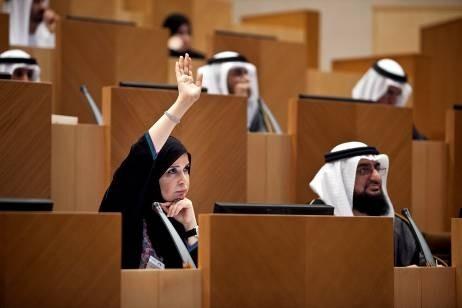
Parliaments and Representatives
Democracy and the equal participation of men and women in the political arena are closely intertwined. No parliament or any decision-making body can claim to be representative without the participation of both men and women. As stated in the Universal Declaration on Democracy adopted by the Inter-Parliamentary Union’s Member Parliaments in 1997, "The achievement of democracy presupposes a genuine partnership between men and women in the conduct of the affairs of society in which they work in equality and complementarity, drawing mutual enrichment from their differences."
Recent years have seen a steady increase in the number of women in parliament, though the world average of less than 22 percent remains far from the goal of parity between women and men. The election of women to the highest positions of state and government in several countries has also contributed to the changing face of politics.
While the road to election is a difficult one, the challenges for women do not stop there. Once women enter parliament or other bodies, they are faced with many new challenges. Parliament is traditionally a male-oriented domain where the rules and practices have been written by men. It is, therefore, an ongoing challenge to transform parliament into a gender-sensitive environment, to ensure that actions are gender-sensitive and to guarantee that gender is mainstreamed throughout the legislature.
Interviews
The passage of a draft law seeking to provide 30 percent women participation in all political parties was stalled recently by a motion for reconsideration made by Nimba County Senator Thomas Grupee.
As many as 556 women contested from various national and regional parties during the 2009 general elections for the 15th Lok Sabha. Out of them 134 contested from the national parties, 27 state parties, 188 from registered parties (unrecognized) and 207 independents.
More work needs to be done post-elections in the Pacific to ensure Pacific countries do not remain at the bottom globally for gender equality in politics.
Increasing Women’s Political Participation Through Effective Training Programs
Increasing Women’s Political Participation Through Effective Training Programs: Aguide to best practices and lessons learned.
Equality in Politics: An Overview of Key Findings
6 key findings on obstacles to women in politics based on a an Inter-parlimentary Union survey of Women and Men in Parliaments
Interviews
Carolyn Bennett
Carolyn Bennett
A quick look at the rights of women across Arab countries today. The article offers a snapshot of how women are fairing in different Arab countries.
Women in Politics 2014
The Women in Politics Map 2014 launched by the Inter-Parliamentary Union (IPU) and UN Women today shows that while progress on women’s political participation continues to be largely positive across the world, glass ceilings remain firmly in place for women at the highest levels.
Pagination
- Previous page
- Page 268
- Next page