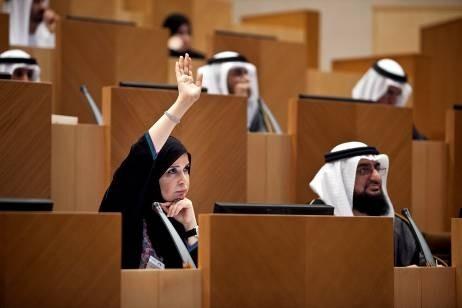
Parliaments and Representatives

Democracy and the equal participation of men and women in the political arena are closely intertwined. No parliament or any decision-making body can claim to be representative without the participation of both men and women. As stated in the Universal Declaration on Democracy adopted by the Inter-Parliamentary Union’s Member Parliaments in 1997, "The achievement of democracy presupposes a genuine partnership between men and women in the conduct of the affairs of society in which they work in equality and complementarity, drawing mutual enrichment from their differences."

Recent years have seen a steady increase in the number of women in parliament, though the world average of less than 22 percent remains far from the goal of parity between women and men. The election of women to the highest positions of state and government in several countries has also contributed to the changing face of politics.

While the road to election is a difficult one, the challenges for women do not stop there. Once women enter parliament or other bodies, they are faced with many new challenges. Parliament is traditionally a male-oriented domain where the rules and practices have been written by men. It is, therefore, an ongoing challenge to transform parliament into a gender-sensitive environment, to ensure that actions are gender-sensitive and to guarantee that gender is mainstreamed throughout the legislature.

November 14, 2013
Swaziland Has the Lowest Number of Women in Parliament

Following the elections and recent government appointments made by King Mswati and members of parliament (MPs), Swaziland has hit rock bottom in women's representation in government, just at the time when the country should be giving its last push for gender equality before 2015.

November 13, 2013
Women and Israeli deMOCKracy

A little while back a lawsuit was filed with the Supreme Court to disallow funding of political parties that do not include women in the party list.

November 13, 2013
TANZANIA: 'Women Likely to Win Top Political Posts'

WOMEN in the country are likely to win overwhelming voters' confidence in the coming General Elections if the findings of a recent survey are anything to go by.

Review of Inter-Parliamentary Union's Gender Programme 'Promoting Gender Equality in Politics'

Back
November 13, 2013

Review of Inter-Parliamentary Union's Gender Programme 'Promoting Gender Equality in Politics'

A Joint Gender Review of the Inter-Parliamentary Union (IPU) was commissioned by Sida together with the Canadian International Development Agency (CIDA) and Irish Aid. The Review was carried out by two Gender Experts (Team Leader Lesley Abdela) between 1 April 2010 and 7 July 2010.

A Joint Gender Review of the Inter-Parliamentary Union (IPU) was commissioned by Sida together with the Canadian International Development Agency (CIDA) and Irish Aid. The Review was carried out by two Gender Experts (Team Leader Lesley Abdela) between 1 April 2010 and 7 July 2010.

November 11, 2013
Annual Summit: The Spirit of women in Parliaments: advancing society

Dear Member of Parliament,

The Women in Parliaments Global Forum (WIP) is delighted to invite you to the Annual Summit 2013, taking place at the European Parliament in Brussels, Belgium from 27 to 29 November 2013.

October 29, 2013
Gambia: 'Women Are the Major Players in Politics'

Madi Jobarteh, the programme manager of The Association of Non-governmental Organisations (TANGO) has said that women are the major players in politics but quality participation of women in politics is needed.

October 28, 2013
Nigeria: Obiano Promises 35 Percent Affirmative Action for Women

IF elected, Chief Willie Obiano of the All Progressives Grand Alliance (APGA) has promised to ensure that women constitute at least 35 per cent of all his appointments.

Papua New Guinea - Country gender assessment for the period 2011-2012

Back
October 28, 2013

Papua New Guinea - Country gender assessment for the period 2011-2012

Papua New Guinea (PNG) became independent in 1976 as a constitutional parliamentary democracy.

Papua New Guinea (PNG) became independent in 1976 as a constitutional parliamentary democracy.