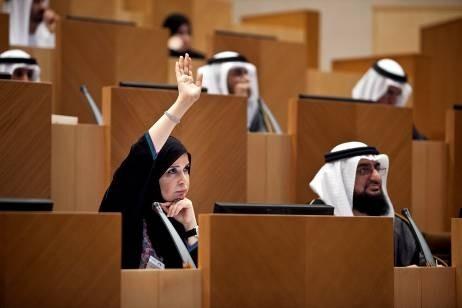
Parliaments and Representatives
Democracy and the equal participation of men and women in the political arena are closely intertwined. No parliament or any decision-making body can claim to be representative without the participation of both men and women. As stated in the Universal Declaration on Democracy adopted by the Inter-Parliamentary Union’s Member Parliaments in 1997, "The achievement of democracy presupposes a genuine partnership between men and women in the conduct of the affairs of society in which they work in equality and complementarity, drawing mutual enrichment from their differences."
Recent years have seen a steady increase in the number of women in parliament, though the world average of less than 22 percent remains far from the goal of parity between women and men. The election of women to the highest positions of state and government in several countries has also contributed to the changing face of politics.
While the road to election is a difficult one, the challenges for women do not stop there. Once women enter parliament or other bodies, they are faced with many new challenges. Parliament is traditionally a male-oriented domain where the rules and practices have been written by men. It is, therefore, an ongoing challenge to transform parliament into a gender-sensitive environment, to ensure that actions are gender-sensitive and to guarantee that gender is mainstreamed throughout the legislature.
Interviews
Interviews
Susan Nakawuki
Susan Nakawuki
Summary of E-Discussion on challenges for women in politics: the glass ceiling - stereotypes in terms of portfolio assignments
iKNOW Politics organized an online discussion on stereotyping portfolio assignments for women in politics, available in Arabic, English, French and Spanish.
At the end of 2011, women made up about 10 per cent of all parliamentarians in Arab states - far below the 19.5 per cent figure worldwide. However, some women in the region are making small steps into the political arena. Lebanon has a reputation as the most liberal country in the Arab world.
More women must take leadership positions in Bulgarian politics, argued former Bulgarian EU Commissioner Meglena Kuneva.
In an interview for Darik Radio Saturday, Kuneva reiterated her calls for a thorough change of the very "model" of Bulgarian politics.
In 2011 the National Democracy Institute (NDI) released Democracy and the Challenge of Change: A Guide to Increasing Women's Political Participation, a guide for democracy practitioners to help them develop and carry out effective programs to bring more women into government and pol
Admitting that her own experience in politics was "mixed", Ms Gillard said she hoped more women would enter politics.
Julia Gillard has given her first known interview since losing the Labor leadership, in which she says she will be pursuing education and women's issues on the global stage.
Gender and the Constituent Assembly: Promoting Women's Political Participation in Fiji
Women make up around 50% of the Fiji population but they continue to be underrepresented in national decision-making and are denied equal participation in such processes.An y democratisation process that does not
Pagination
- Previous page
- Page 287
- Next page