Parliaments and Representatives

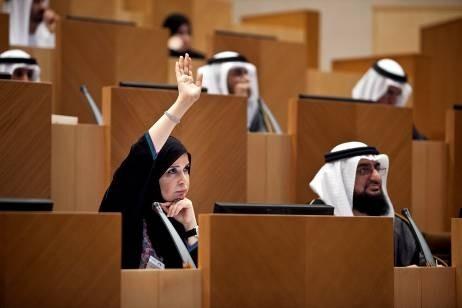
Democracy and the equal participation of men and women in the political arena are closely intertwined. No parliament or any decision-making body can claim to be representative without the participation of both men and women. As stated in the Universal Declaration on Democracy adopted by the Inter-Parliamentary Union’s Member Parliaments in 1997, "The achievement of democracy presupposes a genuine partnership between men and women in the conduct of the affairs of society in which they work in equality and complementarity, drawing mutual enrichment from their differences."

Recent years have seen a steady increase in the number of women in parliament, though the world average of less than 22 percent remains far from the goal of parity between women and men. The election of women to the highest positions of state and government in several countries has also contributed to the changing face of politics.

While the road to election is a difficult one, the challenges for women do not stop there. Once women enter parliament or other bodies, they are faced with many new challenges. Parliament is traditionally a male-oriented domain where the rules and practices have been written by men. It is, therefore, an ongoing challenge to transform parliament into a gender-sensitive environment, to ensure that actions are gender-sensitive and to guarantee that gender is mainstreamed throughout the legislature.

September 18, 2013
Women Who Made It to Parliament, Rwanda

The just concluded parliamentary elections featured women who didn't ask for equality and leadership to be handed to them on a platter. They chose to fight it out with male candidates for their respective positions.

September 18, 2013
Why aren't there more women in Zimbabwe's cabinet?

In 1985, I made it to the front page of The Herald newspaper. It was a photo of me wearing a big smile, shaking President Robert Mugabe’s hand during the five-year independence celebrations. This roused my dream to one day become a politician and lead the country. 

September 18, 2013
Disappointing Number of Women in Cabinet, Zimbabwe

Women make up 34% of the 8th Parliament of Zimbabwe, with 32% in the National Assembly and 48% of Senate. Although the quota for women in parliament led to the dramatic increase from 19% in 2008 to 34%, the number of women who actually won, fell from 34 to 26.

September 18, 2013
OFA Launches Women's Initiative To Step Up Pressure On Congress, State Legislatures, USA

Progressive groups unveiled a major initiative on Wednesday to draw attention to challenges that women still face and to promote public policies to address gender disparities.

September 18, 2013
Constitutional amendments 'fairer' to women: Council for Women, Egypt

Egypt's National Council for Women (NCW) said in a statement issued Wednesday that new amendments under-discussion to the currently suspended 2012 constitution are "fairer" to women.

September 18, 2013
Stakeholders want female replacements for sacked ministers, Nigeria

President Goodluck Jonathan has been urged to replace sacked female ministers with women in order to keep and perhaps surpass the 35 per cent affirmative action as favoured by the current administration.

September 17, 2013
First Lady Urges Women To Vie For Elective Positions In 2015, Nigeria

The First Lady, Dame Patience Jonathan, on Tuesday urged more Nigerian women to vie for elective positions in 2015.

September 17, 2013
Female Senate candidates press Democrats’ gender advantage, USA

The emergence of three female Democrats as competitive Senate candidates has party activists optimistic the 2014 election cycle will end with a record number of women in the upper chamber.

September 17, 2013
Liberal Democrats and lack of women MPs in Westminster, United Kingdom

Former Education Minister Sarah Teather's decision to stand at the next general election highlighted a long-running problem for the Liberal Democrats.

The party only has seven women MPs, and five of those are in the party's 12 most vulnerable seats.