Parliaments and Representatives

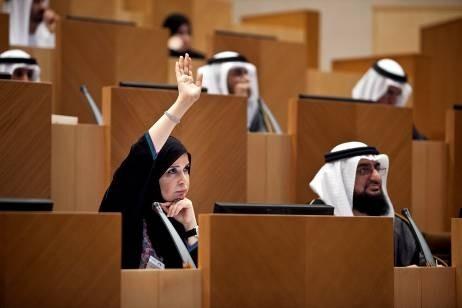
Democracy and the equal participation of men and women in the political arena are closely intertwined. No parliament or any decision-making body can claim to be representative without the participation of both men and women. As stated in the Universal Declaration on Democracy adopted by the Inter-Parliamentary Union’s Member Parliaments in 1997, "The achievement of democracy presupposes a genuine partnership between men and women in the conduct of the affairs of society in which they work in equality and complementarity, drawing mutual enrichment from their differences."

Recent years have seen a steady increase in the number of women in parliament, though the world average of less than 22 percent remains far from the goal of parity between women and men. The election of women to the highest positions of state and government in several countries has also contributed to the changing face of politics.

While the road to election is a difficult one, the challenges for women do not stop there. Once women enter parliament or other bodies, they are faced with many new challenges. Parliament is traditionally a male-oriented domain where the rules and practices have been written by men. It is, therefore, an ongoing challenge to transform parliament into a gender-sensitive environment, to ensure that actions are gender-sensitive and to guarantee that gender is mainstreamed throughout the legislature.

July 28, 2013
Rwanda: Women Poised to Retain Majority in Parliament

With constitutional quotas for interest group seats in their favour and all political parties legally bound to respect women's quota of at least 30 per cent of their parliamentary nominees, women may retain or even widen their majority in the Chamber of Deputies after the upcoming September e

July 26, 2013
Australia's Julia Gillard reveals what she thought when she gave the 'misogyny speech'

As prime minister, Julia Gillard remained instinctively private, consistently contained and, for a figure so much in the public eye, oddly enigmatic.

July 26, 2013
Stepping Stone: Jordan's quota for women's parliament seats is raising the profile of female politicians

Jordanian female parliamentarians have come a long way in the ten years since the quota system was first introduced for the 2003 elections.

July 24, 2013
Six women among Canada's premiers meeting in Ontario

When Canada’s premiers sit down next July 25 for their semi-annual summit, they’ll be making history by changing the face of provincial and territorial leadership.

Do politics matter? Women in Swedish local elected assemblies 1970-2010 and gender equality in outcomes

Back
July 22, 2013

Do politics matter? Women in Swedish local elected assemblies 1970-2010 and gender equality in outcomes

In this paper, it is attempted to explain variations in gender equality at the subnational level in Sweden.
July 21, 2013
Trailblazing Afghan Female MP Forced To Take Shelter

Noorzia Atmar is the human face of women's rights in Afghanistan, her unbridled and open enthusiasm now bruised and sheltered from the public eye.

July 20, 2013
Libya: Women’s seats on Constitutional Commission “insufficient” says lawyers’ group

The NGO Lawyers for Justice in Libya (LFJL) has welcomed the decision by Congress to reserve seats on the 60-member Constitutional Commission for women and ethnic minorities but has criticized the amount set aside for the former. 

July 17, 2013
Slow Ride To City Hall For Female Candidates, USA

When 2013 began, there was a fair amount of hope that women could make up for their relatively measly representation in local offices nationwide by capturing the mayoralty in three of the nation's five largest cities.

July 16, 2013
90,000 women candidates in Bengal rural polls

 In a country where they have been playing second fiddle to men for centuries, women candidates outnumber men in the ongoing polls to the West Bengal village councils, the third tier of India's electoral democracy.