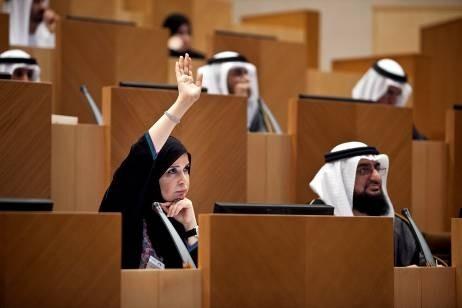
Group seeks to give women equal voice in politics
With five female premiers in Canada, women are making remarkable strides in politics.
Democracy and the equal participation of men and women in the political arena are closely intertwined. No parliament or any decision-making body can claim to be representative without the participation of both men and women. As stated in the Universal Declaration on Democracy adopted by the Inter-Parliamentary Union’s Member Parliaments in 1997, "The achievement of democracy presupposes a genuine partnership between men and women in the conduct of the affairs of society in which they work in equality and complementarity, drawing mutual enrichment from their differences."
Recent years have seen a steady increase in the number of women in parliament, though the world average of less than 22 percent remains far from the goal of parity between women and men. The election of women to the highest positions of state and government in several countries has also contributed to the changing face of politics.
While the road to election is a difficult one, the challenges for women do not stop there. Once women enter parliament or other bodies, they are faced with many new challenges. Parliament is traditionally a male-oriented domain where the rules and practices have been written by men. It is, therefore, an ongoing challenge to transform parliament into a gender-sensitive environment, to ensure that actions are gender-sensitive and to guarantee that gender is mainstreamed throughout the legislature.
With five female premiers in Canada, women are making remarkable strides in politics.
For the first time, women will represent 10 percent of the 150 seats of the Saudi Shura, or consultative council, in the coming legislative term, Xinhua reported.
On December 21, the presentation of the “Participation for Change” book and a roundtable on research findings were held, with representatives of political parties, NGOs, research and scientific centers and mass media attending.
Three days before South Korea elected a woman president, Japanese voters significantly reduced the number of women in parliament. As a result of Sunday’s vote, the new lower house will have 38 women, or 7.9% of all lawmakers in that chamber.
Sierra Leone gender activists on Monday bemoaned the low representation of women in the country’s parliament after recent general elections, saying it has steadily decreased.
Parliament on Tuesday expressed shock and outrage over the barbaric gangrape of a girl inside a moving bus in south Delhi with strong demands being made for capital punishment to perpetrators of such heinous crimes.
In a bid to enhance the role and influence of women MPs in the political scene in Burundi, women parliamentarians in the east African country have been given training on ways to build their leadership, communication and advocacy skills as part of a long-standing IPU programme there on stre
There would have been fewer fights in the Ukrainian parliament if more women were among the deputies. At least female parliamentarians were not seen taking part in the multiple brawls that marked the first working days of Ukraine’s newly elected legislature this week.