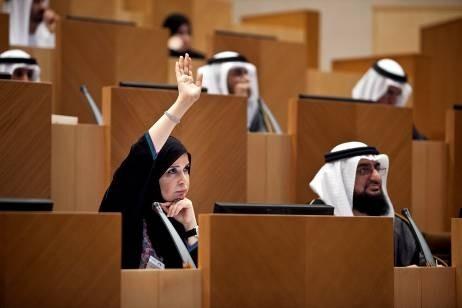
“The Kuwaiti woman remains unfairly deprived of leadership positions in the country even though the Constitution has equated between men and women,” said fifth constituency candidate Saleh Mohawish.
Parliaments and Representatives
Democracy and the equal participation of men and women in the political arena are closely intertwined. No parliament or any decision-making body can claim to be representative without the participation of both men and women. As stated in the Universal Declaration on Democracy adopted by the Inter-Parliamentary Union’s Member Parliaments in 1997, "The achievement of democracy presupposes a genuine partnership between men and women in the conduct of the affairs of society in which they work in equality and complementarity, drawing mutual enrichment from their differences."
Recent years have seen a steady increase in the number of women in parliament, though the world average of less than 22 percent remains far from the goal of parity between women and men. The election of women to the highest positions of state and government in several countries has also contributed to the changing face of politics.
While the road to election is a difficult one, the challenges for women do not stop there. Once women enter parliament or other bodies, they are faced with many new challenges. Parliament is traditionally a male-oriented domain where the rules and practices have been written by men. It is, therefore, an ongoing challenge to transform parliament into a gender-sensitive environment, to ensure that actions are gender-sensitive and to guarantee that gender is mainstreamed throughout the legislature.
Plan of Action for Gender Equality in Parliaments
IPU members have committed to a comprehensive Plan of Action on gender-sensitive parliaments, aimed at radically transforming the way national institutions address gender equality.
Event
Sixth IPU Regional seminar on violence against women
As part of its programme to support parliaments in addressing all forms of violence against women, the IPU
The 113th Congress will have 20 female senators, the most ever in U.S. history.
Last weekend, two women were elected to key positions in the Congress of the People (COP) and the People’s National Movement (PNM).
Sixty women including young women in government, politics, civil society, women network and movements from different West African countries, yesterday converged at Hotel Barmoi in Freetown to participate in the 5thWest African Women Policy Forum to chat the way forward for women’s empowerment and
Hungary occupies the penultimate place within the European Union in terms of the proportion of women among lawmakers, far behind other nations in the CEE region, national daily Nepszabadsag said on Saturday.
None of the 10 women who contested the Vanuatu national election on Tuesday have succeeded in winning a seat.
Pagination
- Previous page
- Page 324
- Next page