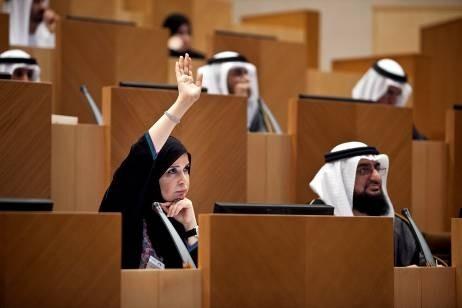
Parliaments and Representatives

Democracy and the equal participation of men and women in the political arena are closely intertwined. No parliament or any decision-making body can claim to be representative without the participation of both men and women. As stated in the Universal Declaration on Democracy adopted by the Inter-Parliamentary Union’s Member Parliaments in 1997, "The achievement of democracy presupposes a genuine partnership between men and women in the conduct of the affairs of society in which they work in equality and complementarity, drawing mutual enrichment from their differences."

Recent years have seen a steady increase in the number of women in parliament, though the world average of less than 22 percent remains far from the goal of parity between women and men. The election of women to the highest positions of state and government in several countries has also contributed to the changing face of politics.

While the road to election is a difficult one, the challenges for women do not stop there. Once women enter parliament or other bodies, they are faced with many new challenges. Parliament is traditionally a male-oriented domain where the rules and practices have been written by men. It is, therefore, an ongoing challenge to transform parliament into a gender-sensitive environment, to ensure that actions are gender-sensitive and to guarantee that gender is mainstreamed throughout the legislature.

Gender Budget Initiatives: Strategies, Concepts and Experiences

Back
February 9, 2007

Gender Budget Initiatives: Strategies, Concepts and Experiences

This publication consists of a collection of papers from the High Level International Conference, "Strengthening Economic and Financial Governance Through Gender Responsive Budgeting," held in Brussels in October 2001.

This publication consists of a collection of papers from the High Level International Conference, "Strengthening Economic and Financial Governance Through Gender Responsive Budgeting," held in Brussels in October 2001.

Report on the Status of Women in Yemen Five Years After Beijing 1995

Back
February 9, 2007

Report on the Status of Women in Yemen Five Years After Beijing 1995

This report evaluates the status of women in Yemen five years after the signing of the Beijing Platform for Action. It looks at women's involvement in a number of areas including poverty, education, health, violence, decision-making processes, human rights and violence.

This report evaluates the status of women in Yemen five years after the signing of the Beijing Platform for Action. It looks at women's involvement in a number of areas including poverty, education, health, violence, decision-making processes, human rights and violence.

Parliamentary Manual: Legal and Institutional Principles

Back
February 9, 2007

Parliamentary Manual: Legal and Institutional Principles

This manual is a legal and institutional resource intended for parliamentary candidates, parliamentarians, and legal/political organizations. It is structured to serve as a training resource on how to study and refer to the Constitution of Afghanistan.

This manual is a legal and institutional resource intended for parliamentary candidates, parliamentarians, and legal/political organizations. It is structured to serve as a training resource on how to study and refer to the Constitution of Afghanistan.

Positioning Pacific Women for Progress, Politics and Peace

Back
February 9, 2007

Positioning Pacific Women for Progress, Politics and Peace

This report provides an overview of a UNIFEM-sponsored training programme and congress on women's political participation in the Pacific region.

This report provides an overview of a UNIFEM-sponsored training programme and congress on women's political participation in the Pacific region.

Status of Jordanian Women: Demography, Economic Participation, Political Participation and Violence

Back
February 9, 2007

Status of Jordanian Women: Demography, Economic Participation, Political Participation and Violence

This report is part of UNIFEM's initiative on Gender Equality Measured Through Statistics (GEMS). It presents statistical information for gender parities and the status of Jordanian women in four areas: demography, economic participation, political participation and violence.

This report is part of UNIFEM's initiative on Gender Equality Measured Through Statistics (GEMS). It presents statistical information for gender parities and the status of Jordanian women in four areas: demography, economic participation, political participation and violence.

Progress of the World's Women 2000

Back
February 9, 2007

Progress of the World's Women 2000

This report examines the progress of the world’s women from the mid 1980s to the late 1990s. It concentrates on the economic dimensions of gender equality and women’s empowerment in the context of globalization.

This report examines the progress of the world’s women from the mid 1980s to the late 1990s. It concentrates on the economic dimensions of gender equality and women’s empowerment in the context of globalization.

Parliament, the Budget and Gender

Back
February 9, 2007

Parliament, the Budget and Gender

This handbook, intended as a reference tool, provides practical examples of a parliament's active engagement in the budgetary process.

This handbook, intended as a reference tool, provides practical examples of a parliament's active engagement in the budgetary process.

Interviews

Anne-Marie Lizin

Submitted by iKNOW Politics on
Back
December 26, 2006

Anne-Marie Lizin

Interview from the Interparliamentary Union (IPU) with Anne-Marie Lizin, President of the Belgian Senate