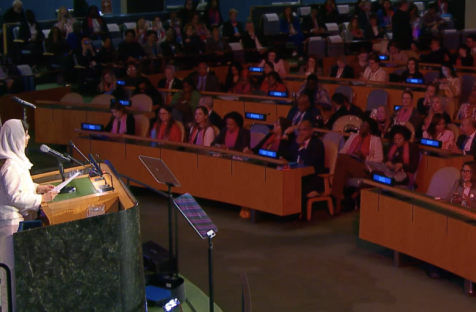
A war that began between the United States and Iran on February 28 led to a two-week ceasefire on April 8, brokered through mediation efforts by Pakistan.
As the prominence of women in politics increases, so does the incidence of violence against women in politics. This section highlights news, interviews, resources and events on violence against women in politics
A war that began between the United States and Iran on February 28 led to a two-week ceasefire on April 8, brokered through mediation efforts by Pakistan.
Yuliana García Mesa’s path to politics began with community work. “Since I was 14, I’ve been involved in social processes,” she recalls. “I started in my parish youth group, collecting food for the elderly and organizing activities for young people.
The Women Advocates Research and Documentation Centre (WARDC), in collaboration with the International Federation of Women Lawyers (FIDA) Kenya, amongst other partners has stepped up efforts to tackle rising cases of online abuse against women and girls across Sub-Saharan Africa.
UNITED NATIONS, New York – As technology reshapes our world, a staggering 85 per cent of women have witnessed online violence against other women, and 38 per cent have been personally affected. 
Dhaka: Bangladesh is witnessing a quiet yet devastating rise in the misuse of technology with rising incidents of women being targetted by superimposing their faces onto pornographic content.
The Digital Rights Foundation has reported a sharp rise in technology-facilitated gender-based violence in its 2025 annual review, with 1,132 cases of male-perpetrated abuse recorded through its Digital Security Helpline.
A staggering 89% of women social media users in Bangladesh have experienced online violence at least once, speakers said at a national consultation, calling for urgent coordinated action to tackle technology
Gender-based civil society organisations (CSOs) have described the use of Technology Facilitated Gender-Based Violence (TFGBV) to silence and discourage women from seeking or holding positions of influence as a threat to equal and meaningful participation.
A recent study published in the journal Violence Against Women surveyed 19 victim-survivor support practitioners and interviewed five across nine Pacific Island nations, finding smartphones, Facebook and AI-generated sexualised deepfakes are used to control and harm women and girls.