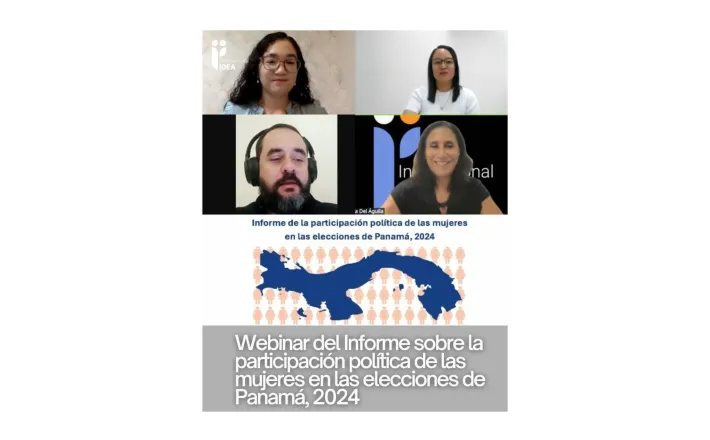
The Report on Women's Political Participation in Panama's 2024 Elections, prepared by researchers Tamara Martínez Paredes and Ramón Benjamín Miranda from the Institute for Democratic Studies (INED) of Panama's Electoral Tribunal, was presented and discussed during an online seminar attended by more than eighty participants. The event was moderated by Alicia del Águila, Programme Manager for International IDEA in Panama.
During the presentation, the authors highlighted a striking contrast: although women constitute 52.31 per cent of registered voters and account for more than 71 per cent of the volunteers serving on presidential election committees and at polling stations, they represented only 21.8 per cent of candidates for the main legislative seats, with just 152 women among a total of 697 candidates.
The researchers also drew attention to the impact of the electoral legislation's "escape clause", a regulatory provision that allows political parties to circumvent genuine gender parity in their principal candidate lists. As a result, no political party submitted gender-balanced slates in the 2024 elections. In addition, women accounted for only 19 per cent of candidates for municipal office. Faced with these barriers at the party leadership level, many women have become independent candidates as an alternative route to compete on more equal terms.

Hear from women leading change in the political space share their experiences and insights.

Explore a wide-range of audio-visual resources on key topics of gender equality.

Hear from a diverse list of panelists and guests as they reflect on critical issues pertaining Women in Politics.