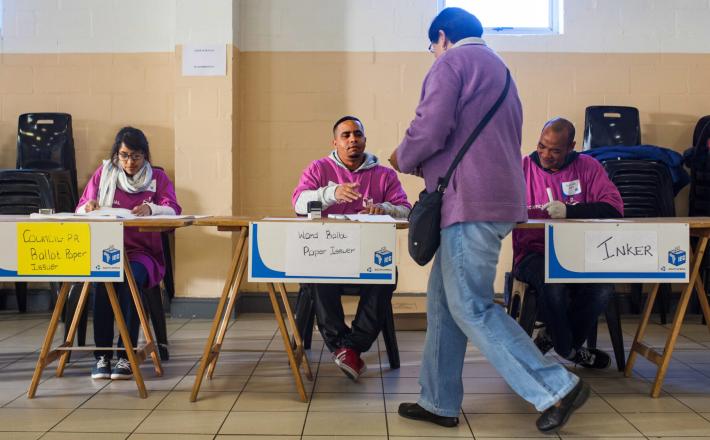
With South Africa’s 2026 Local Government Elections approaching all talk seems to be of the growing prevalence of coalitions in the country. However, the rise in coalition governance is coinciding with another electoral trend: the stalling of progress in women’s representation in legislative bodies. At local government level, improved participation of women is not only essential for ensuring broader social inclusion, but has also been shown to promote better governance, strengthen policy-making, and enhance community resilience. Yet, despite substantial initial progress since 1994 and the introduction of specific policies such as the National Policy Framework for Women’s Empowerment and Gender Equality, the country has struggled to consistently elect women to more than 40% of council seats in recent election cycles. Bearing these two trends in mind, it is necessary to ask what impact coalition politics has had on woman, both in elected government positions and in the broader society.
Outside of coalition politics, women in elected positions or involved in politics already, face a number of challenges to participation. For example, the United Nations (UN) has noted that nearly 60% of women parliamentarians and over 70% of women journalists have experienced sexist abuse online. More worryingly, up to 44% of women in some countries have reported that such online abuse subsequently escalated into offline harassment or violence. More generally, a global study by The Economist found that nearly 40% of woman reported had experienced online abuse, while 85% of women had witnessed digital violence against other women. Online abuse is only one example of the plethora of gender-specific challenges women face in the public sphere, with others including, inter alia, institutional chauvinism, exclusion, epistemic injustice, as well as threats and acts of violence. Equal representation of woman in politics is important not only because it promotes democratic legitimacy, but because it helps to bring these challenges to the fore. Women’s representation is a key factor in the mainstreaming of women’s experiences and thus more gender equality focused policies and practices.