Khadhy Niang’s journey to Deputy Mayor of Dakar: a Collective Victory for All Young Women Leaders
Source: UN Women
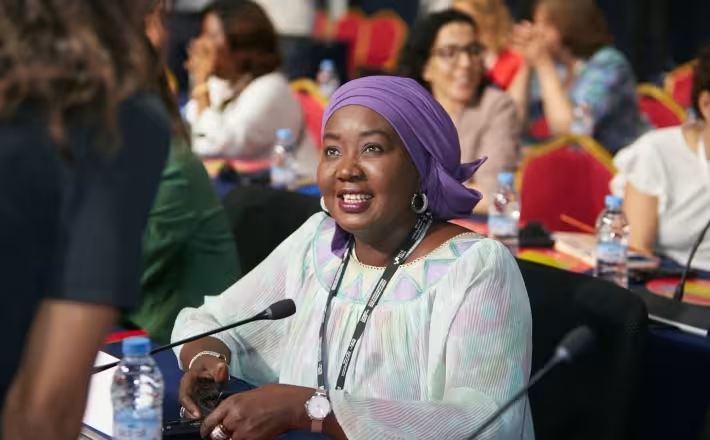
Khady Niang is Deputy Mayor of Dakar, municipal councillor in the commune of Hann Bel-Air, Senegal, and was recently elected Regional Vice-President of Metropolis, the World Association of Major Metropolises. A long-time advocate for women's political participation, she works to expand opportunities for women in local leadership and believes that equitable decision-making begins with women's equal access to power. Niang joined the first-ever Women’s Assembly on 23 June 2026, hosted in the context of United Cities and Local Government’s (UCLG) World Congress and Summit of Local and Regional Leaders in Tangier, Morocco. Supported by WYDE (Women and Youth Democratic Engagement) Women’s Leadership, the Women’s Assembly marked a historic moment for women in local governance, creating a space for women leaders across generations and regions to collectively shape a more inclusive political future.
For Khady Niang, one of the most powerful lessons from the Women’s Assembly was the reminder that progress rarely happens alone. Listening to women leaders share their experiences, challenges and successes reinforced her belief in the power of collective action and mutual support. “The strength of the collective, the importance of listening and sharing experiences,” she reflected, are among the most valuable lessons women leaders can take home. Learning from one another’s journeys, she explained, “helps women identify solutions that can be adapted to their own local realities”. She entered politics at a young age and discovered that women often face obstacles that extend far beyond elections. One of the most significant barriers, she shares, is access to resources “Women, especially young women, often do not have the resources or opportunities to organize and participate in the same way” she explains. As a result, many political spaces continue to be dominated by men who have historically had greater access to influence and decision-making structures.
In addition, Niang refers to the deeply entrenched social norms which continue to shape perceptions of who belongs in politics in her context: “We grow up with the belief that a woman needs to stay at home, listen to her husband and “must [do this], must [do that]!”
”Women are still expected to prioritize household responsibilities and caregiving roles, leaving little or no time for political engagement. These expectations prevent women to participate in decision-making processes, even when formal barriers have been removed”. Niang recalls that, for many years in Senegal, important decisions were taken during meetings scheduled late in the evening, a time when many women left to go back home to care for children and family members. Addressing these barriers requires both policy change and cultural change, she says.
A strong advocate for care-responsive public policies, Niang highlights the importance of local governments investing in services that help redistribute unpaid care work. Access to childcare, eldercare and other support systems can help free up time and opportunities for women who wish to engage in public life. “Many women care for children, older relatives and households while also pursuing professional and community responsibilities,” she notes. Without adequate support, political participation can become an additional burden rather than an accessible opportunity. For Niang, the collective power and solidarity between young women leaders is what helped her overcome these challenges.
As a member of a women's leadership caucus, she participated in initiatives aimed at increasing women's participation in local elections of 2022. Through training sessions, seminars and advocacy efforts supported by international partners, including International IDEA, the programme helped encourage more women to run for office and take on leadership roles. After being elected municipal councillor, Niang was encouraged by other women leaders to take the next step and pursue a leadership position as Deputy Mayor of Dakar. Today, she oversees international cooperation initiatives for the city and has helped strengthen partnerships and exchanges with cities and institutions abroad. Looking back, she describes it both as a personal and collective achievement: “These other women motivated me. It is not only a personal victory, it is also a collective success.”
"As women, engaging in politics is not about challenging men. It is about gaining access to decision-making tools so that the solutions we build are more equitable.”
She believes women's perspectives are essential to shaping communities that are safer, more inclusive and more responsive to people's everyday needs. Whether the issue is public safety, accessibility or children's wellbeing, diverse voices strengthen public decision-making. When asked about any advice to younger women, she highlights the importance of investing in their education but also of building economic independence, so that they can run for office and pave the way for more women in politics.
The Women’s Assembly was organized by United Cities and Local Governments (UCLG) which is an implementing partner of WYDE | Women’s Leadership, an initiative funded by the European Union and led by UN Women. WYDE | Women’s Leadership is a collaborative global effort aimed at advancing women’s full and effective political participation and decision-making at all levels, especially those most often left furthest behind.

Hear from women leading change in the political space share their experiences and insights.

Explore a wide-range of audio-visual resources on key topics of gender equality.

Hear from a diverse list of panelists and guests as they reflect on critical issues pertaining Women in Politics.