Artificial intelligence is no longer a distant prospect for Africa’s courts. It is changing how evidence is assessed, cases are managed and justice is delivered. But with that transformation comes a defining challenge: how can technology advance justice without reproducing the inequalities it should help overcome? In Johannesburg, Africa’s senior women judicial leaders gathered to help shape the answer.
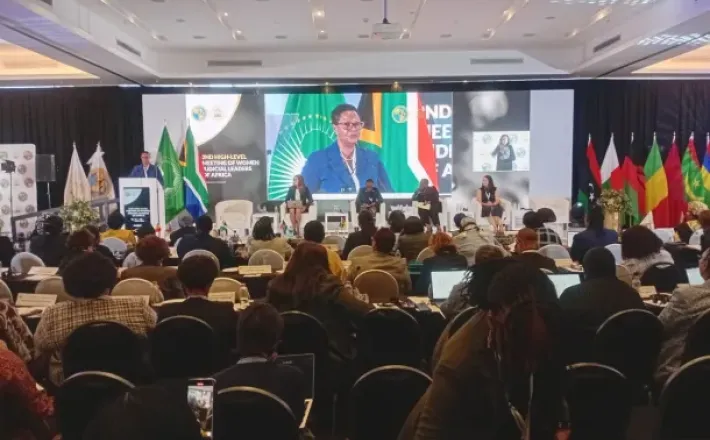
The Second High-Level Meeting of Women Judicial Leaders of Africa, hosted by the Office of Chief Justice of South Africa was held from 20-24 April 2026 under the theme "The Maputo Protocol @20: Consolidating the Jurisprudence of Equality for the Next Generation," brought together more than 300 Chief Justices, Presidents of Constitutional Courts and senior judicial leaders to address emerging challenges facing justice systems across the continent.
As a knowledge partner, UNESCO, with the generous support of the European Union, and its Social Media 4 Peace Coalition contributed to the high-level session on "Artificial Intelligence, the Digital Frontier and Women's Rights." Through its AI and the Rule of Law Programme, UNESCO highlighted both the opportunities AI offers to improve access to justice and the risks it poses when deployed without human rights safeguards. In addition, through its Social Media 4 Peace (SM4P) Project, supported by the European Union, UNESCO further contributed to the event by disseminating the Judicial Handbook on Countering Harmful Online Content. The Handbook serves as a strategic resource for judicial leaders, offering a human rights-based framework to strengthen judicial responses to hate speech, disinformation, and other harmful online content, while safeguarding freedom of expression and reinforcing the rule of law in the digital age.
Participants at the meeting

AI is increasingly supporting judicial administration, analysing evidence and improving responses to gender-based violence. However, it can also reinforce historical bias, facilitate technology-enabled violence and deepen discrimination if left unchecked.
Speaking during the session, Eunice Smith, Head of the UNESCO Office in Namibia and UNESCO Representative, stressed the responsibility of judicial leaders to ensure AI remains accountable to human rights.
Judicial leaders have a critical role to play in demanding transparency about training data, insisting on human oversight, and applying frameworks such as the Convention on the Elimination of All Forms of Discrimination Against Women.
Bedette van Loggerenberg of the University of Oxford emphasised that judicial readiness is essential as AI becomes part of modern justice systems.
AI is already reshaping the realities of judging, evidence, and access to justice. For judicial leaders, the challenge is not to become technologists, but to remain curious, informed, and equipped to ask the right questions. Continuous judicial education is essential to ensure that courts can respond to rapidly evolving technologies while safeguarding fairness, human dignity, and the rights of women and vulnerable communities.
UNESCO also showcased practical tools to help courts navigate this new frontier, including its Guidelines for the Use of AI in Courts and Tribunals and the new AI, Justice and the Rule of Law online course, developed with the University of Oxford. The course includes a dedicated module on AI and Women's Rights, equipping judges with the knowledge to identify algorithmic bias, assess AI-generated evidence and apply human rights principles in judicial decision-making. Through its Global Judges Initiative, UNESCO has already trained more than 38,000 judicial operators in over 160 countries, strengthening judicial capacity to govern AI responsibly.
A landmark outcome of the meeting was the adoption of the Johannesburg Declaration, which commits African judiciaries to ensuring strong human oversight, transparency and accountability in AI systems while promoting judicial education, digital literacy and survivor-centered digital justice tools. It also calls for AI to advance not undermine the rights, safety and equality of women.
Beyond artificial intelligence, the Declaration reaffirmed a collective commitment to strengthening gender-responsive jurisprudence by advancing women's leadership in the judiciary, improving protection against violence, promoting women's economic empowerment and deepening implementation of the Maputo Protocol through greater regional collaboration.
By bringing together judicial leaders, international experts and development partners, UNESCO reaffirmed its commitment to supporting African judiciaries in building AI-ready justice systems that uphold human dignity, protect women's rights and strengthen the rule of law.
As Africa embraces the opportunities of the digital age, the message from Johannesburg was clear: innovation must serve justice, and justice must always serve humanity.

Hear from women leading change in the political space share their experiences and insights.

Explore a wide-range of audio-visual resources on key topics of gender equality.

Hear from a diverse list of panelists and guests as they reflect on critical issues pertaining Women in Politics.