Vous souhaitez en savoir davantage sur la manière dont les femmes s’organisent dans les parlements du monde entier ?
Parliaments and Representatives
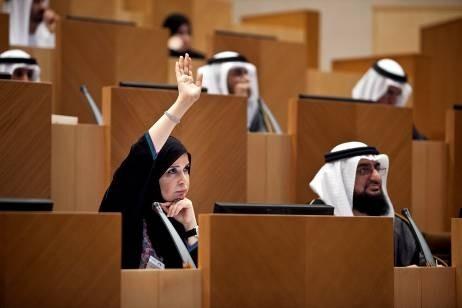
Democracy and the equal participation of men and women in the political arena are closely intertwined. No parliament or any decision-making body can claim to be representative without the participation of both men and women. As stated in the Universal Declaration on Democracy adopted by the Inter-Parliamentary Union’s Member Parliaments in 1997, "The achievement of democracy presupposes a genuine partnership between men and women in the conduct of the affairs of society in which they work in equality and complementarity, drawing mutual enrichment from their differences."
Recent years have seen a steady increase in the number of women in parliament, though the world average of less than 22 percent remains far from the goal of parity between women and men. The election of women to the highest positions of state and government in several countries has also contributed to the changing face of politics.
While the road to election is a difficult one, the challenges for women do not stop there. Once women enter parliament or other bodies, they are faced with many new challenges. Parliament is traditionally a male-oriented domain where the rules and practices have been written by men. It is, therefore, an ongoing challenge to transform parliament into a gender-sensitive environment, to ensure that actions are gender-sensitive and to guarantee that gender is mainstreamed throughout the legislature.
Les organisations féminines faitières du Mali ont présenté, jeudi dernier, leurs vœux de Nouvel An, à la ministre de la promotion de la Femme, de l’enfant et de la famille, Mme SAGARE Oumou BA, dans la salle de réunion de son cabinet.
Les trois femmes politiques françaises les plus mentionnées sur les médias sociaux en 2013 sont Christine Taubira, Marine Le Pen et Christine Boutin. Si elles s'illustrent, notamment sur Twitter, c'est pour des raisons bien différentes.
Lire l'article publié le 9 janvier 2013
Lignes directrices pour forums de femmes parlementaires
Les femmes ne représentent qu’environ 20 % des membres des parlements. Dans presque tous les pays, elles sont minoritaires au sein du Parlement, une institution traditionnellement régie par des principes et une vision du monde émanant des hommes.
Mi janvier 2014, Najat Vallaud-Belkacem, ministre des Droits des femmes, défendra son projet de loi sur l’égalité hommes/femmes qui
Cinquante reines mères au Ghana vont faire leur entrée en cette année 2014 au Conseil National des Chefs (NHC) en tant que membres. Désormais la chambre comptera 100 dignitaires traditionnels dont 50 hommes et 50 femmes. Les membres entrants sont issus des dix régions administratives du Ghana
Coup de colère contre l’establishment laïc israélien, qui dénonce les positions anti-féminines des juifs ultra-orthodoxes, mais limite drastiquement la place des femmes dans la vie publique.
Pagination
- Page précédente
- Page 103
- Page suivante