Parliaments and Representatives
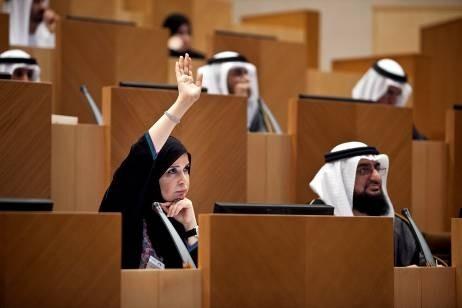
Democracy and the equal participation of men and women in the political arena are closely intertwined. No parliament or any decision-making body can claim to be representative without the participation of both men and women. As stated in the Universal Declaration on Democracy adopted by the Inter-Parliamentary Union’s Member Parliaments in 1997, "The achievement of democracy presupposes a genuine partnership between men and women in the conduct of the affairs of society in which they work in equality and complementarity, drawing mutual enrichment from their differences."
Recent years have seen a steady increase in the number of women in parliament, though the world average of less than 22 percent remains far from the goal of parity between women and men. The election of women to the highest positions of state and government in several countries has also contributed to the changing face of politics.
While the road to election is a difficult one, the challenges for women do not stop there. Once women enter parliament or other bodies, they are faced with many new challenges. Parliament is traditionally a male-oriented domain where the rules and practices have been written by men. It is, therefore, an ongoing challenge to transform parliament into a gender-sensitive environment, to ensure that actions are gender-sensitive and to guarantee that gender is mainstreamed throughout the legislature.
La Barbade a dit adieu, mardi, à des siècles de sujétion à la couronne britannique lors d'une cérémonie pendant laquelle sa première présidente de la République, Dame Sandra Mason, a prêté serment. Le prince Charles était présent.
Une nouvelle étude de l’UIP et de l’Union parlementaire africaine (UPA) révèle que le sexisme, le harcèlement et la violence à l’égard des femmes sont omniprésents dans les parlements du continent africain.
Janice Savoie est catégorique quand on lui demande ce qu’elle a trouvé le plus difficile de ses sept années au conseil municipal de Kedgwick, dont cinq à la mairie : «le manque de respect», répond-elle en fronçant les sourcils.
Dans l'Altaï, territoire éloignée de Moscou, une femme transgenre dirige désormais l'antenne régionale d'un parti politique mineur.
Par Gabriela Cuevas, Présidente de l'Union interparlementaire (UIP), et Liliane Maury Pasquier, Présidente de l'Assemblée parlementaire du Conseil de l'Europe (APCE).
En 2015, selon l’ONU, les femmes et les filles vivant en milieu rural représentaient près de 40 pour cent de l’ensemble des femmes dans le monde.
Tribune: "Nous nous sommes engagés en politique pour les droits des femmes"
Les droits des femmes revus à la ba
Pagination
- Page précédente
- Page 88
- Page suivante