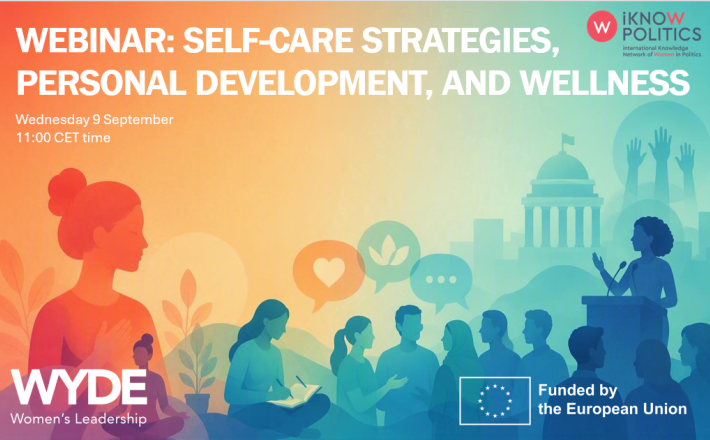
WEBINAR: SELF-CARE STRATEGIES, PERSONAL DEVELOPMENT, AND WELLNESS
Women in political leadership often face significant personal and professional pressures. Alongside their political responsibilities, many navigate online harassment, public scrutiny, caregiving responsibilities, community expectations, and demanding workloads. These challenges can contribute to stress, burnout, and withdrawal from political life, particularly for young women and emerging leaders. The rise of digital technologies has intensified these pressures, with many women politicians experiencing online abuse, disinformation campaigns, and other forms of technology-facilitated violence that affect their wellbeing, confidence, and ability to participate fully in public life.
At the same time, there is growing recognition that sustainable political leadership requires more than technical skills and political knowledge. Women leaders need the support, tools, and networks necessary to maintain their wellbeing, build resilience, and sustain long-term engagement in public life. Across the world, women’s political networks, leadership programmes, and civil society movements are increasingly integrating wellbeing, peer support, mentoring, and resilience-building into their work, recognising that self-care is not a luxury but an essential component of effective leadership.
Self-care and wellness encompass the practices and support systems that help individuals maintain their physical, emotional, mental, and social wellbeing. Research drawing on data from 84 countries between 2006 and 2019 found a positive relationship between women’s political empowerment and subjective wellbeing, with political representation playing a particularly strong role in that dynamic. For women leaders, these practices may include setting healthy boundaries, building supportive networks, managing stress, seeking mentorship, and developing strategies to respond to online harassment and information overload. Equally important are collective approaches that encourage organisations, political parties, institutions, and networks to create environments that support wellbeing and prevent burnout.
A growing body of work among women’s rights movements has begun to reframe self-care not as indulgence but as strategy. As Audre Lorde wrote, “Caring for myself is not self-indulgence, it is self-preservation, and that is an act of political warfare.” Ultimately, wellbeing should not be treated as a privilege available only to those with the luxury of rest, but as a right that sustains women’s ability to lead, engage, and remain in political life for the long term.
This webinar will provide a space for women political leaders, activists, and aspiring leaders to reflect on the wellbeing challenges associated with political and public life, exchange experiences, and explore practical approaches to self-care, resilience, personal development, and work-life balance. Through peer learning and discussion, participants will identify strategies that support both their personal wellbeing and their effectiveness as leaders, while contributing to a broader conversation on sustainable and inclusive political leadership.
RELEVANT QUESTIONS
-
What has your experience taught you about the relationship between political engagement, leadership, and personal wellbeing?
-
What wellbeing challenges have you faced in political or public life, including stress, burnout, online harassment, or other forms of pressure, and how have you navigated them?
-
How have you learned to protect your mental and emotional wellbeing, and what support systems, networks, or practices have been most helpful?
-
What does it mean to treat self-care as a political strategy rather than a distraction from political work, and how has this shaped your leadership approach?
-
What practical changes, whether personal, institutional, or cultural, would better support the wellbeing and long-term participation of women in politics?\
Event link: https://us06web.zoom.us/j/87421817410
Zoom