Advocacy & Lobbying

YAMBIO – The Speaker of South Sudan’s Western Equatoria State Legislative Assembly, Ann Tunna Richard, has urged women to actively participate in politics ahead of South Sudan’s December 2026 general elections.
She made the call on Sunday, while addressing journalists at Yambio Airstrip upon return from an official trip to Juba.
While in Juba, she attended a national conference on women’s equal participation in governance.
Ann Tunna said women in Western Equatoria State and across the country should take advantage of the political space to engage fully in leadership and decision-making processes.
“We demand the full implementation of the 35 percent affirmative action for women, and any political parties that fail to respect the provision may not be registered to contest in the upcoming elections,” Tunna said.
The Speaker highlighted key challenges facing women in politics, including economic hardship, insecurity, and gender-based violence.
“We call on political parties, government institutions, and communities to provide protection, support, and equal opportunities for women candidates,” she said.
Tunna demanded appointment of more women to strategic ministries such as Finance and Defence, saying women have proven to be effective managers, strong peacebuilders, and critical actors in the fight against corruption.
She commended the SPLM leadership in Western Equatoria State, led by Chairperson Barrister James Al-Taib Jazz Berapal, for appointing women to leadership positions within the party.

Three decades after the Beijing Platform for Action, the groundbreaking UN declaration that affirmed that women’s rights are human rights, the global movement for gender equality and women’s empowerment is under strain. Adopted in 1995 and signed by 189 governments, the ambitious framework spurred a generation of legal reforms, gains in political representation, and consolidation of norms around gender equality. Today, however, that momentum is faltering. Although some countries continue to make steady progress, a UN report released in March 2025 found that one in four countries is experiencing a backlash against gender equality. Around the world, 270 million women lack access
Full article here.
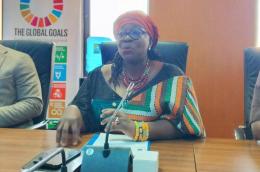
The United Nations Development Programme (UNDP) has cautioned that Nigeria’s continued exclusion of women from political leadership positions is no longer merely a social concern but a growing threat to the nation’s competitiveness in an increasingly dynamic global landscape.
Speaking in Abuja at a high-level roundtable with media practitioners on the Reserved Seats for Women Bill aimed at increasing women’s representation in Parliament, the UNDP Resident Representative for Nigeria, Elsie Attafua, explained that the debate over the proposed Special Seats Bill for Women must move beyond emotion and politics.
Stressing that women’s political participation is now a strategic requirement for Nigeria’s survival and leadership in a world being reshaped by artificial intelligence, demographic disruptions, mineral politics, and geopolitical rivalry.
Full article available here.
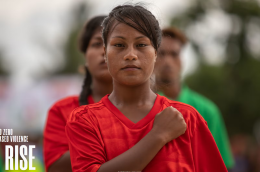
1 in 3 women and girls have experienced intimate partner violence, non-partner sexual violence or both
By responding to the needs of survivors, supporting their agency and investing in individuals, communities and systems, we can end gender-based violence.
No single organization can do it alone.
UNFPA partners with governments, businesses, academics, civil society organizations – including feminist and women-led organizations, adolescent and youth networks, faith-based organizations and traditional leaders – as well as broader movements for human rights and social justice.
 TOGETHER, WE
01
Build and share knowledge on gender-based violence and what works to address it.
02
Advocate to raise awareness, change laws and policies, and support their implementation.
03
Build capacities to respond to and prevent gender-based violence within systems and communities.
04
Deliver the right services at the right time to all survivors, including in humanitarian crises, fragile contexts and online spaces.
05
Make sure that sexual and reproductive health services and comprehensive sexuality education address gender-based violence.
06
Transform social gender norms and address structural inequalities to prevent gender-based violence.
07
Support the agency of women, girls and young people in all their diversity.
08
Respond and act to the impacts of GLOBAL HEALTH CRISES, INCLUDING Covid-19, climate change and environmental degradation, which heighten risks of gender-based violence and make it harder for survivors to access support.
Access the full video here.
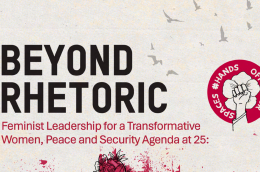
Publication date: 16 October 2025
Twenty-five years after the United Nations adopted Resolution 1325, the Women, Peace and Security (WPS) agenda is both a landmark in diplomacy and a study in unfulfilled promise. Its most profound achievement has been to force open a conversation about the gendered power structures that fuel conflict. But that opening is narrowing. Escalating wars, a backlash against gender justice and a collapse in funding now threaten to strip the agenda of its transformative edge. The WPS agenda remains an essential tool for women peacebuilders. Whether it survives as a force for justice depends on whether the global community backs its principles with the resources and political will to make them real. Without that, the resolution’s 25th anniversary will mark the start of its decline, not its maturity.
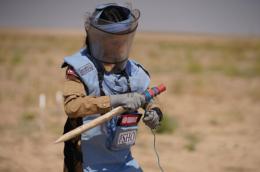
Working in the mine action sector showed me that traditional constraints are created to be broken!” says Dina Khuder.
She, Mahrosa Abdulmuneer, and Maha Jamal are Iraqi women working for the Shareteah Humanitarian Organization, an implementing partner with the UN Mine Action Service (UNMAS) in Sinjar.
Women are valuable players in mine action
Mahrosa Abdulmuneer is a searcher, who works to rid areas of explosive ordnance. To sharpen her skills, she has participated in every training course and capacity-building opportunity.
“As a mother of two kids, I believe that my work is contributing to providing safe areas for children to play around and live their childhood and make nice memories,” she says.
“I’m saving another life on my land”
Maha Jamal, a member of the Explosive Hazard Management Team, has enrolled in capacity enhancement initiatives throughout the last three years to advance her knowledge and skills.
She joined the mine action sector because of seeing the direct effect of mine action on people’s lives.
“I feel proud and happy when I discover and remove an explosive item knowing that I’m saving another life on my land,” says Ms. Jamal.
With the adoption of the General Assembly and Security Council resolutions on sustaining peace and the 2030 Agenda for Sustainable Development, a multilateral policy consensus is emerging around a common vision for peaceful societies. Building and promoting positive peace, rather than containing conflict and its consequences, is recognized as a more effective strategy for addressing today’s complex and interlinked global challenges. These global frameworks treat prevention as an integral part of effective and participatory governance and view peace as both an enabler and an outcome of sustainable development. Under this broad conception of peace, all groups and individuals are free to pursue their needs and aspirations without fear, with equal opportunities, with justice, and in security.
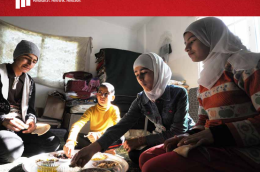
With no political solution on the horizon to end the conflict in Syria, it is clear that humanitarian agencies must continue to prepare for a protracted conflict. In late 2013, the Women’s Refugee Commission (WRC) undertook an extensive literature review and a month-long field assessment in Jordan, including indepth interviews, focus group meetings and observation. The goal of the project was to identify how the humanitarian community was integrating existing gender guidance across all sectors and whether gender was being dealt with centrally as an institutionalized way of working rather than peripherally. It looked at the ways in which humanitarian agencies, including UN agencies and international and local organizations, assessed these needs and planned their programs. It also asked questions about the opportunities and good practices and models for promoting gender equality and women’s empowerment.

The Bill & Melinda Gates Foundation and the No Ceilings initiative of the Bill, Hillary & Chelsea Clinton Foundation joined forces to assess the evidence on the gains and gaps in progress for women and girls over the past 20 years. They asked: What do women’s and girls’ lives look like around the world 20 years after the Beijing conference? What barriers remain? What do the numbers tell us? How have laws and policies progressed over the same period? What information do we still need in order to assess the status of women and girls? The foundations worked with The Economist Intelligence Unit (EIU) and the WORLD Policy Analysis Center at UCLA (WORLD) to examine the performance of 197 countries and Beijing Platform signatories and develop a picture of how the lives of women and girls have changed since the Beijing conference.
The findings are presented in this report and are available in a visual representation at noceilings.org.
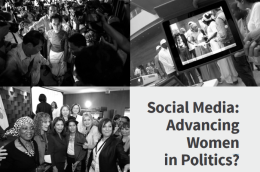
The rise of social media in the past decade has changed the political landscape - not only the way friends connect with one another, but also how people and public officials communicate. Elected officials and governments across the globe are able to engage directly with the people they represent on a scale previously inconceivable. This report, a joint effort between the Shorenstein Center on Media, Politics and Public Policy at Harvard University’s Kennedy School, Facebook, and the Women in Parliaments Global Forum, is designed to show how women legislators from around the world use social media to engage with citizens as well as how social media can play an even more effective role in facilitating a dialogue between governments and their citizens.
This report is based on the results of a survey that examined the use of social media by female Parliamentarians from 107 countries. The survey sought to discover factors affecting their level of social media use and to identify areas where greater knowledge could strengthen that use.
Click here to access the report.
[[{"fid":"11520","view_mode":"default","fields":{"format":"default","field_file_image_alt_text[und][0][value]":"","field_file_image_title_text[und][0][value]":""},"type":"media","link_text":null,"attributes":{"style":"display: block; margin-left: auto; margin-right: auto;","class":"media-element file-default"}}]]
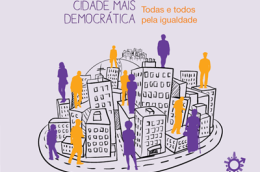
UN Women launched www.cidade5050.org.br where candidates will be able to make public commitments to gender equality. The project was developed in a partnership between UN Women Brazil, the Supreme Electoral Court (TSE), the Patrícia Galvão Institute and the Research Group on Democracy and Inequality at the University of Brasilia (Demodê/UNB). It has institutional support of Congress in Focus, and #MeRepresenta and In Press Group.
The digital platform "City 50-50: All for Equality", available at www.cidade5050.org.br aims to encourage debate on equal rights between women and men in local elections this year. The platform is a place where candidates can make commitments to gender equality and voters can get information to help them define their vote. It arises from the understanding that a society can only be called democratic when there is equal participation between women and men.
Candidates of the 5,568 Brazilian municipalities, which already have registered their candidatures with the TSE can register and make public commitments to promote women's rights during the election campaign. Voters, in turn, will be able to identify their candidates’ proposals for this topic, and afterwards make the elected accountable.
The Minister of the Superior Electoral Court, Luciana Lossio, highlighted some measures already taken to ensure women's political empowerment: "We had a major trial at the Superior Electoral Court that buoyed the condemnation to all political parties that do not comply with the 10 per cent allocation of radio and TV space to encourage women´s participation. Now we are joining in a partnership with UN Women, to seek a solution to this problem of the Brazilian Electoral Politics."
Among the more than 144 million Brazilian voters who will vote in October, 52% are women. However, only 31% of the candidates running for office (Mayors, Vice Mayor and City Council) are women - the percentage is within the law, which requires a minimum of 30% women candidates.
For this elections, 52 municipalities have only women as candidates for city council, according to a survey conducted in mid-August this year by the TSE. Only men compete for Mayor in 3,815 of the 5,568 municipalities, equivalent to 68% of the total. Currently, women occupy 10% of the municipalities and represent 12% of councilors in municipalities.
To read the full story, visit the UN Women regional website for Latin America and the Caribbean.

The report’s chapters were built in response to the Concluding Observation No. 60 by the CEDAW Committee, where the Committee request from the Iraqi government’s side to submit, within two years, a written report on steps and measures taken to respond to the recommendations included in the Concluding Observations (12 and 18). The Concluding Observations, of the CEDAW Committee, were issued after its 57th session on February 2014, in which the last government’s report, submitted to the Committee at the end of 2013, was discussed, concerning Iraq's obligations to implement the CEDAW Convention, also in that session Iraqi CSOs presented the first CEDAW shadow report for Iraq since signing the convention back in 1986.
This report includes a review of the situation of Iraqi women after an increase in the phenomenon of migration and displacement, in addition to the procedures and measures and legislation adopted to implement recommendations 12 and 18, and the civil society’s observations on the government’s report plus a number of activities run by the Iraqi Women Network and some of its members during this period of time.
Click here to read the Summary of the humanitarian situation and the situation of women in Iraq and the role of CSOs.