Advocacy & Lobbying
The persistent underrepresentation of women in The Gambia’s political sphere undermines democratic inclusivity and sustainable development. Women’s perspectives are critical for addressing issues like education, healthcare, and gender-based violence, which disproportionately affect them. This two-day national conference will focus on women’s political participation, providing a timely platform to:
-
Assess progress and gaps since the 2016 democratic transition.
-
Consolidate stakeholder efforts to address systemic barriers.
-
Develop a unified strategy, including policy recommendations and capacity-building initiatives.
-
Inspire a new generation of women leaders to engage in politics.

The Royal Norwegian Embassy andthe Embassy of Switzerland in Bangladesh, in collaboration with UN Women,hosted a high-level dialogue titled "Power Without Fear: Ending Digital and Gender-Based Violence Against Women in Politics" as part of the global 16 Days of Activism against Gender Based Violence (GBV) campaign under the theme "UNiTE to End Digital Violence against All Women and Girls" in Dhaka on December 7, 2025. The event convened political party representatives, young women leaders, civil society, academics, journalists, gender experts, development partners, and diplomats to address the currentthreats women face in political life.
Held at the Norwegian Residence, the dialogue focused on how digital violence has emerged as a modern barrier to democratic participation. As Bangladesh approaches its national elections, women engaged in political activities find themselves increasingly targetsof online harassment, intimidation, gendered misinformation, and coordinated smear campaigns that often extend into real-world harm.
Opening the event, H.E. Håkon Arald Gulbrandsen, Ambassador of Norway, emphasized that digital spaces are now central to political engagement and must be safe for women's participation. As the Ambassador stated, "women's political participation is essential for inclusive democracy, sustainable development, and lasting peace. When women are silenced - whether through digital harassment, character attacks, threats, or physical violence - entire societies lose out. Today,let us explore how we can strengthen legal protections, promote digital safety, hold perpetrators accountable, and empower women to participate in politics without fear."

The Ministry for the Status of Women and Women’s Rights (MCFDF) officially launched, this Friday at the La Cretonne Hotel in Les Cayes, the General Assembly on “women’s political participation and electoral violence,” under the evocative theme: “There is no democracy or elections without women, zero violence.
The Ministry for the Status of Women and Women’s Rights (MCFDF) officially launched, this Friday at the La Cretonne Hotel in Les Cayes, the General Assembly on “women’s political participation and electoral violence,” under the evocative theme: “There is no democracy or elections without women, zero violence.”

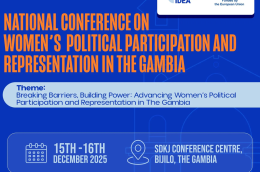
A two-day national conference on Women’s Political Participation and Representation opened Monday at Sir Dawda Kairaba Jawara (SDKJ) Conference Centre.
The conference is being organized by The International Institute for Democracy and Electoral Assistance (International IDEA) and its partners.
The conference aims to assess progress made and identify gaps in women’s political participation since the country’s democratic transition in 2016.
Opening the forum, International IDEA Secretary-General Dr. Kevin Casas-Zamora says nine years after the transition, The Gambia has significant achievements to celebrate, particularly its vibrant civic space and strengthened democratic institutions.
However, he notes that women’s political representation remains critically low.
“Women make up more than half of the population, yet they occupy only 8.6 percent of elected seats in the National Assembly. This is far below the 30 percent benchmark recommended by the Beijing Platform for Action,” Dr. Casas-Zamora said.
Speaking on behalf of the European Union Ambassador, Enya Braun says the theme of the conference highlights a persistent imbalance in decision-making spaces.
“While women are active in society, they are too often absent from formal decision-making structures. This must change,” she said, questioning how a society can claim to be democratic when more than half of its population remains underrepresented.
She reaffirmed the European Union’s commitment to gender equality and inclusivity, stressing that political representation is not a privilege but a fundamental right and a proven asset for democratic governance.
Representing the Speaker of the National Assembly, Hon. Abdoulie Ceesay says The Gambia stands at a critical stage in consolidating its democracy.
He pointed out that women constitute about 57 percent of registered voters and play a central role in political mobilization, yet their presence in executive positions, local councils and the national assembly does not reflect this reality.
“As the People’s House, Parliament must be inclusive. Political parties must dismantle gatekeeping barriers and move beyond using women solely as mobilisers to investing in them as candidates,” he said.
The conference is expected to consolidate stakeholder efforts to address systemic barriers, develop a unified strategy, and produce policy recommendations and capacity-building initiatives aimed at inspiring a new generation of women leaders in Gambian politics.

Stakeholders, women leaders and development partners have called for increased participation of women in leadership and governance
They made the call during the Southern Kaduna Trailblazing Women Association (SOKATWA) Summit and Fundraising, held in Kafanchan, Southern Kaduna.
Chairman of the occasion, Mr. Jerry Adams, emphasized that getting it right with women is key to getting society right, noting that women play a critical role in moulding character at home and within communities.
He commended the organisers for bringing together a high calibre of women at the summit and urged participants not to despise little beginnings but to remain focused and determined.
Earlier, the President of SOKATWA, Mrs. Belinda Augustine Istifanus, described the summit as a defining moment and a mission-driven gathering aimed at repositioning women as central actors in leadership and governance.

YAMBIO – The Speaker of South Sudan’s Western Equatoria State Legislative Assembly, Ann Tunna Richard, has urged women to actively participate in politics ahead of South Sudan’s December 2026 general elections.
She made the call on Sunday, while addressing journalists at Yambio Airstrip upon return from an official trip to Juba.
While in Juba, she attended a national conference on women’s equal participation in governance.
Ann Tunna said women in Western Equatoria State and across the country should take advantage of the political space to engage fully in leadership and decision-making processes.
“We demand the full implementation of the 35 percent affirmative action for women, and any political parties that fail to respect the provision may not be registered to contest in the upcoming elections,” Tunna said.
The Speaker highlighted key challenges facing women in politics, including economic hardship, insecurity, and gender-based violence.
“We call on political parties, government institutions, and communities to provide protection, support, and equal opportunities for women candidates,” she said.
Tunna demanded appointment of more women to strategic ministries such as Finance and Defence, saying women have proven to be effective managers, strong peacebuilders, and critical actors in the fight against corruption.
She commended the SPLM leadership in Western Equatoria State, led by Chairperson Barrister James Al-Taib Jazz Berapal, for appointing women to leadership positions within the party.

In this report, the Working Group examines discrimination against women and girls in cultural and family life. The cultural construction of gender determines the role of women and girls within the family, including in marriage. After analysing the impact of culture and religion on the enjoyment of equal rights by women and girls in society and the family, the Working Group redefines family by incorporating a gender perspective. In reaffirming equality between the sexes and family diversity, it is necessary to apply the principle of women’s right to equality in all forms of family law, in secular family law systems, State-enforced religious family law systems and plural systems. After recalling the obligation of States to combat discrimination against women in cultural and family life, the Working Group makes several recommendations, drawing on good practices, for the establishment of true equality between the sexes in cultural and family life.
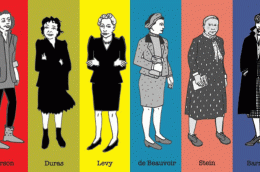
This year, for the first time ever, two of the largest neuroscience societies are led by a female scientist: the Society for Neuroscience (SfN), with nearly 42,000 members, and the Federation of European Neuroscience Societies (FENS), which represents more than 22,000 neuroscientists in 42 member societies across Europe. While the SfN has a history of female presidents, 9 out of 45, FENS welcomed its first female president only recently. Why do women move so slowly through the ranks of the system and why is it important that they do so? More urgently, what can be done to change this and by whom? Here we address current challenges and recommend concrete actions.
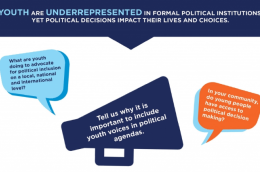
· Young people are not at the center of political decision making even though almost half the world’s population is under 30 years old. [UNDP, 2013, http://bit.ly/1dd2a2L]
· Globally, less than 6% of the parliamentarians are under 35 years old [UNDP, Fast Facts: Civic Engagement and Participation of Youth in Politics and Public Institutions, 2014, p.1, http://www.undp.org/content/undp/en/home/librarypage/results/fast_facts/Fast-Facts-youth-civic-engagement-and-participation/]
· Globally, less than 2 per cent of parliamentarians are under 30 years old. [SDG indicator 16.7.1; Inter-Parliamentary Union, 2016: Youth participation in national parliaments, 2016, http://goo.gl/A83XGf]
· The average age in parliament in 53 years old. [UNDP, 2013, http://bit.ly/1dd2a2L]
· Only 1.65% of parliamentarians around the world are in their 20’s and for a third of countries, eligibility for national parliament starts at 25 years old. [UNDP, 2013, http://bit.ly/1dd2a2L]
· Voter turnout among 18-25 year olds continues to be lower than other age groups [UNDP, Fast Facts: Civic Engagement and Participation of Youth in Politics and Public Institutions, 2014, p.1, http://www.undp.org/content/undp/en/home/librarypage/results/fast_facts/Fast-Facts-youth-civic-engagement-and-participation/]
[[{"fid":"10718","view_mode":"default","fields":{"format":"default","field_file_image_alt_text[und][0][value]":"","field_file_image_title_text[und][0][value]":""},"type":"media","link_text":null,"attributes":{"style":"display: block; margin-left: auto; margin-right: auto;","class":"media-element file-default"}}]]
· 2 out of 3 countries DO NOT consult young people as a part of the process of preparing poverty reduction strategies or national development plans. [The Global Youth Call “Prioritizing Youth in the Post-2015 Development Agenda,” http://www.un.org/youthenvoy/wp-content/uploads/2014/09/The_Global_Youth_Call.pdf]
Source:
http://www.un.org/youthenvoy/wp-content/uploads/2015/06/YouthStatsPublicandCivicParticipation1.pdf
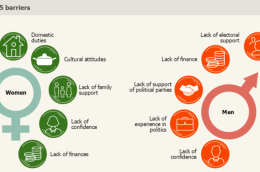
The Compendium of Good Practices on Advancing Women’s Political Participation in the OSCE Region, compiled on the occasion of the 20th anniversary of the Beijing Declaration and Platform for Action, presents good practices for enhancing women’s participation in parliaments, political parties, elections and local politics in the OSCE region.
Learn more about the challenges facing women in politics in our infographic, which is based on statistical data in the compendium. Click here to access the high resolution version of the visual.
[[{"fid":"10688","view_mode":"default","fields":{"format":"default","field_file_image_alt_text[und][0][value]":"","field_file_image_title_text[und][0][value]":""},"type":"media","link_text":null,"attributes":{"style":"display: block; margin-left: auto; margin-right: auto;","class":"media-element file-default"}}]]

As a result of the cooperation between the Centre for Arab Women Training and Research (CAWTAR), UN Women and UNDP, and with the financial support of the Ministry of Foreign Affairs of Finland, and the Arab Gulf Program for Development (AGFUND), CAWTAR successfully launched the “Legal and Human Rights of Women and Men: between Equality and Gaps” in Tunis on 28 March 2016. The e-platform aims to assist policy makers, women machineries and concerned civil society organization to better asses, analyze and understand the legal status of women across the region by compiling laws related to the status of gender and human rights in 20 Arab countries. The e-platform enables users to search by different topics and related rights, such as education, health, violence, political participation and contribution, access to justice and right to litigation in economy in each country. The online tool also allows for regional, cross-country comparisons across topics and indicators and provides information about best practices to facilitate experience exchange among Arab countries, and accordingly encourage legal reforms. Click here to know more.

The first ever indigenous peoples world conference concludes with a focus on climate.The Outcome Document also focuses on the rights of indigenous women and addressed the problem of violence against women, which he said “must be at the top of the agenda.”