Advocacy & Lobbying

Women’s rights activists are calling for a new United Nations roadmap for Afghanistan to result in a political structure that includes non-Taliban figures, particularly women, in leadership and decision-making roles.
The UN has drafted a proposal aimed at gathering the views of Taliban officials and representatives from 25 countries involved in the Doha process, as part of an effort to define a pathway for the country’s reintegration into the international community. A central pillar of the initiative is the formation of an inclusive government — a long-standing demand from the global community, alongside human rights protections and counterterrorism guarantees.
While the UN has not yet disclosed the full content of the responses it received, the Taliban have previously rejected negotiations over any form of power-sharing or broader political inclusion. Their current governing structure remains exclusive to members of their own movement.
Women’s rights defenders argue that any future framework must guarantee women’s participation at all levels of political and civic life.
“The roadmap must address women’s political and social participation and explicitly prohibit violence, including forced marriage and child marriage,” said Golsoom Mehrin, a prominent Afghan women’s rights activist. “If the Taliban object, the UN and international partners must not back down.”
The UN’s “mosaic framework” outlines six key priorities for Afghanistan’s future, with inclusive governance labeled as one of the most complex and time-consuming. Despite claims by the United Nations Assistance Mission in Afghanistan (UNAMA) that it is consulting with non-Taliban stakeholders, the identities of those involved in the talks remain undisclosed.
Meanwhile, the Independent Coalition of Afghan Women’s Protest Movements voiced deep concerns about the process, warning that it risks replicating the failures of the 2020 Doha peace talks.
Full article here published by AMU TV.
Image credits AMU
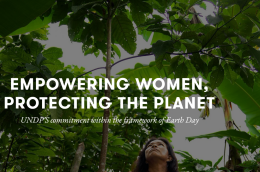
This April 22nd marks International Mother Earth Day with the slogan “Our Power, Our Planet”, which calls for us to rethink our role in ensuring that the use of our resources has a positive impact on both humans and ecosystems. Latin America and the Caribbean, the richest region in terms of flora and fauna, is also one of the most challenged by extreme weather events such as intense droughts, devastating hurricanes, tropical storms, heavy rains, floods, severe heat waves and catastrophic forest fires.
Women in the region, key environmental custodians due to their relationship with the environment and their role in the conservation and sustainable management of natural resources, are disproportionately affected by climate change, disasters, inequalities, and violence. Additionally, they tend to bear most of the burden of unpaid domestic work in their households, are underrepresented in decision-making, and have less access to resources and education. The relationship between gender inequalities and environmental degradation requires transformative and inclusive development. UNDP recognizes that gender equality is essential for effective and sustainable climate action and supports projects that protect biodiversity, boost the use of renewable energy, and empower women as community leaders.
On Earth Day, we share UNDP-supported initiatives that are making a tangible difference in these areas, highlighting the intersection of gender equality, renewable energy, and environmental and biodiversity conservation for a sustainable and equitable Latin America and the Caribbean.
Read here the full article published by UNDP on 23 April 2025.

Despite calls from women's groups urging the government to implement policies to address the underrepresentation of women in politics, the introduction of temporary special measures (TSM) to increase women's political representation in Fiji is remains a distant goal.
This week, leader of the Social Democratic Liberal Party (Sodelpa), Cabinet Minister Aseri Radrodro, and opposition MP Ketal Lal expressed their opposition bjection to reserving 30 percent of parliamentary seats for women.
Radrodro, who is also the Education Minister, told The Fiji Times that Fijian women "are capable of holding their ground without needing a crutch like TSM to give them a leg up".
Lal called the special allocation of seats for women in parliament "tokenistic" and beneficial to "a few selected individuals", as part of submissions to the Fiji Law Reform Commission and the Electoral Commission of Fiji, which is undertaking a comprehensive review and reform of the Fiji's electoral framework.
Their sentiment is shared by Prime Minister Sitiveni Rabuka, who said at a Pacific Technical Cooperation Session of the Committee on the Elimination of all forms of Discrimination against Women (CEDAW) in Suva earlier this month, that "putting in women for the sake of mere numbers" is "tokenistic".
Read here the full article published by RNZ on 22 April 2025.
Image by RNZ
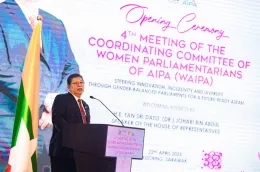
KUCHING: Dewan Rakyat Speaker Tan Sri Johari Abdul has called for stronger laws to protect women in politics, citing online harassment and fake news as key deterrents.
Many women, he said, are hesitant to enter politics due to uncontrollable challenges on social media, including slander, fake news, criticism and threats.
“Fake news, and when we enter politics, we are exposed to criticism and threats sometimes.
“This makes women feel that it’s not worth it and right now, we see Singapore has passed laws to prevent slander and so on.
“I am considering, if necessary, to introduce such laws in Malaysia. We should do so as this would prevent relentless attacks, fake news, which ultimately does not help anyone but gives satisfaction to those irresponsible individuals who spread such slander,” he said.
He was speaking to the media after attending the 4th Meeting of the Coordination Committee of Women Parliamentarians of the ASEAN Inter-Parliamentary Assembly (WAIPA) at Damai Lagoon Resort here today (April 22).
Read here the full article published by Sarawak Tribune 22 April 2025.
Image by Sarawak Tribune

Brussels, Belgium – On 4-5 February 2025, UN Women convened a two-day Expert Group Meeting (EGM) to address one of the most persistent barriers to gender equality in political and public life: discriminatory social norms. The event brought together feminist scholars, policymakers, activists, and practitioners to chart a path forward for transforming social norms and ensuring women’s full and effective political participation. This experts’ meeting was organized under the WYDE | Women’s Leadership, funded by the European Union, and under the leadership of UN Women’s Political Participation team, which is a collaborative global effort aimed at advancing women’s full and effective political participation and decision-making at all levels, especially those most often left furthest behind.
Despite decades of international commitments and mobilization, including the Beijing Platform for Action and the Sustainable Development Goals, women remain significantly underrepresented in political decision-making worldwide. Social norms continue to shape perceptions of women’s roles in decision-making, restricting their access to leadership positions, prescribing what their roles should be and reinforcing structural inequalities. As part of the WYDE| Women’s Leadership Initiative, UN Women is prioritizing social norms change and shifting attitudes that portray women’s roles in communities and society as incompatible with political power, to enhance women’s political participation. Over two days, feminist scholars, policymakers, activists, and practitioners were introduced to UN Women’s corporate work on gender equality social norms and also explored social norms that impact women’s participation in public life with the ambition to lay the groundwork for an approach towards addressing these norms and measuring norms change.
Read here the full article published by UN News on 17 April 2025.

A new report from the Environmental Voter Project (EVP), shared first with The 19th, finds that far more women than men are listing climate and environmental issues as their top priority in voting.
The nonpartisan nonprofit, which focuses on tailoring get out the vote efforts to low-propensity voters who they’ve identified as likely to list climate and environmental issues as a top priority, found that women far outpace men on the issue. Overall 62 percent of these so-called climate voters are women, compared to 37 percent of men. The gender gap is largest among young people, Black and Indigenous voters.
The nonprofit identifies these voters through a predictive model built based on surveys it conducts among registered voters. It defines a climate voter as someone with at least an 85 percent likelihood of listing climate change or the environment as their number one priority.
“At a time when other political gender gaps, such as [presidential] vote choice gender gaps, are staying relatively stable, there’s something unique going on with gender and public opinion about climate change,” said Nathaniel Stinnett, founder of the organization.
Read here the full article published by The 19th News on 14 April 2025.
Image by The 19th News