Advocacy & Lobbying
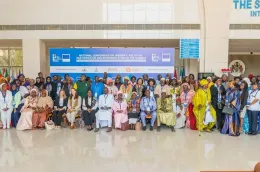
Eighteen (18) out of twenty-two (22) registered political parties in The Gambia have signed a historic communiqué committing to concrete reforms to advance women’s political participation and representation, following the successful conclusion of a two-day National Conference on Women’s Political Participation and Representation.
The conference, held from 15–16 December 2025 at the Sir Dawda Kairaba Jawara International Conference Center, was convened by the International Institute for Democracy and Electoral Assistance (International IDEA) through the EU-CODE-funded project, in partnership with the National Assembly, National Human Rights Commission, Gambia Press Union, and the CSO Gender Platform.
Held under the theme “Breaking Barriers, Building Power: Advancing Women’s Political Participation and Representation in The Gambia,” the conference brought together a broad spectrum of national stakeholders to assess the state of women’s political participation and agree on actionable reforms ahead of the country’s next electoral cycle.
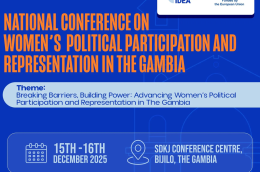
The persistent underrepresentation of women in The Gambia’s political sphere undermines democratic inclusivity and sustainable development. Women’s perspectives are critical for addressing issues like education, healthcare, and gender-based violence, which disproportionately affect them. This two-day national conference will focus on women’s political participation, providing a timely platform to:
-
Assess progress and gaps since the 2016 democratic transition.
-
Consolidate stakeholder efforts to address systemic barriers.
-
Develop a unified strategy, including policy recommendations and capacity-building initiatives.
-
Inspire a new generation of women leaders to engage in politics.

The Royal Norwegian Embassy andthe Embassy of Switzerland in Bangladesh, in collaboration with UN Women,hosted a high-level dialogue titled "Power Without Fear: Ending Digital and Gender-Based Violence Against Women in Politics" as part of the global 16 Days of Activism against Gender Based Violence (GBV) campaign under the theme "UNiTE to End Digital Violence against All Women and Girls" in Dhaka on December 7, 2025. The event convened political party representatives, young women leaders, civil society, academics, journalists, gender experts, development partners, and diplomats to address the currentthreats women face in political life.
Held at the Norwegian Residence, the dialogue focused on how digital violence has emerged as a modern barrier to democratic participation. As Bangladesh approaches its national elections, women engaged in political activities find themselves increasingly targetsof online harassment, intimidation, gendered misinformation, and coordinated smear campaigns that often extend into real-world harm.
Opening the event, H.E. Håkon Arald Gulbrandsen, Ambassador of Norway, emphasized that digital spaces are now central to political engagement and must be safe for women's participation. As the Ambassador stated, "women's political participation is essential for inclusive democracy, sustainable development, and lasting peace. When women are silenced - whether through digital harassment, character attacks, threats, or physical violence - entire societies lose out. Today,let us explore how we can strengthen legal protections, promote digital safety, hold perpetrators accountable, and empower women to participate in politics without fear."

The Ministry for the Status of Women and Women’s Rights (MCFDF) officially launched, this Friday at the La Cretonne Hotel in Les Cayes, the General Assembly on “women’s political participation and electoral violence,” under the evocative theme: “There is no democracy or elections without women, zero violence.
The Ministry for the Status of Women and Women’s Rights (MCFDF) officially launched, this Friday at the La Cretonne Hotel in Les Cayes, the General Assembly on “women’s political participation and electoral violence,” under the evocative theme: “There is no democracy or elections without women, zero violence.”

A two-day national conference on Women’s Political Participation and Representation opened Monday at Sir Dawda Kairaba Jawara (SDKJ) Conference Centre.
The conference is being organized by The International Institute for Democracy and Electoral Assistance (International IDEA) and its partners.
The conference aims to assess progress made and identify gaps in women’s political participation since the country’s democratic transition in 2016.
Opening the forum, International IDEA Secretary-General Dr. Kevin Casas-Zamora says nine years after the transition, The Gambia has significant achievements to celebrate, particularly its vibrant civic space and strengthened democratic institutions.
However, he notes that women’s political representation remains critically low.
“Women make up more than half of the population, yet they occupy only 8.6 percent of elected seats in the National Assembly. This is far below the 30 percent benchmark recommended by the Beijing Platform for Action,” Dr. Casas-Zamora said.
Speaking on behalf of the European Union Ambassador, Enya Braun says the theme of the conference highlights a persistent imbalance in decision-making spaces.
“While women are active in society, they are too often absent from formal decision-making structures. This must change,” she said, questioning how a society can claim to be democratic when more than half of its population remains underrepresented.
She reaffirmed the European Union’s commitment to gender equality and inclusivity, stressing that political representation is not a privilege but a fundamental right and a proven asset for democratic governance.
Representing the Speaker of the National Assembly, Hon. Abdoulie Ceesay says The Gambia stands at a critical stage in consolidating its democracy.
He pointed out that women constitute about 57 percent of registered voters and play a central role in political mobilization, yet their presence in executive positions, local councils and the national assembly does not reflect this reality.
“As the People’s House, Parliament must be inclusive. Political parties must dismantle gatekeeping barriers and move beyond using women solely as mobilisers to investing in them as candidates,” he said.
The conference is expected to consolidate stakeholder efforts to address systemic barriers, develop a unified strategy, and produce policy recommendations and capacity-building initiatives aimed at inspiring a new generation of women leaders in Gambian politics.

Stakeholders, women leaders and development partners have called for increased participation of women in leadership and governance
They made the call during the Southern Kaduna Trailblazing Women Association (SOKATWA) Summit and Fundraising, held in Kafanchan, Southern Kaduna.
Chairman of the occasion, Mr. Jerry Adams, emphasized that getting it right with women is key to getting society right, noting that women play a critical role in moulding character at home and within communities.
He commended the organisers for bringing together a high calibre of women at the summit and urged participants not to despise little beginnings but to remain focused and determined.
Earlier, the President of SOKATWA, Mrs. Belinda Augustine Istifanus, described the summit as a defining moment and a mission-driven gathering aimed at repositioning women as central actors in leadership and governance.
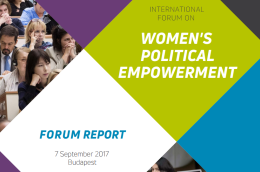
This report is based on the discussions held during the International Forum on Women’s Political Empowerment, held on 7 September 2017 in Budapest, Hungary. It is a short summary of views expressed by experts, guest speakers and participants, as highlighted in their remarks and group discussions that followed.
The OSCE Office for Democratic Institutions and Human Rights (ODIHR), the Hungarian Women’s Lobby, and the Embassy of Finland in Budapest organized the forum, in collaboration with the Friedrich Ebert Stiftung, Corvinus University of Budapest and the Embassy of Estonia in Vienna. The forum was also supported by the Royal Norwegian Embassy in Budapest and the Council of Europe.
The International Forum on Women’s Political Empowerment aimed to raise awareness and facilitate dialogue on women’s participation in political and public life in Hungary and beyond. The forum gathered around 200 participants (165 women and 35 men), including politicians, civil servants, gender equality advocates, representatives of civil society, academia and youth organizations, as well as students. Thirty Hungarian and international experts (23 women and 7 men) shared their knowledge on the topic, including guest speakers from Austria, Estonia, Finland, Germany, Ireland, Norway, and Portugal.
The forum served as a platform to exchange good practices for advancing women’s political participation. It explored persisting and emerging challenges as well as opportunities and good practices for political parties, civil society and youth to strengthen gender equality, women’s rights and women’s access to decision-making.
Click here to access the report.
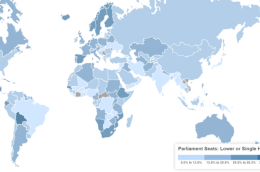
Using data to bridge the gender gap
Globally, women make up 49.7% of the population but hold only 22% of public offices. The Women in Public Service Project Data Portal seeks to answer why this is so, and how to increase the percentage of women in public office to 50% by 2050.
Click here to visit the data portal http://data.50x50movement.org/.
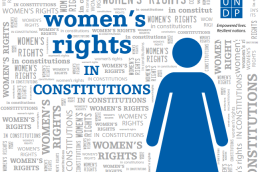
This policy guidance provides a range of good practice options for advancing gender equality in the content of constitutions. It contributes to, and complements, the capacity-building support that United Nations Development Programme (UNDP) staff in country and regional offices provide to a range of national partners and stakeholders for different aspects of constitution-making (which includes but is not limited to support for the drafting of new constitutions and the revision of existing constitutions). Other UNDP initiatives provide guidance and support for the process of constitution-making. This policy guidance is designed to build the capacity of UNDP staff to advocate for the advancement of gender equality and women’s human rights in the content of constitutions. It is intended to provide technical support for a range of partners and national stakeholders involved in constitution-making, including; legislatures, constituent assemblies, constitutional review committees or commissions, governments, civil society organizations and legislative drafters. Through the inclusion of numerous examples from existing constitutions, it aims to foster UNDP entry points for pursuing South–South exchanges through which countries can benefit from, and utilize, the good practice constitutional provisions of similarly situated countries. It also aims to raise awareness of the importance of advancing gender equality in the content of constitutions. With this in mind, examples have been chosen based on the de jure constitutional formulation rather than the record of gender equality in the particular country.
As per the statues of international IDEA, the Secretary-General reports to the Council of Member States on the overall implementation of the Institute’s activities. In April 2014, as part of the Mid-Term Strategy Review, Member States recommended that the organization continue to strengthen its communication about results. This fifth International IDEA Annual Results Report therefore presents improved qualitative reporting of results, giving more information beyond the simple implementation of activities.
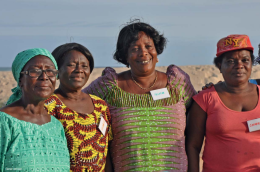
Research on women’s political participation at the community level was undertaken by Womankind in four very different countries – Ghana, Zimbabwe, Nepal and Afghanistan. The work in each context intends to increase women’s political participation and voice. The time available for the research was limited but much was achieved through the participation of Womankind staff and the deep involvement of Womankind’s partners working in each country; this enabled easy access to the women who work with, know and trust the partners. Women’s own situation varied across each country and between the countries; some had previous experience of engagement in public spaces while others were largely confined to their homes; some had formal education, while many were illiterate; some had access to trading and other livelihood work, others were financially dependent within their households. Their starting points for engagement with political influencing at the local level were disparate. Similarly, the political contexts into which they were moving in terms of local governance structures and processes were also diverse. In some, the Government had set up quotas and specific allocations for women, the poorest and the marginalised, such as Dalits, in others there were no such legal or statutory provisions and leverage on those with power over key resources, such as Local Government officials and Councillors, was very limited. In spite of these wide variations, it became apparent that achieving political change is challenging, often dependent on the political will of local officials, and policies made at national level are not necessarily implemented, or easy to get enacted locally.
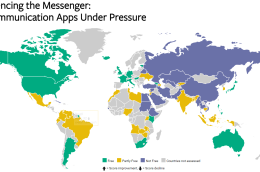
Freedom House has published its new report ‘Freedom on the Net 2016. Silencing the Messenger: Communication Apps Under Pressure’.
Internet freedom has declined for the sixth consecutive year, with more governments than ever before targeting social media and communication apps as a means of halting the rapid dissemination of information, particularly during anti-government protests.
Public-facing social media platforms like Facebook and Twitter have been subject to growing censorship for several years, but in a new trend, governments increasingly target voice communication and messaging apps such as WhatsApp and Telegram. These services are able to spread information and connect users quickly and securely, making it more difficult for authorities to control the information landscape or conduct surveillance.
These are the key findings:
- Internet freedom around the world declined in 2016 for the sixth consecutive year.
- Two-thirds of all internet users – 67 percent – live in countries where criticism of the government, military, or ruling family are subject to censorship.
- Social media users face unprecedented penalties, as authorities in 38 countries made arrests based on social media posts over the past year. Globally, 27 percent of all internet users live in countries where people have been arrested for publishing, sharing, or merely “liking” content on Facebook.
- Governments are increasingly going after messaging apps like WhatsApp and Telegram, which can spread information quickly and securely.
This year, the report highlights some internet freedom issues as they affect women specifically. The India report, highlights research which explores the negative effect of online harassment on women's participation online, as well the unique threats faced by female online activists in Mexico who challenge the social and institutional norms which tolerate violence against women. There is also an emphasis on the specific economic and professional disadvantages faced by Nigerian women who lack access to the internet.