Elections

Despite progress towards gender equality in Australian elections, women remain underrepresented among candidates vying for office on May 3. They are also overrepresented in “glass cliff” seats, which are the ones that are difficult to win and precarious to hold.

The Global Institute for Women’s Leadership at the Australian National University has analysed 591 candidates in the election by gender, political party, and the seats they are contesting.

Our report published today finds that while the major parties are increasing the number of women they pre-select, they are more likely to be running in harder-to-win seats.

Read More here.


When women enter the voting booth, what matters more—policy or identity? The debate over whether female voters prioritize gender representation or political substance has fueled political discourse for years. Some argue that women rally behind female candidates for symbolic progress, while others insist that ideology and policy take precedence. But do women truly vote based on identity, or is there more at play?

The Pew Research Center has documented this trend. Women have historically leaned more Democratic than men. Issues such as healthcare, education, and gender equality rank high among their electoral priorities. However, while female candidates may benefit from a gender advantage in certain contexts, this trend is more pronounced in Democratic primaries than in general elections.

Read the full article here.  


From parliamentary sexism to online harassment, women face multi-faceted barriers to political participation across all levels of government.

What you need to know:

  • Despite claims that gender plays no role in political outcomes, local attitudes reveal persistent biases that affect how women candidates are perceived and evaluated.
  • From parliamentary sexism to online harassment, women face multi-faceted barriers to political participation across all levels of government.
  • Cultural attitudes and institutional practices continue to limit women's leadership opportunities, even as research shows women-led countries perform effectively in crisis management.

In the lush, fertile slopes of Mount Kenya sits Meru County, a place of striking natural beauty—and now, a symbolic battlefield in Kenya's ongoing struggle for gender equality in politics.

As Women's History Month unfolded in March—a celebration imported from the United States but resonant globally—an ironic drama played out in this region where women outnumber men by 10,277 (777,975 women compared to 767,698 men).

Kawira Mwangaza, who in 2022 made history as the first woman to govern Meru County, was unceremoniously removed from office following her third impeachment attempt. The High Court's March ruling upheld her removal, ending a tumultuous chapter that raises profound questions about gender and power in Kenyan politics.

Read here the full article published by The Nation on 4 April 2025.

Image by The Nation


Gender was an important factor in the 2022 election: it shaped the ways the major parties packaged their policies and their leaders. Three years later, as Australians grapple with an uncertain world and a cost-of-living crisis, how might gender shape the 2025 election result?

Ideas about gender have always shaped Australian politics, although male and female political alignments have shifted over time. For example, when Sir Robert Menzies established the Liberal Party in 1944, he crafted messages to appeal to women, in contrast with the Labor Party’s blue-collar masculinity.

By the 1970s and 1980s, as more women entered the workforce and pursued further education, they became more progressive in their voting habits. This trend is evident beyond Australia (for example in the US, and in Europe and Canada).

How gender influenced the 2022 election

Women’s issues were decisive in the last federal election. The gendered impact of the COVID-19 pandemic, the emergence of Grace Tame as a fiery advocate for survivors of sexual abuse, and the Morrison government’s poor response to Brittany Higgins’ allegation of sexual assault enraged many women, who took the streets in the March for Justice in 2021.

Read here the full article published by The Conversation on 3 April 2025.

Image by The Conversation


In a recent blog for a leading German newspaper, the president of the German Institute for Economic Research delivered a stark assessment of political parties’ demographic focus ahead of February’s snap elections. His conclusion was sobering: “We cannot afford the future right now,” he wrote, describing a campaign centred on massive redistribution from the young to the old. In other words, younger generations are footing the bill for older ones—regardless of the cost.

Unsurprisingly, this approach does not sit well with those under 30. It also highlights a deeper challenge: political parties must rethink how they campaign to meaningfully connect with young people. Understanding their concerns is crucial, but so is recognising that most political social media efforts fail to engage them effectively. In an era where most under-30s consume news primarily via social media, parties need to move beyond surface-level outreach and develop strategies that truly resonate.

Young Voters and Political Outreach

Following the 2024 European Parliament elections, we researched how parties engage young voters, particularly given the increasing reliance on social media and the success of far-right parties in mobilising young people. We sought to answer key questions: Are political parties using social media effectively? What strategies are they employing? Are far-right parties outperforming others in youth outreach?

To explore this, we analysed Instagram and Facebook posts from political parties in Germany, Hungary, Poland, and Sweden—countries representing different political landscapes. Our study included far-right, green, conservative, and social democratic parties.

Read here the full article published by Social Europe on 28 March 2025.

Image by Social Europe


Last year, an aura of possibility hovered in anticipation of around 60 elections that were held across the world. Today, we face the outcomes of ballot choices that continue to cap women’s political leadership at a global level, as the UN Women's latest report highlights a slowdown of equality between women and men in politics.

Moving the needle on political empowerment

Approximately half of the head of state elections held in 2024 had women running for the top job. Out of virtual parity however, there were three times as many men re-elected than women elected overall. In terms of gender, the balance is slightly more positive. While two economies saw female incumbents replaced by newly elected male candidates, in four economies, electorates chose women to succeed men as head of state. However, when it comes to volume, out of the Global Gender Gap Report’s most populous economies, three elected men, and only one elected a woman as head of state.

For the legislative sphere, results are mixed. Among economies with parliamentary elections in 2024, Mexico and Rwanda continue to lead in female representation, with 50% and 64% of seats won by women in their lower houses, respectively. Belgium, Iceland, Senegal, South Africa, and the UK, achieved just over 40% of female representation. However, 80% of legislatures elected in 2024 selected men to the role of speaker, keeping legislative leadership overwhelmingly male.

Most countries have tackled the lack of female representation in their political decision-making by implementing legal candidate quotas. While this approach increased the proportion of female candidates, no major impacts have been observed on the proportional representation among elected officials. Notably, only two economies achieved higher percentages of elected women compared to female candidates.

Click here to read the full article published by the World Economic Forum on 17 March 2025.

Image by WEF


The Research and Advocacy Unit (RAU) has cited violence as a leading factor discouraging young women from actively participating in politics.

Zimbabwe will hold general elections next year, and women participation is pivotal as they constitute 52% of the population.

In a recent report titled “Do middle class women defend democracy?” RAU noted that young women shied away from politics mainly because of violence, polarization, corruption and nepotism.

“The general consensus was that political participation is risky and violence is too frequently a part of the contest; and politics are strongly associated with corruption and nepotism,” read part of the report.

Other reasons given for poor participation of young women in politics were difficulties encountered in registering to vote.

“The young women want to participate but are failing to find spaces they are comfortable in to express themselves politically, and it is important for them to see that sitting out is also a political statement.

Click here to read the report.

Despite women comprising nearly half of the world’s population, they continue to be drastically underrepresented in political leadership positions around the world. In fact, most have little or no access to the very decision-making tables where the policies are made that govern their lives.

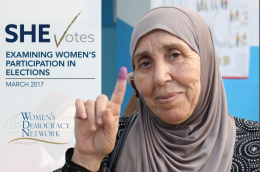
Unfortunately, there is no one-size-fits-all model when it comes to designing and implementing successful women’s empowerment programs related to political participation. All too often the focus in this sphere centers on election data, such as turnout of women voters, how many women competed as candidates, and how many women obtained seats. However, the barriers to women’s progress in this field are complex, and successful interventions must take into account the holistic nature of the issue.

[[{"fid":"12213","view_mode":"default","fields":{"format":"default","field_file_image_alt_text[und][0][value]":"shevotes","field_file_image_title_text[und][0][value]":""},"type":"media","link_text":null,"attributes":{"alt":"shevotes","style":"display: block; margin-left: auto; margin-right: auto;","class":"media-element file-default"}}]]

Based on its experience conducting gender assessments of elections throughout the world, as well as a review of external research and analysis of women’s participation in elections, IRI has developed a framework for this assessment based on a three-part typology of barriers. Individual barriers impede women’s self-efficacy and empowerment. Government barriers include legislative and regulatory provisions that undermine—through omission or commission—women’s participation. Societal barriers include norms of patriarchy or misogyny that exclude women from participating fully in the public sphere. These three types of barriers can exist in isolation and have discrete effects on women’s political participation. However, they are more often mutually constitutive and reinforcing. For example, electoral rules that fail to explicitly protect women’s access to political and electoral processes often indicate deeply embedded social norms of patriarchy. Therefore, the barriers to women’s political participation in any society are often multidimensional, reflecting the complex interaction of cultural values and institutional rules. Consequently, overcoming these barriers necessitates not simply encouraging women to overcome them, or even changing laws and practices, but also transforming the gender norms that undergird them.

Click here to access the study. 


In an effort to address the persistent gender gap at the highest levels of political office, this study investigates one of the stereotype-based social costs that women face as political candidates. Because power and power-seeking are central to the way masculinity is socially constructed and communality is central to the construction of femininity, intentionally seeking power is broadly seen as anti-communal and inconsistent with the societal rules for women’s behavior. The study aims to determine whether women political candidates who are seen to be seeking a political office as a means to gain power will be penalized for their seeming lack of communality. More specifically, the authors suggest that women’s power-seeking will evoke emotional reactions of contempt and disgust and therefore voters will be less likely to support their candidacy.

Findings

  • Voters are less likely to vote for female politicians when they perceive them as power-seeking, though male politicians are not penalized.
  • All things being equal, study participants were likely to perceive female politicians as being just about equally power-seeking as male politicians.
  • When participants saw male politicians as power-seeking, they also saw them as having greater agency (i.e., being more assertive, stronger, and tougher) and greater competence, while this was not true for their perceptions of power-seeking female politicians. 
  • When participants saw female politicians as power-seeking, they also saw them as having less communality (i.e., being unsupportive and uncaring), while this was not true for their perceptions of power-seeking male politicians.
  • When female politicians were described as power-seeking, participants experienced feelings of moral outrage (i.e., contempt, anger, and/or disgust) towards them.
  • Participant gender had no impact on any of the study outcomes – that is, women were just as likely as men to have negative reactions to power-seeking female politicians.
  • In short, both a power-seeking image and expressed power-seeking intent can bias voters against female politicians.

Click here to access the paper. 

For women across the world, electoral politics can be a hostile and violent place. Women who stand for office can expect casual sexism and discrimination, ranging from snide remarks about their appearance to being propositioned by their male colleagues. In some countries, this psychological violence escalates to physical violence in which men seek to make the public sphere so inhospitable for women that they disengage from electoral politics.

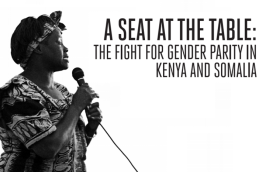
Writer Nanjala Nyabola investigates in this paper the parliamentary quota systems in East Africa and demonstrates how well quotas can work when supported with institutional will and how resoundingly they can fail when patriarchal political spaces conspire to undo them. All of the eight countries that are traditionally thought to make up East Africa—Kenya, Uganda, Tanzania, Rwanda, Burundi, Somalia, Ethiopia, South Sudan—have quotas entrenched in their electoral systems.These quotas take different shapes however.

Click here to read the paper. 

It is a well-established finding that proportional representation (PR) is associated with greater female legislative representation than single member majoritarian systems However, the degree to which different types of PR rules affect voting for female candidates has not been fully explored. The existing literature is hampered by a reliance on cross-national data in which individual vote preferences and electoral system features affect one another.

In this study, Sona N. Golder, Laura B. Stephenson, Karine van der Straeten, André Blais, Damien Bol, Philipp Harfst and Jean-François Laslier draw upon an experiment conducted during the 2014 European Parliament (EP) elections to isolate the effects of different PR electoral systems. Participants in the experiment were given the opportunity to vote for real EP candidates in three different electoral systems: closed list, open list, and open list with panachage and cumulation. Because voter preferences can be held constant across the three different votes, the authors could evaluate the extent to which female candidates were more or less advantaged by the electoral system itself. The study concludes that voters, regardless of their gender, support female candidates, and that this support is stronger under open electoral rules. Concerns about voters being put off because of the presence of women on the ballot appear to be unfounded.

Click here to read the study

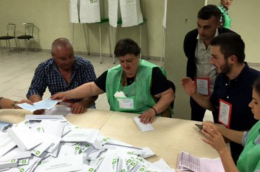
Georgia’s October 2016 parliamentary elections were characterized by an open political environment, a competitive campaign, overall results that were validated by credible observers, and some underlying problems that need concerted attention. NDI's final report draws attention to a set of recommendations that could contribute to greater public confidence in the approaching local and presidential elections.

The elections were characterized by an open political environment, a competitive campaign, overall results that were validated by credible observers, and some underlying problems that need concerted attention.

Yet the elections highlighted some problems. The most pressing of these were incidents of violence and intimidation that occurred throughout the process; concerns about the qualifications, neutrality, and competence of some polling station commissioners; and questions about the impartiality and consistency of adjudication measures. In addition, the elections underscored shortcomings related to the legal framework, parties’ campaign strategies, election observation, campaign financing and the misuse of administrative resources, and the underrepresentation of women and minority groups.

Women in Georgia were well represented among voters (51.1 percent), observers, and election administrators, demonstrating their commitment to and engagement in politics and elections. However, women were underrepresented as candidates, making up only 17 percent of majoritarian candidates and 37 percent of party list candidates. At this stage, it appears that only three parties and one bloc qualified for the financial incentive of a 30 percent increase in state funding for including three candidates of a different gender in every 10 names on their proportional lists, with Patriots’ Alliance the only party to both qualify for the financial benefit and pass the threshold to hold seats in parliament. The overall number of women MPs did increase slightly, from 18 (12 percent) prior to the election to 24 (16 percent); however, fewer women majoritarian MPs were elected -- five in October as compared to seven in the previous parliament.

Click here to read the full report. 


For more information, contact:

In Georgia: Diana Chachua, dchachua@ndi.org577 779639

In the United States: Emily Rodriguez, erodriguez@ndi.org+1 202 728-5500