Elections
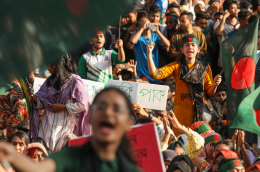
It is a striking paradox. For more than three decades, Bangladesh has been led by women—an exceptional continuity across the globe. Yet the outcome of the 13th national election tells a different story. Even with women at the top position, women's presence in Parliament has declined significantly day by day.
In the elections of 1991, 1996 and 2001, women's participation was gradually increasing. The 2008 election is often seen as a milestone in terms of women's representation in the National Parliament. That year, 5.9 percent of all candidates were women, and 19 women won in directly contested seats—a record that still stands.
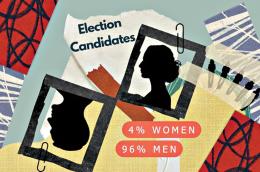
But in the 2026 election—widely regarded as relatively free and competitive after a long period—the share of women candidates fell to 4.08 percent. Out of more than two thousand candidates, only 84 were women. In a 300-seat Parliament, just 7 women were directly elected—the lowest number since 2001.
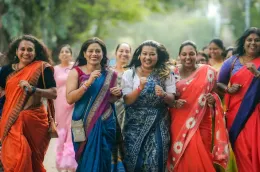
As Assam, Tamil Nadu, West Bengal, and Kerala prepare for Assembly elections, two decades of electoral data reveal a clear pattern: more women are entering the fray, but they are not winning in proportion to their participation. In contrast, men’s win percentages have remained relatively steady over the last 20 years.
Let’s look at this state by state.
West Bengal
While Mamata Banerjee, one of India’s most prominent women leaders, has been chief minister since 2011, women’s overall electoral performance in West Bengal has been bad. While more women contested elections, the number of women victors has only declined. They did not win proportionally to the increase in participation.
From 2001 to 2006, women’s victory rate increased. But after 2006, it began to decline steadily. By 2021, only 16.7 per cent of women contesting the election won seats — quite a fall from 24.6 per cent in 2001.
Despite this decline over the past two decades, women in West Bengal have consistently recorded higher winning percentages than men. In 2001, 17 per cent of male candidates won their seats, compared to 24.6 per cent of women candidates. This pattern has largely continued. In 2021, 13.4 per cent of men won, while that figure stood at 16.7 per cent for women.
Concerns Over Women's Political Representation
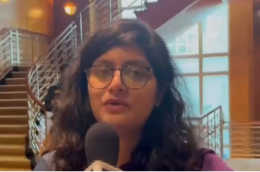
Member of the Forum for Women's Political Rights and Research Fellow at Aarshi Trust, Nafisa Raihana, on Sunday, expressed concerns about women's political representation following the 13th national parliamentary elections in Bangladesh. She alleged the existence of systemic barriers to women's participation in political parties. Speaking to ANI after the results were announced, Raihana said many women were unable to secure party nominations despite being politically active. "Many women could not get nominated this time, and many of the male members of their political parties did not or could not give their nomination. We met various women politicians, and all said that they are active, but it is difficult for them to reach a higher level or even talk to a higher authority," she told ANI...
On the morning of February 9, a large crowd gathered near the Mirpur-1 Eidgah field.
The air was filled with commotion and the festive rhythm of a band party. Rickshaws and cars came to a halt, and pedestrians stopped to watch.
Suddenly, an open-top vehicle emerged from the crowd. A woman stood inside, waving to people lining both sides of the road.
A five-year-old girl standing with her mother on the sidewalk waved back.
The mother, Swapna Akhtar, said their house was nearby. Her daughter insisted on coming out after hearing the band. When they arrived, they realised it was an election campaign procession for Sanjida Islam Tulee.
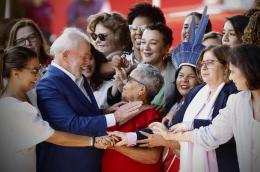
With an eye on attracting sectors considered decisive for the elections, President Lula has concluded that he needs to further calibrate his rhetoric and actions aimed at women in order to reverse disapproval of his administration among this electorate, which exceeds 40%.
The move comes as the Palácio do Planalto sees a kind of window of opportunity due to the absence, within the far-right camp, of a strong female leadership figure for the 2026 elections. Initially, one of the main bets in that field was former first lady Michelle Bolsonaro. However, her stepson Flávio Bolsonaro (Liberal Party, PL, São Paulo) emerged and was announced as a pre-candidate. Privately, the two disagree over the family’s electoral project for 2026, which, in the government’s view, weakens their presence on certain issues.
On women’s rights, the rift between them is even more evident. Michelle Bolsonaro heads PL Mulher, and on social media the women’s wing of the PL party has ignored Flávio’s pre-candidacy. Posts highlight Michelle and Jair Bolsonaro in particular, without reference to her stepson.
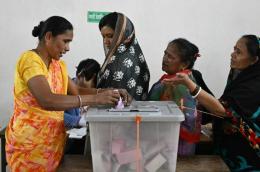
DHAKA – As the dust settles on Bangladesh’s 13th National Parliamentary Election, with the Election Commission (EC) declaring the 297 candidates elected to our parliament, a major source of disappointment remains: the systematic lack of women’s political participation. While a total of 85 women contested the polls last Thursday, including 66 with party nominations and 19 as independent candidates, only seven have been elected. Of the seven candidates, only one is independent; the rest are from BNP. Furthermore, as per pre-election stats from the EC, nearly a third of female candidates were relatives of influential men. Although in the ninth parliament, 21 women were directly elected, the total number of female contestants in this election was the highest on record. These numbers put the low participation of women politicians in perspective.
Myriad factors are cited by those who attempt to deny that a systemic exclusion of women persists in Bangladesh’s politics. But when a party announces outright that it will not include women in roles of leadership in a post-uprising Bangladesh, we must acknowledge the urgency of this problem.
Women played a crucial role in the ousting of the Awami League regime in 2024, yet hardly any female representatives were included in the July National Charter consensus discussions. When male politicians were subjected to enforced disappearance by Sheikh Hasina’s regime, it was the women in their families who led the fight for justice for years. The requirement by the Representation of the People Order, 1972, for political parties to reserve at least 33 percent of committee posts for women, including at the central level, was also not heeded by the major political parties in this election. Unsurprisingly, the recommendation by the Women’s Affairs Reform Commission to increase the number of reserved seats for women to 100 with direct elections was not accepted by political parties. Meanwhile, promises and sentiments about women’s empowerment by contesting politicians sound more like rote than out of a genuine wish to improve the persisting imbalance.

Progress toward gender parity in politics slowed in 2024 — a quiet shift after a streak of record-breaking years for women’s political candidacies. While Kamala Harris makes history this year as the first woman of color atop a presidential ticket, some political organizers are hoping her candidacy will pull more women back into power.
After 2018 was dubbed a second “year of the woman,” — the first being in 1992 — marking a record number of women running for the highest offices in the country, women continued to reach new highs in the subsequent elections: 583 women ran for the House in 2020 and 2022, and 70 women ran for the Senate in 2022, according to data from Rutgers’ Center for American Women and Politics.
In 2024, those numbers dropped back down to 466 for the House and 52 for the Senate, a conspicuous decline after years of steady growth.
“Progress for women in politics appears to be slowing, if not stalling,” RepresentWomen warned in its 2024 Gender Parity Index last month, noting that women are still significantly underrepresented at all levels of U.S. government.
Read here the full article published by Politico on 23 August 2024.
Image by Politico
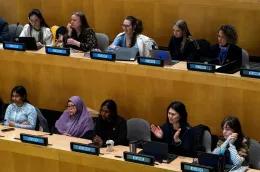
What’s the context?
Mid-way through a bumper election year, there are few gains for women in power
¨Gender equality pledges fall short in some countries
¨Women make up slightly more than a quarter of parliaments worldwide on average
¨Experts say underrepresentation creates democratic deficit
BRUSSELS - Billed as “democracy's biggest test,” 2024 is a major election year with billions of citizens casting their votes. But commitments to gender equality in politics are falling short in some parts of the world.
While there have been historic moments, such as the election of Mexico's first female president Claudia Sheinbaum in June and Kamala Harris' bid to become the first female president of the United States, elections in Indonesia, India, the United Kingdom, Pakistan and South Africa had no female frontrunners.
The picture isn't much better in houses of parliament around the world. The percentage of women in legislatures globally stood at 26.9% on average on June 1, according to the Inter-Parliamentary Union (IPU), an independent organisation promoting democracy.
At the current rate, it will take 130 years before gender equality is reached in the highest positions of power, according to the United Nations.
Read here the full article published by Context on 21 August 2024.
Image by Context
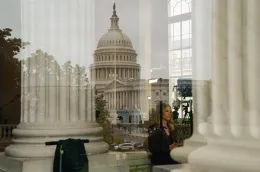
The number of women running for the House and Senate has dropped, including a record number of incumbent women not running for reelection.
Women continue to make record-breaking progress in politics — most notably with Vice President Kamala Harris becoming the first woman of color at the top of a major party presidential ticket. However, an annual report by RepresentWomen, a nonprofit organization that supports institutional reforms to help women enter public office, found that progress has been inconsistent.
The report, called the Gender Parity Index, tracks gender representation across local, state and federal offices.
“The 2024 Index reflects our complex political landscape, suggesting progress in women’s political representation may stagnate or even backslide,” according to the report.
Overall, the United States lags behind most established democracies. Women are still underrepresented at every level of government, holding under one-third of all elected positions despite accounting for more than 50 percent of the total national population. In the last year, the number of women congressional candidates has fallen by 20 percent in the House and 26 percent in the Senate. And a record number of incumbent women are not running for reelection.
Read here the full article published by 19th News on 12 August 2024.
Image by 19th News
What you need to know:
-
There’s a growing consensus among academicians that these quotas “work”.
-
However, there is a conundrum as women who are elected in countries with gender quotas are often criticised as being less qualified.
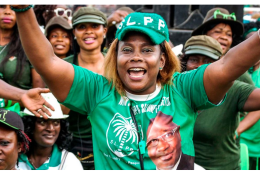
Standing in the scorching afternoon heat, Aminata Bilkisu Kanu took off her sunglasses to wipe away the beads of sweat trickling down her face as she appealed to the crowd of mostly male voters.
“Think ‘women’ when voting in the June 24 elections,” she told them.
“We keep your resources within; the men take them away.”
The 24-year-old single mother was the first woman to run for the national parliament from Mamoi village, part of the Masimera Chiefdom in Port Loko District, located in the conservative north of the country.
Patriarchal culture runs deep in Sierra Leone, but it is even stronger in the north and parts of the east, where customs do not allow for women to become a paramount chief, the traditional name for the district leader.
Read here the full article published by The Nation on 11 August 2024.
Image credits: The Nation
With voters heading to the polls in countries around the world, 2024 has been dubbed the year of elections. While a recent change in the United States election will put a woman at the top of a major party ticket, a June presidential election just over the border in Mexico stood out. Earlier this summer, Claudia Sheinbaum Pardo was elected president of Mexico, shattering the political glass ceiling in North America. In second place came Xóchitl Gálvez Ruiz, another woman. Sheinbaum–in addition to perhaps being born a leader (and having a Nobel-prize winning brain)–and Gálvez are the product of an enabling environment–otherwise, how to explain the rise in women’s political leadership only in the second half of the 20th century? The first woman ever to be elected to the highest office (in this case, the office of prime minister) occurred in Ceylon (present-day Sri Lanka) in 1960.
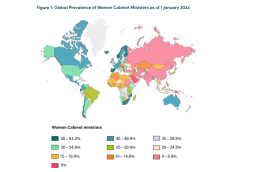
This blog, part of CGD’s work on women’s leadership, focuses on political leaders and explores which conditions enable women’s leadership by contrasting Latin America and the Caribbean (LAC), a region that is ahead of most in women’s presence in politics, with Sub-Saharan Africa (SSA) that is currently some steps behind. The 42 countries in LAC have had a total of 26 women heads of state, presidents, or prime ministers (PMs), with seven incumbent women heads of government (including Sheinbaum who will assume office on October 1, 2024). The 48 countries in SSA have had a total of 16 women heads of state, presidents, or PMs, with four incumbent ones.[1] Women currently hold 36 percent of parliamentary seats in LAC and 27 percent in SSA. Countries in LAC also have a higher share of women cabinet ministers.
Read here the full article published by the Center for Global Development on 09 August 2024.
Image by Center for Global Development
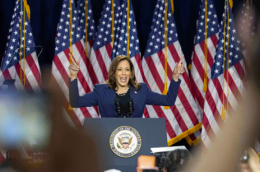
Shirley Chisholm, a Democratic congresswoman, was the first African American woman to run for president of the United States. Sixty years later, Kamala Harris will become the first Black and South Asian American woman to be nominated for president by a major party. Is the United States poised to elect her?
Chisholm, from Brooklyn, N.Y., first ran for office in 1964 — the year both Harris and I were born (the vice president on Oct. 20 and me on Oct. 30). When Chisholm began her presidential campaign in 1972, Harris and I were probably more focused on our toys and our friends, but I was fascinated by politics and aware of Congresswoman Chisholm.
For Black women of my generation, Black women political leaders were few and far between in the 1960s and ’70s, and the numbers remain below our percentage of the population.
Black women represent 7.7 per cent of the total U.S. population, according to the U.S. Census. The Center for American Women and Politics (CAWP) reports that 5.4 per cent of all voting members of Congress identify as Black women. Nonetheless, the situation has improved greatly compared to 1968, when Chisholm became the first Black woman elected to U.S. Congress.
Read here the full article published by The Conversation on 24 July 2024.
Image by The Conversation