Women's Leadership
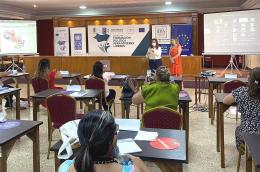
In a region that has seen the greatest progress in political gender equality in the last two decades, Paraguay stands out, but for the wrong reasons: it has the third-lowest percentage of women in parliament in the Americas, with 17.5%, roughly half the regional average of 33.9%. When considering other elective positions, the divide widens.
Though the gender political gap is a complex and multi-dimensional issue, Paraguayan women clearly are politically underrepresented, despite their high interest and ample participation in electoral processes. For instance, in the 2021 municipal elections, female voter turnout was equal to men's, and women's participation in voting tables were even higher than men's.
Click here to read the full article published by Euronews on 8 March 2022.
Enhancing Women's Political Participation in Africa (Women in Political Participation (WPP) is a Pan-African gender project on the different facets of Women and Politics in Africa. Funded by Sida and implemented by International IDEA, it aims to advance gender equality in politics and governance, in line with the Maputo Protocol of 2003, various associated sub-regional protocols and standards, and the United Nations Sustainable Development Goals (SDGs).
The project includes working with key institutions of democratic governance such as political parties, parliaments, and the media, amongst others, to build constituencies, alliances, norms, templates, and targets for reform and change towards greater women's political participation.
Click here to read the full article published by International IDEA on 4 March 2022.
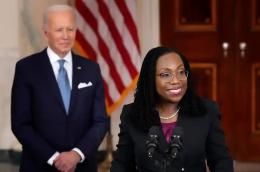
Joe Biden on Friday nominated Judge Ketanji Brown Jackson to the supreme court, seeking to elevate a Black woman to the nation’s highest court for the first time in its 232-year history.
Biden’s decision to nominate Jackson to succeed Justice Stephen Breyer, for whom she clerked, sets up a fierce confirmation battle in the deeply partisan and evenly-divided Senate. Breyer, 83, the most senior jurist in the court’s three-member liberal wing, will retire at the end of the court’s current session this summer.
Click here to read the full article published by The Guardian on 25 February 2022.
By Chiedo Nwankwor
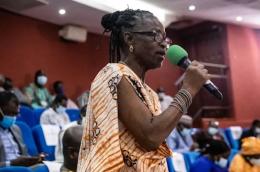
Women’s equal participation in government is central to democracy and achieving sustainable development and egalitarian societies. While the struggle to redress the marginalization of women in leadership positions show a measure of success, this progress has been slow and uneven since 1995. Gender disparity persists in access to political leadership across local governments, national parliaments, and executive institutions of power—despite and in violation of an array of global, regional, and national laws that invest women with rights to equal political participation and representation as citizens. Women also face significant disparities within political parties, who serve as the gatekeepers to women’s political access and competitiveness. For example, in Africa, 24 percent of national parliamentarians and 21 percent of local government leaders are women. The continent also ranks far below the global average of 20 percent for women ministers in national cabinet positions.
Click here to read the full article published by Brookings on 23 February 2022.
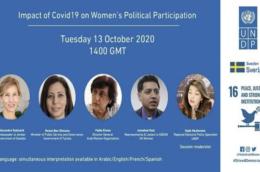
The regional electoral assistance project hold the 9th webinar about the impact of Covid-19 on women’s political participation.
The webinar focused on the impact of COVID-19 on vulnerable and marginalized communities, particularly the effects it has had on the political participation of women. Women, who make up 65% of the global healthcare workers, are at highest risk of infection, are losing jobs at higher rates than men, face sharply increasing rates of domestic violence and are bearing new burdens of home school and family responsibilities. I will discuss the gendered impact of the pandemic in public life with women largely being left out of decision-making processes. As the pandemic continues, it is critical to raise awareness and advocate for COVID-19 response measures that not only take into account but directly address the many obstacles women face as public officials, voters, candidates, electoral administrators, observers and poll workers. Panelists will offer unique national and regional perspectives on the impact of COVID-19 on women’s political participation.
Click here to watch the webinar.
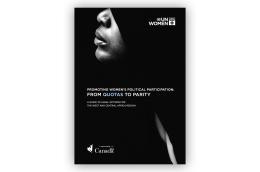
This guide is designed to increase the understanding of the legal obligations of countries in the West and Central Africa (WCA) region to achieve gender equality in decision-making. It focuses on strengthening efforts to improve the legal framework in the region to ensure that laws are clearly drafted, implementable and effective. Special focus is devoted to the processes by which laws supporting political participation of women are developed, negotiated, drafted, passed and implemented. It aims to strengthen law-making processes that build and secure the legal rights of women who want to run for elections and who are ready to take over leadership positions in their parliaments and governments. Legal instruments are presented that can be used to advance the political participation of women.
The comparative experiences presented in this guide address both examples of good practices and laws that have failed because their regulations are imprecise, unclear and/or lack effective sanctions. The guide presents also various provisions of laws resulting from different constitutional requirements or electoral systems, assessing their advantages and disadvantages.
Click here to download the guide published by UN Women in 2021.