Women's Leadership
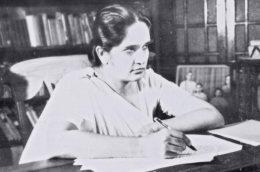
South Asia has elected its share of prominent women politicians. But what has that meant for gender equality and women’s rights on the ground?
With Kamala Harris assuming office as the United States’ first female vice president this month, conversations have been renewed over the role of women leaders in politics – particularly in South Asia, given Harris’ Indian heritage. South Asia has seen many female politicians and even elected them as heads of government, from Indira Gandhi – the first and only woman prime minister of India – to Benazir Bhutto – the first female head of state of a Muslim country and twice premier of Pakistan – despite being home to largely patriarchal and male-dominated societies. These women leaders, however, have strong dynastic backgrounds that boosted their political careers. There are also questions as to whether their tenures have been any different from their male counterparts’ or have led to any significant changes on the ground concerning women’s rights and their better representation in government and society.
A recent online cross-border discussion hosted by Himal Southasian shed light on female representation in South Asian countries and discussed how women leaders’ ideologies and governance have shaped politics. Speakers also talked about the challenges women face today as leaders and political workers in these countries. The discussion was moderated by Indian journalist, writer, and editor Luxmi Murthy.
Click here to read the full article published by The Diplomat on 28 January 2021.
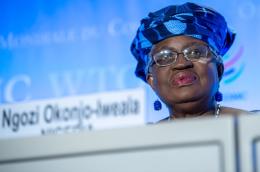
Her path was cleared after Yoo Myung-hee, the South Korean trade minister, announced she was withdrawing from consideration to head the World Trade Organization.
Ngozi Okonjo-Iweala, an economist and former finance minister of Nigeria, appears set to become the next director general of the World Trade Organization, with the Biden administration announcing its “strong support” for her candidacy on Friday. She would be the first woman and the first African national to lead the organization.
Yoo Myung-hee, the South Korean trade minister who was also a finalist for the role, said on Friday that she planned to withdraw herself from consideration, leaving the path open for Dr. Okonjo-Iweala, The Associated Press reported.
The two women were announced as finalists for the trade organization’s top job in October, whittled down from a group of eight candidates over several months, with Dr. Okonjo-Iweala emerging as the person with the broadest support, the W.T.O. said at the time.
But because the organization, a trade-regulation body that has existed in its current form since 1995, requires that none of its 164 members oppose the choice, President Donald J. Trump, who supported Ms. Yoo and said he would not back the candidacy of Dr. Okonjo-Iweala, was able to hold up the process, according to the W.T.O. statement.
Click here to read the full article published by The New York Times on 5 February 2021.
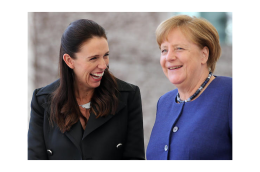
As Boris Johnson’s Britain notches up 100,000 deaths, the statistics for female-run countries are incomparably better. But is the connection as simple as it looks?
If it’s possible for a plague to have a pin up, then Jacinda Ardern is it. She is the female prime minister whose quick and decisive actions have succeeded in holding Covid-19 deaths in New Zealand down to just 25 in a population of around five million. On any metric, Ardern has one of the best records in the world for containing the deadly virus. Is it the Jacinda effect? Or are women leaders better at battling the disease?
Ardern, now in her second term, had already established a record for meeting terrible national adversity with grace and empathy after the mosque shootings in Christchurch in 2019 which left 51 dead. She also has the geographical bonus of being prime minister of distant and sparsely populated New Zealand. Locking down and shutting out the world was devastating to the economy, but it was a whole lot easier than locking down Britain.
But Ardern’s relative success in limiting the impact of Covid-19 is not unique. However brutal it feels to reduce individual deaths to global statistics, there is a striking correlation between countries with women leaders and low death rates.
Click here the full article published by Prospect on 29 January 2021.
The question of "what if women ruled the world" is getting less hypothetical these days as experts and studies note that countries governed by women have “systematically and significantly better” COVID-19 outcomes. Now a new study suggests that differences in communication might help explain why.
"The contribution women have made has not earned them an equal say in COVID-19 decision-making. They remain in the minority on COVID-19 task forces — expected to run health systems while men make decisions that impact all our health and lives," Roopa Dhatt, executive director of Women in Global Health and one of the authors of the study, told Medical News Today. "Yet, it has been noted that when women do make decisions, the outcomes are positive — COVID-19 deaths in women-led countries have been six times lower than in countries led by men."
While women make up roughly 70 percent of the health care workforce both in the United States and around the world, they are far less represented at leadership levels. At the beginning of the pandemic, there were 17 women acting as heads of government, 10 of whom were included in the study due to limited access to records in some countries.
Click here the full article published by The Hill on 26 January 2021.
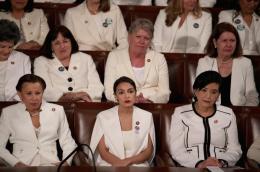
The Biden administration must move beyond superficial inclusion and actively promote gender equality globally while seeking to reverse the harm done in the name of forever wars.
Liberal world order is back, and ostensibly more inclusive than ever. As outgoing U.S. President Donald Trump’s team of grifters, conspiracy theorists, and would-be putschists torch Washington on their way out, incoming President Joe Biden continues to introduce his cabinet—most recently picking former United Nations Ambassador Samantha Power as head of the U.S. Agency for International Development. The new administration promises a revival of progressive foreign policy, signaled above all by the “racial and gender mix” of its leadership, as the New York Times described it. Yet, the relief at Trump’s exit risks obscuring the contest between a form of elite inclusion within the national security system and more radical challenges to that same order.
The incoming team is much-celebrated for the diversity of its membership, projecting a very different image of American power than the Trump administration’s “alpha male” nationalism.
Click here the full article published by Foreign Policy on 20 January 2021.
By Emma Batha
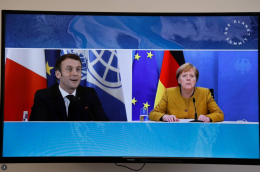
LONDON, Feb 1 (Thomson Reuters Foundation) - Boosting the number of female leaders and government ministers will help build a stronger post-pandemic world, the head of U.N. Women, Phumzile Mlambo-Ngcuka, said on Monday as data showed women may wait 130 years to see equality at the top.
Here are some key facts about women in leadership positions:
- There are 22 countries with elected female heads of state or government. Recent additions to the list include Peru, Lithuania and Moldova.*
- On Jan. 25, Estonia became the only country with a female president and female prime minister.
- A total of 119 countries have never had a woman leader.
- At the current rate of progress, gender parity at the highest positions of power will not be reached for 130 years.
- Parity will not be achieved in national legislative bodies before 2063 and in ministerial positions before 2077.
Click here to read the full article published by Reuters on 1 February 2021.