Women's Leadership
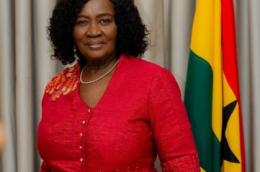
Ghana made history when the National Democratic Congress (NDC) nominated Professor Jane Naana Opoku-Agyemang as the running mate to former President John Dramani Mahama for the 2020 general elections. Her nomination marked a significant milestone in Ghanaian politics, as she became the first female to run for vice presidency on a major party ticket. This bold move by the NDC proves a progressive shift towards gender inclusion and amplified discussions around women's representation in governance.
Nomination by the NDC
The selection of Professor Opoku-Agyemang was met with widespread praise from various quarters of society. As a former Minister of Education and an accomplished academic, her nomination was seen as a strategic and progressive decision by the NDC. John Mahama, in his announcement, highlighted her integrity, leadership, and commitment to national development as key reasons for her selection. The party’s decision to choose a woman of her caliber sent a strong signal about its commitment to promoting gender equality and diversifying leadership.
Read here the full article published by My Joy Online on 9 January 2025.
Image by My Joy Online
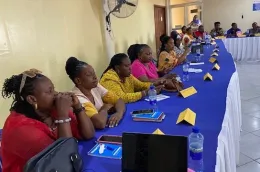
MOST often during political elections in Tanzania and across the world, women face a number of gender-based barriers to leadership, something which contributes to their defeat.
Recently, the Tanzania Gender Networking Programme (TGNP) in collaboration with the Coady International Institute brought together a number of women who vied for different leadership positions in last year’s civic polls.
On November 27th, 2024 Tanzanians voted for their leaders at local government level whereas posts being vied for included 12,280 village chairpersons, 4,264 street chairpersons, 63,886 hamlet chairpersons, 230,834 village council members and 21,320 street committee members.
The facilitator of a two-day training on psycho-social support, Mayasa Kalinga mentioned several factors which contributes to women being defeated in elections including gender inequality, harassment, psychological torture, cultural norms and stereotypes.
Traditional beliefs often prioritize male leadership, placing women primarily in domestic roles. This perspective limits women's opportunities in leadership positions.
Read here the full article published by IPP Media on 8 January 2025.
Image by IPP Media

Introduction
Gender equality has been a point of debate in the recent past. This is based on the ability to accord equal rights and opportunity for both genders where discrimination and prejudice are prevented. In Nigeria, gender equality and related issues are prevalent in different cases.
This is where the female gender is facing different inequalities and challenges, which are making it hard for them to cope and become effective in community participation and development (. This is based on the rise of various forms of conflict in the region, such as the Boko Haram and Harder-Farmer conflicts.
These are negatively impacting the country’s economy, and they are also affecting women and gender dynamics in the area. Therefore, this research outlines the way such conflicts have led to issues impacting women, such as gender-based violence, and also impacts the roles of women in society. Also, the discussion outlines the relationship between conflict and political participation of women in the country and the post-conflict challenges and opportunities available in the case of women in Nigeria.
Read here the full article published by The Vanguard on 7 January 2025.
Image by The Vanguard
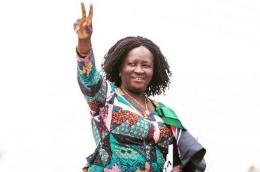
Prof. Naana Jane Opoku-Agyemang has officially assumed the role of Vice President of Ghana following her swearing-in on Tuesday.
The ceremony took place at the iconic Independence Square in Accra, where Chief Justice Her Ladyship Gertrude Torkornoo administered the oath of office.
Prof. Opoku-Agyemang, who served as the running mate to President-elect John Dramani Mahama during the 2024 general elections, has made history as Ghana’s first female Vice President.
Running alongside President-elect John Dramani Mahama, her historic win under the National Democratic Congress (NDC) banner in the 2024 elections has been widely celebrated as a groundbreaking achievement for gender representation in Ghanaian politics.
Read here the full article published by New National Star on 8 January 2025.
Image by New National Star
This is the second issue of our policy insight series on gender-inclusive conflict transformation. This paper explores the political re-conversion pathways that women ex-combatants pursue after the signing of a peace agreement. From 2022 to 2023, we engaged in focus group discussions, interviews, and peer-learning workshops with over 70 women ex-combatants from Colombia, El Salvador, and the Philippines. In this publication, we present their testimonies and analyse their experiences of continuing their engagement post-war through nonviolent means in both formal and informal political spheres.
Click here to read the full article published by Relief Web on 17 December 2024.
Image by Relief Web
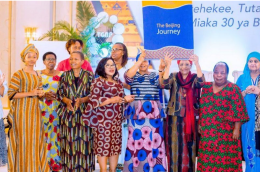
Following their victories in the recent Local Government Elections, newly elected female leaders are encouraging other women to pursue leadership roles despite the challenges.
Mtwara Ms Rukia Myachi, chairperson of Myegedi village in Mkunwa ward, emphasised the importance of resilience. "I faced many obstacles, from stereotypes to lack of support," she shared.
"But I persevered. This proves that women can lead effectively. Don't let challenges deter you. Step up and take on leadership roles to represent other women's voices."
Read here the full article published by The Citizen on 2 January 2025.
Image by The Citizen
Women who seek to participate in peace processes and political decision-making face many obstacles. To achieve sustainable peace and development, societies emerging from conflict must remove these obstacles. In so doing, they must recognize and prioritize that women are fully capable of active participation in all political processes. Women’s equal participation in leadership at every level and in every sector is imperative to eliminating gender-based violence, poverty and enabling sustainable peace.
In this policy brief, Women in International Security examines five main barriers to women’s participation at the peace table and in politics. And presents recommendations to the international community, state actors, civil society organizations, women’s rights defenders, and male champions to help create an enabling environment for the full participation of women in all political processes.
Click here to see the report.
A seemingly inescapable feature of the digital age is that people choosing to devote their lives to politics must now be ready to face a barrage of insults and disparaging comments targeted at them through social media. This article represents an effort to document this phenomenon systematically. We implement machine learning models to predict the incivility of about 2.2 m messages addressed to Canadian politicians and US Senators on Twitter. Specifically, we test whether women in politics are more heavily targeted by online incivility, as recent media reports suggested. Our estimates indicate that roughly 15% of public messages sent to Senators can be categorized as uncivil, whereas the proportion is about four points lower in Canada. We find evidence that women are more heavily targeted by uncivil messages than men, although only among highly visible politicians.
Click here to see the paper.
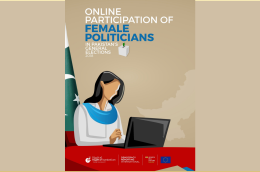
This research report seaks to analyze the use of social media during the 2018 General Election in Pakistan. The report focuses on online participation and harassement of female politicians along with issues pertinent to elections in the digital age: online advertising, misinformation and regulation of social media spaces.
Click here to see the report.
Around the world, women are targeted by violence because of their commitment to vote, their jobs as electoral officials and their aspirations to hold political office. NDI categorizes this kind of violence as “violence against women in elections” (VAW-E), and defines it as any act of violence -- threats, hate speech, assault, blackmail or assassination -- that is unduly directed at someone because of her gender, and that seeks to determine, delay or otherwise influence her engagement in an electoral process.
Election-related violence against women is a separate issue from general electoral violence because it is specifically aimed at preventing women from exercising their voice and agency. Women are targeted specifically because they are women, as opposed to the election violence that stems from differences in candidates’ or parties’ positions on issues.
Click here to see the report.
The Win With Women Political Party Assessment (WWW Assessment) is an initiative designed to help political parties become more inclusive and representative through an assessment that gauges men and women's perceptions of women in leadership, the types of social norms held by members of parties, and the individual, institutional and socio-cultural barriers to gender equality.
Click here to see the report.
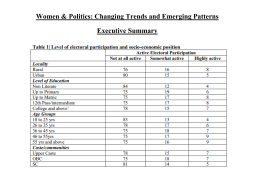
This collaborative report between, Lokniti a programme of the Centre for the Study of Developing Societies and Konrad Adenauer Stiftung has attempted to look at women and politics from a multi-track perspective. While the assessment relied quite extensively on existing aggregate data on the theme and an exhaustive review of literature, the key focus of the analysis was the findings of a survey conducted among women across the country. The report is divided into eight chapters including the conclusion and the introduction and relies heavily on Lokniti’s survey data. Having chosen a sample of respondents that helped best mirror the larger `universe` it was meant to represent (Indian women), a range of questions on the patterns of political participation and representation were asked. The survey attempted to assess the perception of women to different dimensions of political participation and representation and the challenges in this regard. The survey findings have helped present the socio-economic and cultural context that define and decide the attitudes and perception of women to issues of political participation and representation. The varied factors that contribute to greater women’s participation in politics and the pathways to greater political representation were also assessed as part of the study. The study examines the perceptions of women to their role as voters. Their views on different dimensions of political participation and the barriers to the same are also studied. The impact of political socialization and the family are also analysed as part of the survey. Factors that influence voting decisions as well as womens’ perception of women as leaders, has also been attempted in this study.
Click here to see the academic article.