Women's Leadership

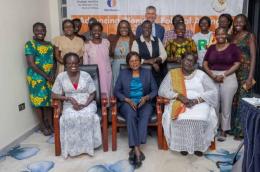
September 4, 2024 (JUBA) – The Tumaini Initiative and its mediators should adopt an inclusive, transparent, and people-centered mediation process, women leaders resolved during a round table discussion. 

The group, in a communique, extended to Sudan Tribune, urged the mediators to visit South Sudan to consult with conflict-affected communities, stakeholders, and the broader population to gather their views and experiences.

“After thorough reflection and thought-provoking discussions, we agree upon and put forward the following key priority areas, as well as corresponding recommendations that call for an inclusive and holistic approach to addressing the challenges faced by South Sudanese women and girls,” it reads in part.

 Represented by 16 different organizations, the coalition urged the government of South Sudan to expedite the adoption of the National Action Plan (NAP) 2020-2025 and allocate sufficient funding to the Ministry of Gender, Child, and Social Welfare to support its implementation.

 All political parties, it noted, should adhere to the 35% affirmative action policy for women by appointing more women to leadership positions and cease the practice of replacing women in decision-making roles with men.

 “Prioritize the Tumaini Peace process and address any contradictions between the Tumaini Initiative and the R-ACRSS through political dialogue and national consensus that includes women and civil society organizations,” reads the communique.

Read here the full article published by the Sudan Tribune on 4 September 2024.

Image credits: Sudan Tribune


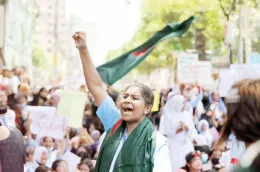
One of the most exciting features of Bangladesh’s “Monsoon Revolution” were the visuals of courageous young girls and women on the streets, their defiant chants animating fierce feminist organizing and the individual and collective acts of rebellion of women against a powerful fascist regime.

They appealed to our conscience as daughters, sisters, mothers, and citizens, enabling us to overcome our fear of the unknown and leave our “natural domain” of the home to engage with the outside world of politics and public debate.

Indeed, the student-led uprising would not have been successful if ordinary girls and women had not mobilized in the public and private sphere to inform and shape public debate and shift public opinion.

Yet, as we celebrate the one month anniversary of the incredible achievements of the student-led uprising, the absence of women from political spaces driving the reformation agenda and in leadership positions in public office is alarming. 

From the scattered presence of women in the interim government’s meetings to their limited inclusion in leadership positions in the chief adviser’s office and cabinet, women have been strikingly relegated to the backseat of the reformation process.

How did the face of the students' platform on anti-discrimination post August 5 become largely male? The masculine nature of the leadership, debate, and deliberations that excludes or limits participation of women in all their diversity undermines the revolutionary promise of the uprising and limits the possibilities of imagining an inclusive future.

Read here the full article published by Dhaka Tribune.on 6 September 2024.

Image credits: Dhaka Tribune


True progress for women is not merely about breaking barriers but fundamentally transforming the structures that have long hindered their advancement. Nowhere is this transformation more critical than in the realm of electoral politics, where Indian women face significant under-representation and systemic obstacles. Despite some strides in recent years, India’s position in global rankings of female political representation remains dismal, highlighting the urgent need for comprehensive reform and active measures to create a more inclusive and equitable political environment.

Current State of Women in Indian Politics: India, with its vast population and diverse demographics, ranks a troubling 143rd in the monthly ranking of women in Parliament compiled by the Inter-Parliamentary Union’s Parline, out of approximately 180 countries. This places India alongside nations such as Congo, Botswana, and Jordan, underscoring a significant disparity between the potential and the reality of women’s political representation.

In recent general elections, female voter engagement has shown a steady increase. However, this has not translated into a proportional rise in successful female candidates. Out of 543 Lok Sabha constituencies, only 74 women candidates emerged victorious in the latest elections, resulting in a strike rate of 9.3%. This figure is a decline from the 11.7% strike rate observed in 2019 and a stark contrast to the 48.6% strike rate in 1962, when 74 women contested and 36 won. Despite over 790 women contesting this year, the number of women hopefuls remains significantly lower across all parties and independent candidates, freezing the level of female representation for another five years. This stagnation will inevitably impact debates, policy-making, and the presence of women in crucial decision-making positions.

Read here the full article published by The Sentinel on 7 September 2024.

Image credits: The Sentinel


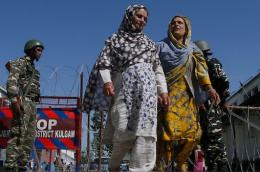
The political landscape of Jammu and Kashmir presents a unique set of challenges for women’s empowerment. Historically, the representation of women in political roles in the region has been limited. Before the 1972 elections, political arenas were predominantly male dominated, with no female candidates successfully securing seats. The 1972 elections marked the beginning of female political participation, though the success rate of female candidates remained minimal. Subsequent elections, including those in 1977, saw a slight increase in female candidates, but their success remained low. The 1983 elections showed a marginal rise in female candidates, yet their representation was still limited.

By 2002, women occupied just 8 per cent of the seats in the Jammu and Kashmir Legislative Assembly, highlighting only modest progress. The year 2011 saw a rise in female candidates for panchayats, but women’s representation in higher positions, such as sarpanchs, remains limited. The 2011 Panchayati Raj Act mandated the reservation of one-third of seats for women in panchayats leading to a notable increase in female panches. However, women’s representation in higher positions like sarpanchs remains limited. [...]

Cultural norms and traditional gender roles

Cultural norms and traditional gender roles significantly influence women’s political participation in Jammu and Kashmir. Traditional roles often confine women to domestic responsibilities, restricting their time and energy for political activities. A 2023 study by the Centre for Social Research found that societal expectations still place women in secondary roles, with many feeling that politics is not an appropriate field for them. The perception of politics as a corrupt and dangerous sphere further discourages women from participating, as revealed by a 2019 survey by the Jammu and Kashmir State Election Commission, where 60 per cent of women voters expressed disillusionment with the political process due to corruption and violence. Societal attitudes favouring male leadership contribute to women’s underrepresentation, with traditional norms often hindering their electoral success. Despite an increase in female candidates in the 2011 Panchayat elections, women remain significantly underrepresented in leadership positions.

Read here the full article published by the First Post on 5 September 2024.

Image credits: First Post


In a statement issued on Thursday, August 29, 2024, the Minister for Gender, Children, and Social Protection, Dakoa Newman, expressed concern over the persistent harassment, discrimination, and violence directed at female politicians, candidates, and activists.

The Ministry noted that recent reports indicate that women in politics are subjected to high levels of verbal abuse, threats, and cyberbullying, impacting both their personal lives and professional reputations.

This hostile environment, she noted, discourages many women from engaging in public service.

The Ministry emphasised that despite the principle of equal representation requiring the participation of both men and women in decision-making processes, women remain underrepresented in Ghana’s political and economic sectors.

'In 2012, only 30 out of 275 Members of Parliament (MPs) were women, representing 10.9%. The 2016 elections saw this figure rise to 36 women MPs (13.1%), and the elections recorded 40 female MPs (14.5%)''. The ministry in a statement added.

''As a leading advocate for social justice and gender equality, the Ministry is committed to advancing practices and policies that are inclusive, through public education, advocacy and research.''

Read here the full article published by Graphic Online on 5 September 2024.

Credits: Graphic Online


This paper is part of a Gender Briefing Series to support women’s meaningful participation and the integration of gender perspectives in peace processes that aim to end violent intrastate conflict. The key target audience of these series of papers is women, gender equality advocates, and others engaged in peace processes, who wish to influence negotiations with a view to:

  • addressing the particular experiences of women during conflict, and
  • achieving lasting peace process outcomes that will improve women’s lives and the lives of those around them.

This brief sets out the various contexts in which different forms of political power-sharing are established in peace agreements. It indicates the challenges for women but also for other groups who are not at the centre of conflict, who may be useful allies in any struggle for greater inclusion.

Click here to see the paper Women and political power - sharing in peace processes.   

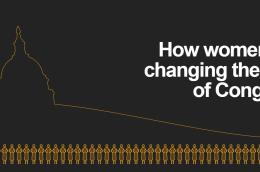
History will be made in America on 3 January when a record number of women are sworn in as part of the 116th Congress.

It will be the culmination of two years of resistance to President Donald Trump - primarily led by women - following his unexpected victory over Hillary Clinton in 2016.

The day after his inauguration, millions of women joined protests against him across the country.

As the mid-term elections approached, Democrats saw a surge of women who wanted to represent the party - a stark contrast to previous years when they appeared reluctant to enter politics.

This led to suggestions that 2018 could become another “Year of the Woman” - a reference to the 1992 elections in which the number of women in Congress nearly doubled.

That jump 26 years ago was put down to a controversy over claims of sexual assault against a Supreme Court nominee - a situation similar to the case of Brett Kavanaugh in 2018.

Here's how the mid-term results have changed the make-up of Congress and a look at some of the women leading that change.

Click here to see the BBC report.

As the world becomes increasingly connected online, our reliance on social media platforms such as Twitter has also become increasingly important. But the online world, and social media platforms like Twitter are not immune to many of the human rights abuses that women face offline.

Over the last 16 months, Amnesty International has conducted qualitative and quantitative research about women’s experiences on social media platforms including the scale, nature and impact of violence and abuse directed towards women on Twitter, with a particular focus on the United Kingdom (UK) and the United States of America (USA). Such abuse includes direct or indirect threats of physical or sexual violence, discriminatory abuse targeting one or more aspects of a woman’s identity, targeted harassment, and privacy violations such as doxing or sharing sexual or intimate images of a woman without her consent.

(…) Many of the women who spoke to Amnesty International about the violence and abuse they experience on Twitter emphasized how important the platform is to them – both professionally and personally. Women rely on social media platforms like Twitter to advocate, communicate, mobilize, access information and gain visibility.

Pamela Merritt, a US blogger and reproductive rights activist, told us,

“I am a bit of a Twitter addict. I wake up, I check Twitter. I have two cups of coffee, and I check it again. Being online is important for my work. I want to know what’s going on. I want to know what people are saying and I want to weigh in, so I’m on Twitter through the day”.

Seyi Akiwowo, UK Politician and activist, talked about how Twitter makes her feel part of a movement and ‘puts words to her experiences’ of being a woman of colour. She told us,

“I feel torn. I love Twitter. The platform has connected me to people I will probably never see in my entire life and they are amazing, successful and inspirational people. There is now a massive movement of women of colour online. We express our beauty and confidence and talk about self-care and intersectional inequality…and so some of my life changing moments and development into womanhood has happened because of and via Twitter. I remember finding my first international job through Twitter. The possibilities and opportunities on that platform are endless.”

(…) Politicians themselves agree. Scottish Parliamentarian and Leader of the Opposition, Ruth Davidson, emphasized how important Twitter is as a tool to communicate and listen to her constituents and the wider public. She notes.

“Social media platforms are where a lot of political debate now happens, particularly as we see the divide in age range of voters. For a lot of younger voters, actually – they don’t want to be told things – they want to be able to discuss them.”

Click here to see the report.

Gender parity is fundamental to whether and how economies and societies thrive. Ensuring the full development and appropriate deployment of half of the world’s total talent pool has a vast bearing on the growth, competitiveness and future-readiness of economies and businesses worldwide. The Global Gender Gap Report benchmarks 149 countries on their progress towards gender parity across four thematic dimensions: Economic Participation and Opportunity, Educational Attainment, Health and Survival, and Political Empowerment. In addition, this year’s edition studies skills gender gaps related to Artificial Intelligence (AI).

Click here to see the report.

El artículo presenta evidencia actualizada sobre la brecha de género en la implicación, el cono- cimiento y la participación política en España y en perspectiva comparada. Los resultados muestran que mientras que la brecha de género ha disminuido hasta casi desaparecer para el caso de la participa- ción política, sigue siendo importante respecto al conocimiento, la implicación con la política, y la creencia en la propia capacidad para entender cómo funciona la vida política. Se discuten los factores explicativos de estos hallazgos, incidiendo en la importancia de la socialización en roles de género y el predominio de la idea de que la política sigue siendo cosa de hombres.

Haga clic aquí para acceder al informe. 

The Reykjavik Index for Leadership measures how people feel about women in leadership. It measures the perceived legitimacy of male and female leadership in politics and across twenty professions, as well as a measure of how men and women differ in their views, and the extent to which men and women are viewed equally in terms of suitability of individuals for positions of power.

The Index evaluates the G7 groups of nations, surveying the attitudes of more than 10,000 people.

Click here to see the report.