Women's Leadership

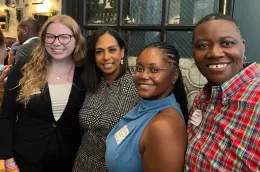
The struggle for gender parity in politics is far from over, but this week I felt a surge of hope for the future. This optimism stems not only from the increasing prominence of women in political leadership, exemplified by the potential for a woman to win the 2024 presidential election but also from a powerful gathering I attended on Tuesday.

Organized by RepresentWomen and Vote Run Lead, the luncheon was held as an ancillary event to the Democratic National Convention. "Women are the Winning Strategy: Solutions from the States" featured influential speakers such as Rep. Barbara Lee (D-Calif.) and policy advocate Maya Harris, along with women leaders from across the country.

The gathering not only highlighted the critical role of women in shaping the political landscape but also provided a fertile ground for fostering female leadership and activism.

A shared mission

RepresentWomen and Vote Run Lead are united in their commitment to dismantling the barriers that have historically hindered women's participation in politics.

RepresentWomen focuses on structural reforms, including ranked-choice voting and gender quotas, aiming to create a political environment where women can thrive. Vote Run Lead complements this mission by offering training and resources to women aspiring to run for office, equipping them with the skills needed to navigate and succeed in political campaigns.

The synergy between these two organizations is a powerful force in the movement for gender parity. RepresentWomen tackles the systemic issues that keep women out of politics, while Vote Run Lead empowers individual women to step into the political arena with confidence and competence. Together, they are not just advocating for change — they are actively creating it.

Read here the full article published by The Fulcrum on 23 August 2024.

Image by The Fulcrum


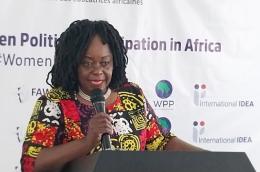
Women aspiring to contest for various political seats in the country have been advised to shadow leaders holding similar positions for mentorship.

Suba North MP Millie Odhiambo said this will protect them from campaigns and election shocks.

“You need to follow and closely watch an MP or a person holding a similar position you want to vie for. If you want to go for governorship, shadow a governor and if you want to contest for MCA, shadow an MCA,” she said.

Odhiambo spoke on the sidelines of an intergenerational women mentorship workshop in Machakos county on Friday.

“I say this because we have over-glamourised politics in Kenya. Politics is a selfless service,” Odhiambo said.

The capacity building forum was organised by Forum for African Women Educationists.

Odhiambo, who was accompanied by Dagoretti North MP, Beatrice Elachi and nominated MP Irene Mayaka, mentored 30 women on leadership skills.

Nominated senators Beth Syengo and Crystal Asige also spoke to the women.

Read here the full article published by The Star Kenya on 18 August 2024.

Image by The Star Kenya
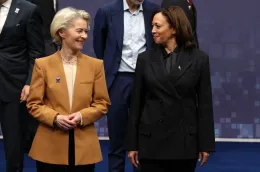
 

Last month several women rose to the top echelons of international politics. Kamala Harris emerged as the lead presidential candidate of the U.S. Democratic Party, Ursula von der Leyen was elected to serve a second term as president of the European Commission, Kaja Kallas was appointed foreign policy chief of the European Union (EU), and Rachel Reeves became Britain’s first female chancellor.

And yet feminists, while generally pleased, were not particularly jubilant. Every success counts, they say, particularly if Harris becomes the U.S. president and acquires the most influential political office in the world. But there’s little reason to think that the arrival of a few women in top positions will change how international affairs are conducted in a male-dominated world.

According to the United Nations (U.N.), at the current rate it will take nearly a century and a half to achieve gender equality in the highest positions of power and almost four more decades to achieve gender parity in national legislative bodies. There are simply not enough women in top jobs to give the concerted, collected push needed to implement a feminist foreign policy and usher in the radically different global order that feminist intellectuals desire.

Read here the full article published by Foreign Policy on 12 August 2024.

Image by Foreign Policy


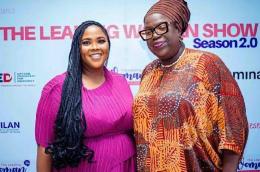
In a deliberate effort to encourage more women to pursue leadership roles, WILAN Global is set to launch a documentary on women, who contested elections into various offices in Nigeria’s 2023 general elections.

The documentary, which premieres on Channels Television on August 31, will delve into the compelling stories of women who participated in the last general elections.

Titled, ‘Her fight, our future: Women in Nigeria Politics,’ the insightful documentary captures their journeys, highlighting their struggles, joy and pains as they navigate the political landscape. The documentary provides an intimate look at the experiences of the courageous women, shedding light on the challenges they faced and the triumphs they achieved.

It also aims at inspiring future generations of women leaders by showcasing the resilience and determination of those who dared to make a difference in Nigeria’s political arena.

The founder and executive director, Abosede George-Ogan, expressed excitement about the documentary.

“We are thrilled to bring these powerful stories to the forefront. This documentary is not just about politics; it’s about the strength, passion, and unwavering spirit of women who stepped into the political spotlight to create change. Their experiences are a testament to the impact women can have in shaping the future of our nation,” she enthused.

Read here the full article published by The Sun on 11 August 2024.

Image by The Sun


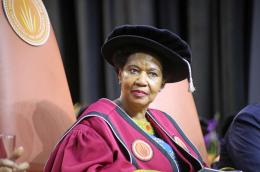
Globally, history has shown that politics is predominantly male dominated, where women were not expected to hold significant political views or opinions. This reality is also evident in Africa, where men occupy most major political positions in African countries.

However, in South Africa, the political landscape has evolved significantly toward greater inclusivity since the end of Apartheid.

While there have been advancements in terms of inclusivity, women are still under-represented in nearly all major political parties and top positions in South Africa, perpetuating gender inequalities across various sectors of the country.

Increasing women’s participation in politics will help address and advocate for women’s rights, challenge gender stereotypes, and promote gender equality.

There is a common misconception that women are incapable of effective leadership due to perceived weaknesses in decision-making, leading to unreliable outcomes.

However, women’s political participation is crucial for a healthy democracy, and it is time for women to step up and claim their rightful place in the political arena. Women in politics can also serve as role models for young girls, inspiring them to aspire to leadership positions.

Factors such as age, education level, influence, financial strength, and access to health facilities encourage women to engage fully in political activities. Conversely, illiteracy, lack of capital, and discouragement from spouses, among others, can hinder women’s political participation.

Read here the full article published by The African on 9 August 2024.

Image by The African


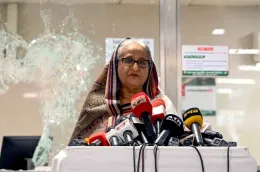
Bangladesh’s Prime Minister Sheikh Hasina has reportedly resigned and fled the country in the face of ongoing protests.

The longtime leader of the country has boarded a military helicopter, an aide told Al Jazeera, after crowds ignored a national curfew to storm the prime minister’s palace in Dhaka.

Close to 300 people have died amid weeks of protest the authorities have sought to crush. Following a night of deadly violence that killed close to 100 on Sunday, tension had remained high on Monday as protesters called for a march on Dhaka and the army prepared to address the nation.

By early afternoon, however, media reported that the mood on the streets had turned to one of celebration after the news of Hasina’s departure spread.

Chief of Army Staff General Waker-Uz-Zaman has cancelled his planned address and is instead holding talks with major political parties, including the opposition Bangladesh Nationalist Party (BNP).

Images on national television showed thousands of people breaking into the prime minister’s official residence. It also showed large crowds of protesters out in the street in scenes of jubilation as the news of the departure of Hasina started spreading.

Al Jazeera’s Tanvir Chowdhury, reporting from Shahbag Square – the epicentre of the student protesters – said he has “never witnessed something like this” in the capital.

Read here the full article published by Aljazeera on 5 August 2024.

Image by Aljazeera


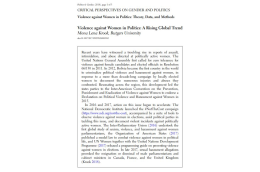
Recent years have witnessed a troubling rise in reports of assault, intimidation, and abuse directed at politically active women. The United Nations General Assembly first called for zero tolerance for violence against female candidates and elected officials in Resolution 66/130 in 2011. In 2012, Bolivia became the first country in the world to criminalize political violence and harassment against women, in response to a more than decade-long campaign by locally elected women to document the numerous injuries and abuses they confronted. Resonating across the region, this development led the states parties to the Inter-American Convention on the Prevention, Punishment and Eradication of Violence against Women to endorse a Declaration on Political Violence and Harassment against Women in 2015.

Click here to see the academic article.

Latin America has been at the vanguard in implementing diverse strategies to combat violence against women in politics (VAWIP). In 2012, Bolivia became the first country to criminalize “political violence and harassment against women” with Law 243. Soon, Ecuador, Peru, Costa Rica, and Mexico followed with similar proposals (Krook and Restrepo Sanín 2016). Despite high levels of criminal impunity (Piscopo 2016), legislative measures have been the preferred strategy to combat VAWIP within the region. The Inter-American Commission on Women (CIM) recently published a model law, drawing on experiences in Bolivia, to serve as inspiration for other legislative measures in the region. What can these legislative definitions tell us about the phenomenon of VAWIP, its limits, and its challenges?

Click here to see the academic article.

Violence against women in politics (VAWP) is a human rights violation, as it prevents the realization of political rights. Violence against women in political and public life can be understood as “any act or threat of gender-based violence, resulting in physical, sexual, psychological harm or suffering to women, that prevents them from exercising and realizing their political rights, whether in public or private spaces, including the right to vote and hold public office, to vote in secret and to freely campaign, to associate and assemble, and to enjoy freedom of opinion and expression” (UN Women/UNDP 2017, 20).

Although awareness of the gravity and increasing levels of VAWP is growing, the issue is a relatively new area of investigation, with no global statistics or measurements available on prevalence or incidence, a lack of commonly agreed definitions and indicators, a reliance on anecdotal evidence, and underreporting because of the stigma attached to genderbased violence in many societies. The absence of commonly agreed definitions and methodologies for measuring VAWP is a barrier to the advancement of research, monitoring, and policy and programming responses in this field. Are agreed indicators and methodologies for measuring VAWP necessary? How can consistency across different measurement approaches be ensured? This essay examines the extent to which VAWP is measured, identifying gaps in current violence against women (VAW) measurements and considering new opportunities for measuring and monitoring VAWP.

Click here to see the academic article.

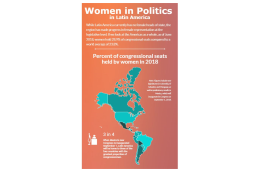
Four years ago, Latin America was home to a third of the world’s female presidents. Today, it has none. But that doesn’t mean the region hasn’t made progress in advancing women’s role in the political sphere. In fact, as of the inauguration of Colombia’s new administration on August 7, there are more female vice presidents—in 12 different countries—in the hemisphere than ever before.

Latin America is also moving ahead when it comes to balancing the male-to-female ratio in legislative branches. The Inter-Parliamentary Union’s last update on June 1, registered that 28.9 percent of all congressional seats in the region were occupied by women, an increase of 3.7 percent since January 2014, and 5.1 percent above today’s global average. When Mexico’s new Congress is inaugurated on September 1, Latin America will be home to three of the four countries with the greatest proportion of congresswomen.

Click here to see the full Infographic.

Two years after Hillary Clinton became the first woman to win the presidential nomination of a major U.S. political party, and with a record number of women running for Congress in 2018, a majority of Americans say they would like to see more women in top leadership positions – not only in politics, but also in the corporate world – according to a new Pew Research Center survey. But most say men still have an easier path to the top and that women have to do more to prove their worth. And the public is skeptical that the country will ever achieve gender parity in politics or in business.

Republicans and Democrats have widely different views about where things stand today and what factors are holding women back. Democrats and Democratic-leaning independents are more than twice as likely as Republicans and those who lean Republican to say there are too few women in high political offices (79% vs. 33%). And while 64% of Democrats say gender discrimination is a major reason why women are underrepresented in these positions, only 30% of Republicans agree.

There are also wide gender gaps in views about women in leadership. About seven-in-ten women say there are too few women in high political offices and in top executive business positions; about half of men say the same.

Click here to see the report.

This report reflects discussions held during the May 2018 Expert Group Meeting hosted by UN Women on women’s meaningful participation in negotiating peace and the implementation of peace agreements. The meeting included some 50 experts from a diverse range of countries and contexts, including Bosnia, Colombia, Kenya, Kosovo (under UNSCR 1244), Georgia, Mozambique, Myanmar, Philippines, South Sudan, Syria, and Yemen.

The report highlights how far the international community and Member States have come in advancing women’s meaningful participation in conflict resolution since the adoption of UN Security Council resolution 1325 (2000). The report highlights the aims and outcomes of the convening, which included:

  • the exchange of current research and good practice on women’s representation and “meaningful” participation in peace processes;
  • the exploration of the concept of “meaningful participation”—what it includes and how the United Nations, Member States, civil society, and other relevant actors can best effectively advocate for it and consistently operationalize it;
  • discussion of the barriers to women’s meaningful participation; and
  • assessment of the trends and challenges in gender-responsive provisions of peace agreements and their implementation.

The report includes a menu of actions for relevant actors and recommendations that reflect on nearly 20 years of implementation of the women, peace, and security agenda.

Click here to see the report.