Women's Leadership
India, the world’s largest democracy, has made significant strides in women’s political participation since its independence in 1947. However, a substantial gender gap persists in Indian politics, reflecting deeper societal inequalities and cultural barriers. This article examines the current state of women’s representation in Indian politics, the progress made so far, and the challenges that continue to hinder gender parity in the political sphere.
Current State of Women’s Representation:
While women constitute nearly 50% of India’s population, their representation in political bodies falls far short of this proportion. As of 2024, women make up approximately 15% of the Lok Sabha (the lower house of parliament) and 14% of the Rajya Sabha (the upper house). At the state level, women’s representation in legislative assemblies averages around 9%. These figures, though gradually improving, highlight the significant underrepresentation of women in Indian politics.
Read here the full article published by Odishabarta on 27 June 2024.
Image by Odishabarta
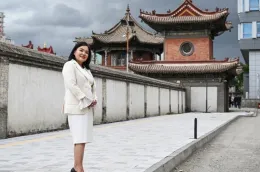
Mongolians go to the polls in parliamentary elections on Friday, with the ruling Mongolian People's Party widely expected to retain a majority it has held for eight years.
But for the first time in almost a decade, parties are required by law to ensure that 30 percent of their candidates are women, in a country where politics is overwhelmingly dominated by men.
As a result, more women than ever before are running this year, in a new voting system that balances proportional lists with district candidates elected directly by the people.
"The era we are living in demands the quota," Dorjzodov Enkhtuya, a 51-year-old former TV anchor running for the main opposition Democratic Party, told AFP in capital city Ulaanbaatar.
"There are almost no women in decision-making positions," she said.
"We are changing the game."
Read here the full article published by France 24 on 27 June 2024.
Image by France 24
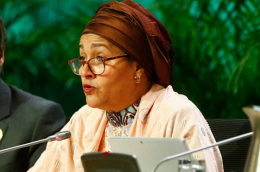
A lack of women at decision-making tables around the world is hindering progress when it comes to tackling conflicts or improving health and standard of living, the highest ranking woman in the UN has said.
“We’re half the population. And what we bring to the table is incredibly important and it’s missing,” said Amina Mohammed, the United Nations deputy secretary general. “I think it’s why mostly our human development indices are so bad, why we have so many conflicts and we’re unable to come out of the conflicts.”
Since her appointment in 2017, Mohammed has been a constant voice in pushing back against the under-representation of women in politics, diplomacy and even the UN general assembly. Her efforts have helped cast a spotlight on the fact that women remain relegated to the margins of power around the world; last year the global proportion of female lawmakers stood at 26.9%, according to Switzerland’s Inter-Parliamentary Union.
Speaking to the Guardian, Mohammed said “flexing muscle and testosterone” often dominated at tables of power around the world.
“This win, win, win at all costs – I think that would change if women were at the table,” she said.
Read here the full article published by The Guardian on 19 June 2024.
Image by The Guardian
¨Global comparable data on women in cabinet positions, in the latest Global Gender Gap Report 2024, shows limited gains towards equal participation.
¨Most countries are far from reaching gender parity in cabinet positions, but global trends towards more inclusive cabinets can be accelerated.
¨Women ministers are leading in areas like human rights and gender equality, but remain a minority in areas such as defence, justice and home affairs.
Global data gaps on women in political decision-making positions are being closed, providing much needed evidence to assess countries’ progress toward gender equality. Most recently, the measurement of women’s representation in cabinet positions was strengthened by UN Women by defining clear and transparent criteria for global comparisons, based on agreed concepts, mapping of legislative frameworks on cabinet compositions in all countries, and expert technical meetings. These criteria are practical to implement and reduce the space for interpretation of what needs to be measured, thus ensuring feasibility, reliability, comparability and quality of the global data.
Read here the full article published by the World Economic Forum on 24 June 2024.
Image by WEF
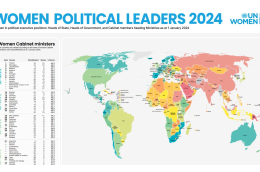
This poster presents global data on women in executive positions as Heads of State, Heads of Government, and Cabinet members heading Ministries. Data indicate that women are underrepresented at all levels of executive decision-making worldwide, and achieving gender parity in political life remains a distant goal.
Only 26 countries are led by a woman, a modest increase from just 18 countries a decade ago. Women represent 23.3 per cent of Cabinet members heading Ministries in 2024—a less than 0.5 percentage point increase from 2023—and continue to primarily lead portfolios related to women and gender equality, family and children affairs, social affairs, and indigenous and minority affairs. Policy domains such as economic affairs, defence, justice, and home affairs, continue to be dominated by men.
Click here to see the full poster published by UN Women on June 2024.
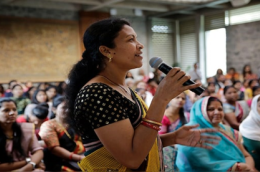
India recently concluded its 2024 general elections, which took place in seven phases—from April 19 to June 1—to elect all 543 members of the Lok Sabha (lower house). While the results have taken many by surprise, what has been even more astonishing is the fact that for a country that has rigorously been trying to establish a more progressive front on women’s rights and gender equality over the past few years, the new Indian parliament has failed to showcase a notable uptick in the representation of women after the latest elections.
Making just 13.63 per cent of the elected strength, the 18th Lok Sabha will comprise only 74 women compared to 469 men. This share is not only abysmally skewed but also lower than the 14.4 per cent share of female representation during the 2019 election, where 78 women were elected as MPs.
The irony here is that just last year, India—during its G20 presidency—brought about a paradigm shift in gender-based policymaking by challenging the status quo and with the innovative idea of women-led development in order to ensure women’s inclusion and representation at all levels of decision-making.
Even at the domestic level, India—after many deliberations—finally passed the historic Women’s Reservation Bill in 2023, which seeks to reserve one-third of the seats in the Lok Sabha and state legislative assemblies for women.
Read here the full article published by the First Post on 20 June 2024.
Image by First Post
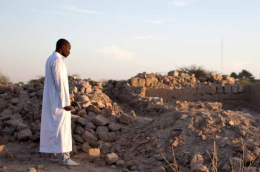
With a special attention to gender, this four-year regional development project is designed to strengthen the development responses to mitigate the growth of violent extremism in Africa.
This focus is motivated by the ever-increasing presence of violent extremist groups on African soil. Violent extremism is having a devastating impact on the lives and livelihoods of populations across the continent - particularly the most vulnerable, and including youth, women and children.
The Independent Commission on Multilateralism (ICM) is a project of the International Peace Institute (IPI). It asks: How can the UN-based multilateral system be made more “fit for purpose”? In answering that question, the ICM has analyzed fifteen topics. These include armed conflict, humanitarian engagements, sustainable development, and global public health, among others (see complete list in Annex 2). The goal of the ICM is to make specific recommendations on how the UN and its member states can improve responses to current challenges and opportunities. The ICM undertook simultaneous tracks of research and consultation for each issue area on its agenda. The Commission initially launched in New York in September 2014, followed by subsequent launches in Vienna, Geneva, and Ottawa. In February 2015, the ICM briefed delegates from the five UN Regional Groups in New York. The Commission also convened meetings with Ambassadorial and Ministerial Boards in New York, Vienna, and Geneva. Global outreach included briefings to officials in Addis Ababa, Berlin, Brasilia, Copenhagen, New Delhi, London, Madrid, Montevideo, and Rome. Civil society and private sector outreach and engagement also constituted an important component of the ICM’s consultative process, including a briefing specifically for civil society in June 2015. The research process began with a short “issue paper” highlighting core debates and questions on each of the fifteen topics. Each issue paper was discussed at a retreat bringing together thirty to thirty-five member state representatives, UN officials, experts, academics, and representatives from civil society and the private sector. Based on the inputs gathered at the retreats, each issue paper was then revised and expanded into a “discussion paper.” Each of these was uploaded to the ICM website for comment and feedback, revised accordingly, and presented at a public consultation. The public consultations were webcast live on the ICM’s website to allow a broader audience to take part in the discussions. This paper is one of the fifteen final “policy papers” that emerged from this consultative process. An overview of participation in consultations on this specific issue area is included in Annex 3. The recommendations from all the policy papers are summarized in the ICM’s September 2016 report “Pulling Together: The Multilateral System and Its Future.” The ICM thanks the three sponsoring governments for their financial support for its operations: Canada, Norway, and the United Arab Emirates. Without their support, the ICM would not have been possible.
Like many countries around the world, the Hashemite Kingdom of Jordan faces risks from “violent radicalization,” often defined as a process through which a person comes to embrace the use of violence to serve an ideology, religion or political goal. Violent radicalization may lead to violent extremism and terrorism, therefore threatening the rights and well-being of citizens. The ways in which violent extremism affects women—both as victims and participants—are rarely discussed and remain underexplored. As Jordan moves toward taking new efforts to combat violent extremism within its borders, it is necessary for all involved to have a deeper understanding of how women in Jordan play roles in preventing or promoting such radicalization.
2015 was UN Women’s fifth year. As we marked this milestone, the United Nations celebrated 70 years of fostering human rights, and governments and civil society assessed 15 years of implementation of the Beijing Platform for Action, and of Security Council resolution 1325 on Women, Peace and Security. Informed by these reviews, we looked ahead to the world we want with the Paris Agreement on climate change, and saw the transformative power of women and girls set at the heart of the 2030 Agenda for Sustainable Development.
Unexpected and transformative revolutions broke off in North Africa and quickly spread to the Middle East and the rest of the world in 2010 and 2011. Spontaneous, leaderless, youth-driven, and backed by social media, these revolutions called for karamah (dignity) and democracy. Centering on women’s movements before, during, and after the revolutions, Women’s Movements in Post-“Arab Spring” North Africa highlights the broader sources of authority that affected the emergence of new feminist actors and agents and their impact on the sociopolitical landscapes of the region. Until recently, studies of North African women’s movements have focused on single aspects of women’s achievements at a time. By providing a comparative analysis, this book for the first time sheds light not only on the role that these superstructures play in shaping women’s experiences in North Africa, but also on the rich variety of women’s responses to authority, and their potential contributions to African and global feminist thought. From the pre-history of the revolutions to their aftermath, the far-reaching historical and national scope of this collection expands the study of women’s movements in North Africa beyond national borders, while still paying close attention to local characteristics. Click here to access the book.

Gender equality is both an essential development goal in its own right and a driver of human development. International law recognizes that everyone has a right to participate in public life, but it remains an ongoing challenge to achieve women’s equal participation, especially in decision-making. The importance of advancing women’s leadership in politics has continued to gain traction. Although much remains to be done, advances are being made slowly but surely. Unfortunately, less attention and support has been given to promoting women’s leadership in public administration. In response, UNDP developed a joint research and policy development initiative titled Gender Equality in Public Administration (GEPA) to help fill this gap. This global report reflects extensive research based on available national data, and provides analysis of the obstacles in the way of women’s equal participation and decision-making in public administration. It highlights examples of approaches which can work, and offers recommendations for further action.