Women's Leadership
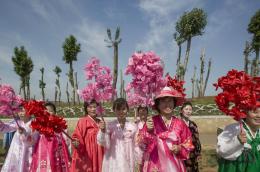
News reports over the past few years featuring Kim Jong Un’s sister, Kim Yo Jong, or his daughter, Kim Ju Ae, have led to speculation about a future North Korea ruled by a woman. This is an intriguing development worth monitoring, given the North Korean regime’s history of patrilineal succession. However, ordinary North Korean women may have a greater role to play in the future of the country.
These women are typically out of the spotlight but always present in the background, working for the Kaesong Industrial Complex, applauding Kim Jong Un or his military parade with flowers, or dancing to songs in front of respected guests. They have never received significant attention, but they might have the potential to empower themselves and create positive dynamics in contemporary North Korea. Accordingly, the international community should focus specifically on increasing those women’s access to opportunities and resources and their ability to effect change in North Korean society through various multilateral engagements.
Read here the full article published by the United States Institute of Peace on 28 May 2024.
Image by United States Institute of Peace
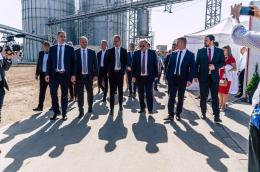
In the last five-year term, both the proportion of women in the European Parliament and in relevant positions in European institutions have improved significantly. In contrast, the Hungarian government hold a negative record for the participation of female ministers: there are none. Hungary is also last in the EU when it comes to the percentage of women in parliament.
Hungary came last on yet another EU list, this time it has become the leader in the ratio of women ministers and MEPs, in the wrong way. After the resignation of Judit Varga, not only Hungary has the lowest proportion of female ministers in Europe, but this figure is simply 0 percent, as it has no female ministers at all.
For voters familiar with the reality of Hungarian politics, this is probably not an outlier: even before the Fidesz government, the proportion of female ministers in Hungary was never above 30%, and there were occasional periods, such as in 2009, when there were no female ministers. In the first quarter of 2024, Hungary also came last in the EU in terms of female representatives in the national parliament, with 14.1%, just behind Cyprus with 14.3%.
Also, the proportion of Hungarian female MEPs in the European Parliament is 38.1%, barely below the European average of 39.4%. In this article, we focus on how many women are elected, the number of those in prominent positions, and why there are so few of them.
Read here the full article published by the European Data Journalism Network on 24 May 2024.
Image by European Data Journalism Network
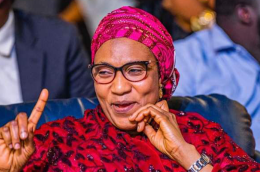
Nana Shettima, wife of Vice-President Kashim Shettima and other stakeholders, says political equity and women’s empowerment are crucial to sustainable development in Nigeria.
They stated this at the Women of Worth Group Global Magazine unveiling and Award Dinner in Abuja.
Ms Shettima said Nigerian women had faced numerous challenges yet were relentless in achieving their dreams.
She said, “I encourage you women to continue to be strong and to strive to succeed in all you do because you hold the key to national development.
“I urge you to carry everyone along regardless of religion and ethnicity, strive to create inclusion in all you do and work together as one, encouraging each other to be better.
“I commend the initiative of the Women of Worth Global Group. This is a major milestone in promoting women and giving them hope in politics and all spheres of life.’’
The keynote speaker, a humanitarian and politician Amina Farouk, said that although women were more than half of Nigeria’s population, lamenting, ”their political participation has been regressing over time.”
Read here the full article published by Peoples Gazette on 26 May 2024.
Image by Peoples Gazette
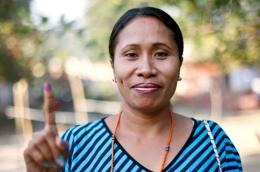
From the local to the global level, women’s leadership and political participation are restricted. Women are underrepresented as voters, as well as in leading positions, whether in elected office, the civil service, the private sector or academia. This occurs despite their proven abilities as leaders and agents of change, and their right to participate equally in democratic governance.
Women face several obstacles to participating in political life. Structural barriers through discriminatory laws and institutions still limit women’s options to run for office. Capacity gaps mean women are less likely than men to have the education, contacts and resources needed to become effective leaders.
As the 2011 UN General Assembly resolution on women’s political participation notes, “Women in every part of the world continue to be largely marginalized from the political sphere, often as a result of discriminatory laws, practices, attitudes and gender stereotypes, low levels of education, lack of access to health care and the disproportionate effect of poverty on women.”
Individual women have overcome these obstacles with great acclaim, and often to the benefit of society at large. But for women as a whole, the playing field needs to be level, opening opportunities for all.
Read here the full article published by UN Women on 27 May 2024.
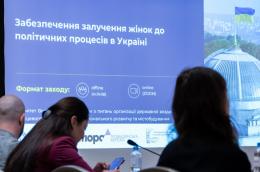
On 20 May 2024, a round table on "Ensuring women’s engagement in political processes in Ukraine" was held in Kyiv.
The round table discussion was focused on the issues of common strategy towards supporting active women participation in political process, ensuring guarantees for the exercise of electoral rights by women in view of the challenges caused by the military aggression of the Russian Federation, as well as strengthening the legal framework for the provision and effective enforcement of gender quota in electoral lists, and other issues.
The round table discussion was attended by more than 50 participants, including members and representatives of the Parliament of Ukraine, Central Election Commission, other state authorities, civil society and international organizations.
During the event, amongst other, the results of the Council of Europe study "Gender equality, balanced political participation and representation of women and men in post-war public and political processes in Ukraine: challenges and perspectives" were presented and discussed, as well as the results of the strategic session, which the Council of Europe Office in Ukraine co-organised with the Central Election Commission in November 2023 on issues of needs, challenges and relevant support measures to ensure gender-balanced participation and representation of women and men in public, political and electoral processes in Ukraine in the post-war period.
The event was organised by the Ukrainian Parliamentary Committee on State Power, Local Self-Government, Regional and Urban Development in cooperation with the Civic Network “OPORA,” International Foundation for Electoral Systems and Council of Europe*.
Read here the full article published by the Council of Europe on 22 May 2024.
Image by Council of Europe
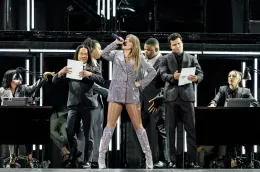
Before Donald Trump was a president, he was a television celebrity and high-profile real estate mogul. His political experience, or lack thereof, was touted on the campaign trail eight years ago as a fresh presence in Washington.
A few other men have garnered celebrity status before they ventured into politics. Ronald Reagan, Clint Eastwood and Arnold Schwarzenegger were all tough-guy film stars long before they ran for president, mayor and governor respectively. Al Franken got people laughing on Saturday Night Live before serving as a Minnesota Senator.
But no woman has transitioned from stardom to high public office.
To better understand why and which famous female might be able to make the shift, Suffolk University and USA Today conducted an exclusive poll earlier this month of 1,000 likely voters.
Three celebrity women would win the backing of nearly 30% of those polled: TV personality Oprah Winfrey, actor Sandra Bullock and 23-time Grand Slam champion Serena Williams. Actresses Viola Davis and Julia Roberts and comedian Tina Fey each earned the support of about a quarter of those surveyed, with Whoopi Goldberg, Jodie Foster and Rachel Maddow not too far behind.
Read here the full article published by USA Today on 22 May 2024.
Image by USA Today

The Jordanian National Commission for Women (JNCW) drafted a National Action Plan (NAP) on United Nations Security Council resolution 1325 (2000) to advance women, peace and security on the national level. The JNCW proposed a draft for the NAP in October 2014, which then was transferred for discussion within the Government of Jordan. The United Nations Entity for Gender Equality and the Empowerment of Women (UN Women) Jordan country office produced this note, which serves as a summary of the discussions hosted by UN Women and the JNCW on issues of women, peace and security in Jordan. Two consultations were held under the framework of the Beijing+20 review and appraisal process and the high level review of the implementation of resolution 1325. The consultations targeted national actors and decision makers on issues of women, peace and security, as well as Syrian refugees living in the Za’atari refugee camp in Al Mafraq governorate. For more information, click here.

The Women in Parliaments Global Forum (WIP) will present the WIP – World Bank Study “The Female Political Career” at the Palace of Westminster, on October 20th, 2015. A panel discussion on how to increase the presence of women in parliaments and best-practice examples will follow the presentation of the study, which comes as a response to the poor presence and participation of women in politics around the world. Please visit here for further information.

Women are often dynamic leaders of change, galvanizing women and men to get involved, claim their rights, strengthen their communities and protect their planet. Their participation is fundamental to democratic governance. Yet women still have far to go towards equal representation in positions of power and leadership, whether in corporate boardrooms or presidential cabinets.
Discriminatory laws and practices hold women back, as do limits on education, income and time away from caregiving. Just over 21 per cent of parliamentarians are women, up from around 11 per cent when the Beijing Fourth World Conference on Women took place in 1995. While women have made inroads in many areas, at the current pace of change, we won’t see gender parity in governments, parliaments or peace tables until the next century.
The Beijing conference agreement, known as the Platform for Action, dubbed women in power and decision-making one of 12 critical areas of concern. It made two essential commitments to change. First, it called for measures ensuring women’s equal access to and full participation in power structures and decision-making. Political quotas or positive measures are examples of these. By reserving seats or candidacies for women, they have driven dramatic increases in the number of women leaders in some countries. Second, the Platform urged steps to increase women’s ability to participate. Training on leadership, public speaking and political campaigning, for instance, grooms women to compete, win and be good leaders who can inspire others.
Women have a right to equal participation. Once in leadership roles, they can make a difference that benefits whole societies. The Inter-Parliamentary Union has found that women politicians give more attention to social welfare and legal protections, and improve trust. Taking up the Beijing commitments and rallying around women’s leadership could accelerate progress towards equal participation—right now. We can’t wait until the next century!