Women's Leadership

It is truly disappointing that, out of 2,582 candidates who filed nomination papers for the upcoming parliamentary election, only 110 are women.
That about 4% of total candidates are women is nothing if not a sobering indictment of our political culture and the utter failure to empower, encourage, and embrace half the nation’s population as equals in leadership.
While we have long projected ourselves as a nation where women have risen to the highest political offices repeatedly and have stayed there for years, what cannot be denied is that, beyond the two prime ministers, we have largely failed to see systemic inclusion of women in our politics.
Indeed, the fact is that women remain sidelined, oftentimes even contesting as independents after being denied party nominations. That we remain a country where mainstream parties are reluctant to trust women with winnable seats shows a deep-rooted bias that is unmistakable.
What we repeatedly fail to comprehend is that such an exclusion, beyond being unjust, is ultimately self-defeating. No nation can truly prosper when half its citizens are denied meaningful participation in shaping its future.
That we continue to reject the perspectives women can bring, from their resilience to community-building to their lived experiences of inequality, is nothing if not baffling. In an increasingly volatile and complex world, their leadership is essential for tackling the crises that define our times.
Women have already proven their mettle in every sphere, and our aspirations for democracy remain incomplete without their adequate presence in political leadership. We can only hope that the nation sees this 4% representation as a collective failure, and that we can be a nation that starts recognizing the value of women as leaders and starts empowering them to shape our country’s destiny.

National Women Leaders Forum of Political Parties in Nigeria ,NWLFPPN, has called for stronger digital protection systems against Technology-Facilitated Gender-Based Violence ,TF-GBV, targeting women in politics.
The President of the group, Mrs Amina Darasimi-Bryhm, made the call during a high-level dialogue with the theme “Advancing Feminist Leadership to End Digital Violence Against Women in Politics in Abuja on Thursday.
The News Agency of Nigeria ,NAN, reports that the event, supported by the Westminster Foundation for Democracy ,WFD, was to mark the 2025 16 Days of Activism Against Gender-Based Violence ,GBV, and the 2025 International Human Rights Day.
GBV refers to any act of violence directed against an individual based on his or her gender.
It is a widespread menace that affects people of all ages and backgrounds, manifesting in various forms such as physical, sexual and psychological violence, including intimate partner abuse, trafficking and forced prostitution, considered as serious violation of human right.
NAN also reports that the 16 Days of Activism Against GBV is a United Nations’ international campaign that runs from Nov. 25, which is the International Day for the Elimination of Violence Against Women, through Dec. 10, which is the International Human Rights Day.
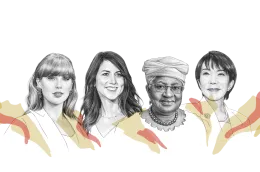
For all the setbacks for the world’s women in 2025—job losses that rival those of the pandemic, worsening toxicity of the online “manosphere,” a certain presidential rebuke directed to a female reporter that invoked a farm animal—the leaders and vanguards on the 2025 Forbes Power Women list stood as examples of resilience in turbulent times. Sanae Takaichi was elected as prime minister of Japan, becoming the first woman in history to helm the $4 trillion (GDP) nation. Billionaire philanthropist MacKenzie Scott deployed some $700 million to support historically Black colleges and universities in the U.S. AMD CEO Lisa Su struck an agreement with OpenAI to build six gigawatts of AI chips over the next several years—in a deal that could be worth tens of billions of dollars and transform the AI ecosystem. And Kim Kardashian, who has more than 350 million social media followers, partnered with Nike on NikeSkim and her brand raised money at a $5 billion valuation in 2025.
Powering massive ecosystems—from countries and commerce to education and artificial intelligence—is what the most influential women including these four women do across the globe on a daily basis. The 22nd annual Forbes list of the World's 100 Most Powerful Women was determined by four main metrics: money, media, impact and spheres of influence. For political leaders, we considered gross domestic products and populations; for corporate chiefs, revenues, valuations and employee counts were critical. Media mentions were analyzed for all.
The result: 100 women including 17 newcomers—who command a collective $37 trillion in economic power and influence more than 1 billion people.
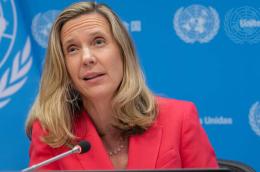
NEW YORK CITY: Twenty-five years after the adoption of UN Security Council Resolution 1325, which committed world leaders to advancing the inclusion of women in peace and security processes, a new UN report reveals a troubling reversal of progress.
While global military spending is surging and armed conflicts are intensifying, women are increasingly shut out of peace processes.
“Despite the promise and the engagement around Resolution 1325, military spending is at record levels, gender equality is under attack, and multilateralism is weakening,” said Nyaradzayi Gumbonzvanda, the deputy executive director of UN Women.
“Last year, 87 percent of peace talks took place without a single woman at the table,” she said, at a time when the world is seeing more conflicts than at any time since the Second World War, with devastating consequences for women and girls.
According to the report, nearly 700 million women and girls now live within 50 kilometers of armed conflict, the highest number since the 1990s. Civilian casualties among women and children have quadrupled over the past two years, while conflict-related sexual violence has increased by 87 percent.
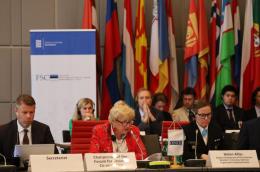
VIENNA, 18 June – The OSCE Forum for Security Co-operation placed the Women, Peace and Security agenda at the forefront of its programme today, with a dedicated Security Dialogue during the plenary session and a side-event focused on gender-responsive security.
The Security Dialogue, held under the theme “The Role of Women in Strengthening Defence and Ensuring Resilience”, brought together expert panellists from Estonia, Sweden, and France. Discussions emphasized that women’s meaningful participation enhances operational effectiveness and community trust in defence institutions. As global threats evolve—from armed conflict to cyber warfare and climate-related disasters—harnessing the full potential of women in defence is not only a matter of equity but of strategic necessity.
“Inclusive national security institutions that integrate women at all levels of society are more operationally effective, community-responsive and resilient,” said Ambassador Kaja Tael, Permanent Representative of Estonia to the OSCE and Chair of the FSC.
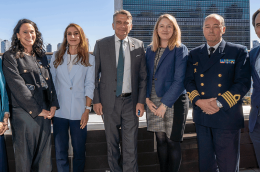
In October 2025, the UN community will mark the 25th anniversary of UN Security Council Resolution 1325, which launched the women, peace, and security (WPS) agenda. Since 2019, IPI has analyzed challenges and successes in increasing uniformed women’s meaningful participation in peace operations as part of its partnership with the Elsie Initiative for Peace Operations, contributing to a global community of practice that provides evidence-based research on gender and peacekeeping. Over the past six years, this research has explored a range of topics related to women in peace operations, highlighting gaps and offering actionable recommendations for the implementation of the WPS agenda.
IPI in partnership with the Elsie Initiative for Women in Peace Operations (led by Global Affairs Canada), the Stimson Center, the Latin American Security and Defence Network (RESDAL), and the Gender and Security Sector (GSS) Lab, cohosted a hybrid policy forum on October 9th on “Reflecting on 25 Years of the WPS Agenda: Lessons Learned from Gender Research and UN Peace Operations.
Men still dominate political decision-making in the United Kingdom. Women hold just one or two seats on prestigious select committees in the House of Commons, like Defence, Foreign Affairs, and Justice. No women sit on the Domestic and Economic Affairs cabinet committee. And 95% of all local councils have majority-men membership.
Yet voters do care about women’s leadership in elected office. My research shows that when women are absent from political decision-making, voters view governments as less legitimate.
Click here to read the full article published by the Electoral Reform Society on 21 November 2023.
Image by Electoral Reform Society
To what extent has the glass ceiling in global governance been shattered? To answer this question, we need to look beyond the numbers on women’s representation and study how far women are perceived as inspiring and visionary leaders in global governance. This article offers an analysis of perceptions of inspiring and visionary leadership in global multistakeholder initiatives from a gender perspective. Based on 467 interviews with participants in a leading multistakeholder initiative, the Internet Corporation for Assigned Names and Numbers (ICANN), it presents four findings: (1) respondents identify more men than women as inspiring and visionary leaders, with the difference roughly corresponding to the share of women in leadership roles; (2) respondents tend to ascribe more leadership attributes to women than to men when explaining why they find them inspiring and visionary; (3) both feminine and masculine leadership traits are appreciated in relation to both men and women leaders at ICANN; (4) female respondents identify more women as inspiring and visionary leaders than male respondents. These findings contribute novel insights into gendered perceptions around leadership and the importance of role models in global governance. They also shed much-needed light on the demands and expectations from leadership in global multistakeholder arrangements.
Click here to read the full report published by the Cambridge University Press on 26 October 2023.

RepresentWomen is committed to researching and identifying the best practices for increasing women’s representation in politics, drawing from evidence around the world. Part of this work leads us to closely track parliamentary elections and compare the outcomes from year to year. In 2021 and 2022, we identified 43 elections where women achieved record highs for their representation in parliament. The purpose of this analysis is to bring attention to how election rules and voting systems shape opportunities for women to enter politics.
Click here to read the full report published by RepresentWomen on 11 October 2023.

Abstract
Extensive research investigates the impact of descriptive representation on women’s political participation; yet, the underlying mechanisms remain unclear. This article develops a novel theory of descriptive representation, arguing that women politicians mobilize women’s political participation by recruiting women as grassroots party activists. Evidence from a citizen survey and the natural experiment of gender quotas in India confirm that women politicians are more likely to recruit women party activists, and citizens report greater contact with them in reserved constituencies during elections. Furthermore, with women party activists at the helm, electoral campaigns are more likely to contact women, and activist contact is positively associated with political knowledge and participation. Evidence from representative surveys of politicians and party activists and fieldwork in campaigns, further support the theory. The findings highlight the pivotal role of women’s party activism in shaping women’s political behavior, especially in contexts with pervasive clientelism and persistent gender unequal norms.
Click here to read the full article published by the Cambridge University Press on 9 October 2023.

This publication is the latest instalment in the annual series jointly produced by UN Women and UN DESA. The report provides a comprehensive analysis of gender equality progress across all 17 Sustainable Development Goals (SDGs).
Halfway to the end point of the 2030 Agenda for Sustainable Development, the world is failing to achieve gender equality, making it an increasingly distant goal. If current trends continue, more than 340 million women and girls will still live in extreme poverty by 2030, and close to one in four will experience moderate or severe food insecurity.
Click here to read the full article published by UN Women on 8 September 2023.

There is a fast-growing body of literature on women’s political representation in Africa—a continent that often challenges the existing beliefs and common understandings of women’s representation in politics developed in the Global North. A recent addition to this literature is Women and Power in Africa: Aspiring, Campaigning and Governing, edited by Leonardo Arriola, Martha Johnson, and Melanie Phillips. As a result of the research in this book, conventional wisdoms are upended. The book tackles women’s pathways into power, the gendered effects of electoral systems, media coverages of campaigns, gender stereotyping, and women’s access to campaign finances. Other variables such as educational background, family obligations, and organizational capital are also investigated. The book represents a significant contribution to the field of comparative politics and deepens the theorization of women’s representation in politics.
Click here to read the article by the Cambridge University Press on 18 August 2023.