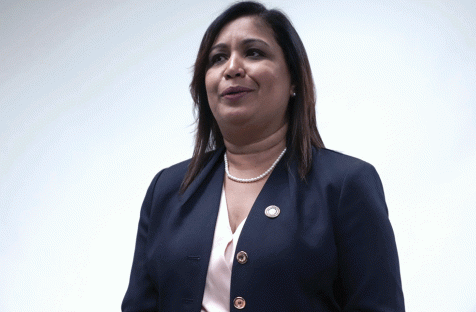
The Arab world’s first female interior minister has hailed her appointment as a “point of pride for all women”.
While there have been important advances in women’s leadership in politics, as of November 1 2017, women make up only 7.2% of Heads of State and 6.2% Heads of Government. Data on women representatives in local government, including as mayors, heads of villages and towns, is not well collected and analyzed. The adoption of an SDG indicator on women’s representation in local government is a great step forward in tracking progress on gender balance, allowing for the systematic collection and analysis of data on women in local government. Women’s access to and continued role in leadership positions is challenged by a range of barriers, including discriminatory laws and practices, as well as social norms that prescribe traditional roles and attitudes towards women’s participation in leadership and decision-making roles. Proactive gender-equality policies within political parties and local government structures, including quotas and special temporary measures, gender-sensitive approaches to electoral processes, support networks, mentoring, training, and engagement of male champions, can all help promote women’s role in political leadership.
The Arab world’s first female interior minister has hailed her appointment as a “point of pride for all women”.
In a posh ballroom overlooking Central Park on Manhattan’s Upper West Side, a hushed roomful of state and local elected officials from across the country gathered for a 9 a.m. Sunday session.
As early as 1966, India elected a female prime minister, becoming only the second country in the world to do so.
KUALA LUMPUR (Bernama): Women's participation in politics has long been recognised as an important measure of the status of women and in Malaysia, the women have indeed stamped their mark in the Cabinet, the Dewan Rakyat and the Dewan Negara.
Readers discuss if and how gender bias and stereotypes play a role in politics, citing past presidential races.
To the Editor:
Readers discuss if and how gender bias and stereotypes play a role in politics, citing past presidential races.
To the Editor:
SHAHDARA, Pakistan – Bushra Khaliq stood in the middle of a village home, chin up and shoulders back, holding the attention of fifty women around her.
“Our candidates are mostly women who work in the NGO sector and have grassroots experience. There are many retired IAS officers who are joining our party. The candidates will depend on their own resources for campaigning,” Shetty said.
With Democratic Sens. Elizabeth Warren of Massachusetts and Amy Klobuchar of Minnesota launching their presidential bids over the weekend, there are now more women running for a single party's nomination than ever.
By Nerima Wako-Ojiwa,
Student politics in our universities is a replica of our national politics.
By Nerima Wako-Ojiwa,
Student politics in our universities is a replica of our national politics.