Campaigns
An effective political campaign is a connected series of operations designed to persuade constituents to vote for you, your candidate, a party or an issue. Campaigns require methodical planning, organization and implementation.
Women face a number of obstacles implementing effective, winning campaigns. Women generally have more difficulty than men do in raising sufficient funds to win a campaign, in large part because they are traditionally not the primary breadwinners. Similarly, women may not have equal access to decision-making regarding the distribution of funds. Traditionally, women must earn the internal support of their party or, alternatively, work even harder to win as independent candidates. Rather than focusing on the substance of a campaign and its message, the media and the public may focus instead on the appearance of a woman candidate or her role in the home. To earn the support of their own party and constituents, women must work harder than men do to create clean, targeted and compelling messages.
Park Geun-hye has won her party's nomination to run as presidential candidate for the upcoming elections in December. If elected, Park would become the nation's first female head of state.
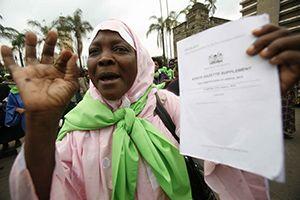
THE Independent Electoral and Boundaries Commission (IEBC) has agreed to reduce by half, the Sh500,000 it was demanding as nomination fee for any of the women hoping to join the country representative race.
Two women are running for president: Amal Abdi Ibrahim and Asha Ahmed Abdalla.
In announcing her candidature, Asha Ahmed Abdalla, a member of parliament, accused the current government of favouring corruption and intimidation in the parliament.
18 women have shown their interest to run as candidates in Vanuatu's general elections in two months time.
Since independence in 1980, only five women have been elected as members of Vanuatu's parliament.
Electoral funding for women - Case studies in Latin America
In this document the author analyzes the legislation on political parties' electoral funding from a gender perspective in Argentina, Colombia, Costa Rica, Chile, Brazil and Panama
In Pakistan, where instability, distrust, violence and political rivalries can impede interaction among political parties, women and young people — the majority of the population — often have difficulty making their voices heard.
Across the country, female operatives are leading more campaigns, starting their own political consulting firms, taking the reins of Super PACs and controlling millions in independent expenditure dollars.
Pagination
- Previous page
- Page 58
- Next page