Parliaments and Representatives

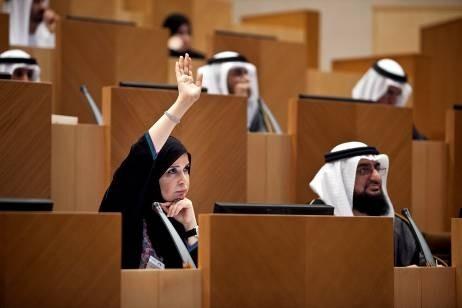
Democracy and the equal participation of men and women in the political arena are closely intertwined. No parliament or any decision-making body can claim to be representative without the participation of both men and women. As stated in the Universal Declaration on Democracy adopted by the Inter-Parliamentary Union’s Member Parliaments in 1997, "The achievement of democracy presupposes a genuine partnership between men and women in the conduct of the affairs of society in which they work in equality and complementarity, drawing mutual enrichment from their differences."

Recent years have seen a steady increase in the number of women in parliament, though the world average of less than 22 percent remains far from the goal of parity between women and men. The election of women to the highest positions of state and government in several countries has also contributed to the changing face of politics.

While the road to election is a difficult one, the challenges for women do not stop there. Once women enter parliament or other bodies, they are faced with many new challenges. Parliament is traditionally a male-oriented domain where the rules and practices have been written by men. It is, therefore, an ongoing challenge to transform parliament into a gender-sensitive environment, to ensure that actions are gender-sensitive and to guarantee that gender is mainstreamed throughout the legislature.

Women At The Top 2005: Changing Numbers, Changing Politics?

Back
May 31, 2007

Women At The Top 2005: Changing Numbers, Changing Politics?

This report focuses on women’s representation in political life in the United Kingdom, examining the feminization of politics and the integration of women and women’s perspectives into British politics.

This report focuses on women’s representation in political life in the United Kingdom, examining the feminization of politics and the integration of women and women’s perspectives into British politics.

National machinery , action plans and gender mainstreaming in the Council of Europe member states since the 4th World Conference on Women (Beijing 1995)

Back
April 27, 2007

National machinery , action plans and gender mainstreaming in the Council of Europe member states since the 4th World Conference on Women (Beijing 1995)

This document presents the situation concerning institutional mechanisms for equality and their effective functioning in Council of Europe member States.

This document presents the situation concerning institutional mechanisms for equality and their effective functioning in Council of Europe member States.

The Challenge of Implementing Gender Responsive Legislation in Central Asia

Back
April 17, 2007

The Challenge of Implementing Gender Responsive Legislation in Central Asia

This report describes the processes and challenges faced by the Central Asian countries moving towards creating gender equality in governance.

This report describes the processes and challenges faced by the Central Asian countries moving towards creating gender equality in governance.

Women's Environment and Development Organization

Back
April 5, 2007

Women's Environment and Development Organization

The Women's Environment and Development Organization (WEDO) is an international organization that advocates for women’s equality in global policy. It seeks to empower women as decision-makers to achieve economic, social and gender justice, a healthy, peaceful planet and human rights for all.

The Women's Environment and Development Organization (WEDO) is an international organization that advocates for women’s equality in global policy. It seeks to empower women as decision-makers to achieve economic, social and gender justice, a healthy, peaceful planet and human rights for all.

The White House Project

Back
April 5, 2007

The White House Project

The White House Project, a national, nonpartisan, not-for-profit organization, aims to advance women’s leadership in all communities and sectors, up to the U.S. presidency.

The White House Project, a national, nonpartisan, not-for-profit organization, aims to advance women’s leadership in all communities and sectors, up to the U.S. presidency.

National Women’s Council of Ireland (NWCI)

Back
April 4, 2007

National Women’s Council of Ireland (NWCI)

The National Women’s Council of Ireland (NWCI) is the national representative organization for women and women’s groups in Ireland.

The National Women’s Council of Ireland (NWCI) is the national representative organization for women and women’s groups in Ireland.

Council of Women World Leaders

Back
April 4, 2007

Council of Women World Leaders

The Council of Women World Leaders is a network of current and former women presidents and prime ministers. Its mission is to mobilize the highest-level women leaders globally for collective action on issues of critical importance to women and equitable development.

The Council of Women World Leaders is a network of current and former women presidents and prime ministers. Its mission is to mobilize the highest-level women leaders globally for collective action on issues of critical importance to women and equitable development.

Report of the Fifth South Asia Regional Ministerial Conference Celebrating Beijing Plus Ten

Back
March 20, 2007

Report of the Fifth South Asia Regional Ministerial Conference Celebrating Beijing Plus Ten

This report is an account of the Fifth South Asia Regional Ministerial Meeting, "Celebrating Beijing Plus Ten.” It provides an overview of the presentations, discussions and recommendations given at the meeting; contains the consensus document "Islamabad Declaration: Review and Future Action," a

This report is an account of the Fifth South Asia Regional Ministerial Meeting, "Celebrating Beijing Plus Ten.” It provides an overview of the presentations, discussions and recommendations given at the meeting; contains the consensus document "Islamabad Declaration: Review and Future Action," a