Parliaments and Representatives
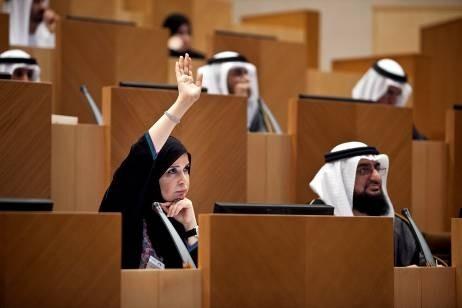
Democracy and the equal participation of men and women in the political arena are closely intertwined. No parliament or any decision-making body can claim to be representative without the participation of both men and women. As stated in the Universal Declaration on Democracy adopted by the Inter-Parliamentary Union’s Member Parliaments in 1997, "The achievement of democracy presupposes a genuine partnership between men and women in the conduct of the affairs of society in which they work in equality and complementarity, drawing mutual enrichment from their differences."
Recent years have seen a steady increase in the number of women in parliament, though the world average of less than 22 percent remains far from the goal of parity between women and men. The election of women to the highest positions of state and government in several countries has also contributed to the changing face of politics.
While the road to election is a difficult one, the challenges for women do not stop there. Once women enter parliament or other bodies, they are faced with many new challenges. Parliament is traditionally a male-oriented domain where the rules and practices have been written by men. It is, therefore, an ongoing challenge to transform parliament into a gender-sensitive environment, to ensure that actions are gender-sensitive and to guarantee that gender is mainstreamed throughout the legislature.
A Scottish council which has no female councillors hopes to encourage more women to stand in next May's local government elections. In the last elections in 2017, for the first time in its history, no women were elected t
A sea of change is washing across New South Wales local government as more women and young people take up seats as councillors. Until recently, 22-year-old Imogen Draisma could not see herself reflected in the local council running her home city of Kiama, in
Democracy Works Foundation (DWF) in conjunction with Botswana Editors Forum Botswana recently held a two-day workshop to train journalists on how media can play a supportive role in advancing meaningful participation of women in politics.
In just two years, the pandemic has threatened decades worth of progress towards gender equality.
India: women deserve bigger say in politics
By Sushma Ramachandran
RepresentWomen's Arab State Brief
RepresentWomen's Arab State Brief reviews the extent to which women are represented in Arab countries, the history of Arab independence and revolutions - and their impact on women's rights and representation; and country-specific information that covers the history of
In a society of transition, the role of women is also in transition in Bhutan, but the farsighted leadership of Their Majesties the Kings has helped Bhutanese women progress.
A game of political one-upmanship is being witnessed among the major political parties ever since Congress general secretary Priyanka Gandhi Vadra promised 40% party tickets to women candidates and made some populist announcements for them ahead of the 2022 Uttar Prad
Pagination
- Previous page
- Page 142
- Next page