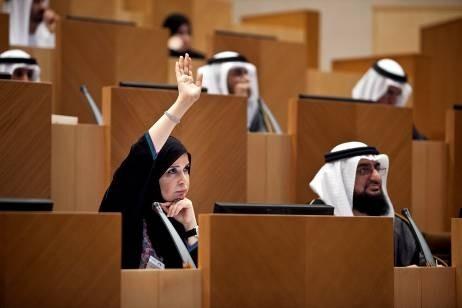
Parliaments and Representatives

Democracy and the equal participation of men and women in the political arena are closely intertwined. No parliament or any decision-making body can claim to be representative without the participation of both men and women. As stated in the Universal Declaration on Democracy adopted by the Inter-Parliamentary Union’s Member Parliaments in 1997, "The achievement of democracy presupposes a genuine partnership between men and women in the conduct of the affairs of society in which they work in equality and complementarity, drawing mutual enrichment from their differences."

Recent years have seen a steady increase in the number of women in parliament, though the world average of less than 22 percent remains far from the goal of parity between women and men. The election of women to the highest positions of state and government in several countries has also contributed to the changing face of politics.

While the road to election is a difficult one, the challenges for women do not stop there. Once women enter parliament or other bodies, they are faced with many new challenges. Parliament is traditionally a male-oriented domain where the rules and practices have been written by men. It is, therefore, an ongoing challenge to transform parliament into a gender-sensitive environment, to ensure that actions are gender-sensitive and to guarantee that gender is mainstreamed throughout the legislature.

May 27, 2014
South Africa Misses the Mark on Women in Politics

Following the elections and President Jacob Zuma's recent cabinet appointments, South Africa has missed its last opportunity - so tantalizingly close - to achieve gender parity in politics ahead of the 2015 deadline.

May 27, 2014
How Not to Close the Gender Gap in Politics, USA

Colorado Republicans, concerned about their string of statewide losses in recent years, have been making some efforts to reach out to demographic groups that have not historically backed their party.

May 27, 2014
Why the hell has Europe voted in a feminist party?

Feminists of the world, unite and celebrate. The European Parliament has the first member to be elected on a feminist ticket.

May 27, 2014
What Makes Successful Women Politicians? India
May 23, 2014
Teluk Intan Malays denounce bikini smear campaign against Dyana

The dissemination of posters featuring DAP’s Dyana Sofya Mohd Daud alongside a bikini-clad actress with whom she shares a striking facial resemblance has drawn outrage from several Malay residents in this usually placid town.

May 23, 2014
Egypt: Women Council Opposes Proposed Women Representation in Parliament

Women were angered by the percentage allocated to their representation in the future parliament according to the new parliament law, the National Council for Women said on Thursday.

A committee formed by a presidential decree to draft this new law announced it yesterday.

May 23, 2014
Will Narendra Modi government bring in the Women's Reservation Bill?

The 2014 Lok Sabha elections saw many highs for women. 

Does this mean that finally the Women’s Reservation Bill and others Bills pertaining to women’s representation, security and development will be passed?

Why the European Parliament Elections Matter

Back
May 22, 2014

Why the European Parliament Elections Matter

Voters in all 28 member states of the European Union (EU) will go to the polls May 22–25, 2014, to elect representatives to the 751-seat European Parliament.

Voters in all 28 member states of the European Union (EU) will go to the polls May 22–25, 2014, to elect representatives to the 751-seat European Parliament.

European Elections 2014: Gender Perspective

Back
May 22, 2014

European Elections 2014: Gender Perspective

Voters in the EU will elect the 751 Members of the European Parliament during the European elections of 22-25 May 2014. The new European Parliament, representing the interests of over 500 million citizens, will shape European legislation over the next five years.