Parliaments and Representatives

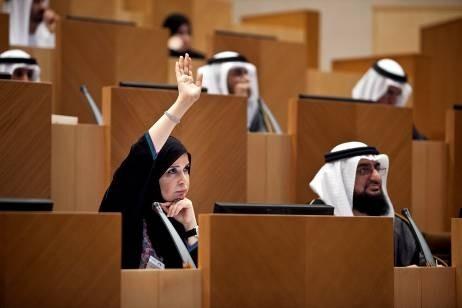
Democracy and the equal participation of men and women in the political arena are closely intertwined. No parliament or any decision-making body can claim to be representative without the participation of both men and women. As stated in the Universal Declaration on Democracy adopted by the Inter-Parliamentary Union’s Member Parliaments in 1997, "The achievement of democracy presupposes a genuine partnership between men and women in the conduct of the affairs of society in which they work in equality and complementarity, drawing mutual enrichment from their differences."

Recent years have seen a steady increase in the number of women in parliament, though the world average of less than 22 percent remains far from the goal of parity between women and men. The election of women to the highest positions of state and government in several countries has also contributed to the changing face of politics.

While the road to election is a difficult one, the challenges for women do not stop there. Once women enter parliament or other bodies, they are faced with many new challenges. Parliament is traditionally a male-oriented domain where the rules and practices have been written by men. It is, therefore, an ongoing challenge to transform parliament into a gender-sensitive environment, to ensure that actions are gender-sensitive and to guarantee that gender is mainstreamed throughout the legislature.

May 7, 2014
Support to Egypt begins on fulfilling roadmap to democracy

IPU has kick-started its priority support to Egypt in its efforts to establish democracy by providing advice and expertise on the drafting on a new electoral law.

Only Until the Rice is Cooked? The Domestic Violence Act, Familial Ideology, and Cultural Narratives in Sri Lanka

Back
May 2, 2014

Only Until the Rice is Cooked? The Domestic Violence Act, Familial Ideology, and Cultural Narratives in Sri Lanka

In August 2005, the Sri Lankan Parliament unanimously passed the Prevention of Domestic Violence Act No 34 (PDVA), marking the culmination of a legal advocacy process initiated by a coalition of women’s NGOs in 1999.

Women Members of the Constituent Assembly: A summary of a study on contribution of women in constitution making in Nepal

Back
May 2, 2014

Women Members of the Constituent Assembly: A summary of a study on contribution of women in constitution making in Nepal

This publication reveals stories of leadership, struggle and achievement of the 197 women in the Constituent Assembly in Nepal.

This publication reveals stories of leadership, struggle and achievement of the 197 women in the Constituent Assembly in Nepal.

Parliaments and Gender Equality: Gender mainstreaming in legislatures

Back
May 1, 2014

Parliaments and Gender Equality: Gender mainstreaming in legislatures

The experience accumulated by the UNDP with other institutions is synthesized in the proposal we hereby present today: “Parliaments and Gender Equality. Gender mainstreaming in legislatures”.

The experience accumulated by the UNDP with other institutions is synthesized in the proposal we hereby present today: “Parliaments and Gender Equality. Gender mainstreaming in legislatures”.

May 1, 2014
CAR President Samba-Panza Inspires Congolese Women Politicians

In Sub-Saharan Africa, where women hold just 23 percent of the seats in national parliaments and there are only three women heads of state, Catherine Samba-Panza, president of the Central African Republic (CAR), is an inspirational figure.

April 28, 2014
Women’s participation in Slovene politics

“Slovene politics is no longer a boys-only game”, said the Slovene prime minister Alenka Bratušek on 8.3.2013. 

Women’s Political Participation in Asia and the Pacific

Back
April 28, 2014

Women’s Political Participation in Asia and the Pacific

This paper examines current patterns of women’s political participation in the four subregions (Eastern Asia, South-Eastern Asia, South Asia and the Pacific Islands) of the Asia-Pacific region.