Parliaments and Representatives
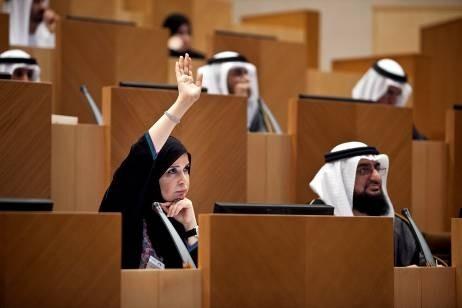
Democracy and the equal participation of men and women in the political arena are closely intertwined. No parliament or any decision-making body can claim to be representative without the participation of both men and women. As stated in the Universal Declaration on Democracy adopted by the Inter-Parliamentary Union’s Member Parliaments in 1997, "The achievement of democracy presupposes a genuine partnership between men and women in the conduct of the affairs of society in which they work in equality and complementarity, drawing mutual enrichment from their differences."
Recent years have seen a steady increase in the number of women in parliament, though the world average of less than 22 percent remains far from the goal of parity between women and men. The election of women to the highest positions of state and government in several countries has also contributed to the changing face of politics.
While the road to election is a difficult one, the challenges for women do not stop there. Once women enter parliament or other bodies, they are faced with many new challenges. Parliament is traditionally a male-oriented domain where the rules and practices have been written by men. It is, therefore, an ongoing challenge to transform parliament into a gender-sensitive environment, to ensure that actions are gender-sensitive and to guarantee that gender is mainstreamed throughout the legislature.
Democratic women have gained legislative seats at a much higher rate than Republican women in recent years. To a great extent, the rise of female Democrats is about the rise of Democratic women of color. Although they do not hold office in proportion to their presence in the U.S.
After decades of trying to amass power, several women have vaulted to the top of influential congressional committees, putting them in charge of some of the most consequential legislation being considered on Capitol Hill.
The 113th Congress has been applauded for its diversity, but women – and specifically women of color, who only make up 4.5% of the 535 members – are still the vast minority.
Across the world, female political representation continues to be an issue.
Most recently, it’s become a significant issue in Jamaica, where the 51 Percent Coalition has been pushing for more women in Parliament (and in boardrooms) in the country.
Want to know more about how women MPs are organizing themselves in parliaments around the world? IPU has launched a new global database on women’s caucuses in parliament to capture such information in one useful place.
The first women officers appointed to join the military bloc in parliament since it convened nearly three years ago after the 2010 elections have been sworn in as members of the Pyithu Hluttaw.
A PN MEP candidate has called for more female candidates for the European Parliament elections.
Pagination
- Previous page
- Page 274
- Next page