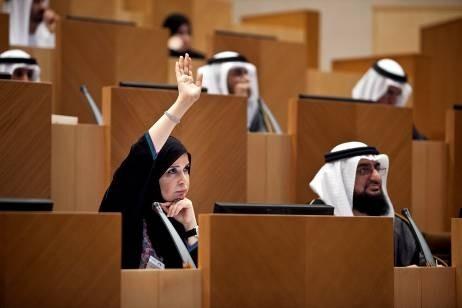
Despite efforts to increase the number of women in politics, they still face an uphill battle to join the male-dominated political world, a political expert has said.
Parliaments and Representatives
Democracy and the equal participation of men and women in the political arena are closely intertwined. No parliament or any decision-making body can claim to be representative without the participation of both men and women. As stated in the Universal Declaration on Democracy adopted by the Inter-Parliamentary Union’s Member Parliaments in 1997, "The achievement of democracy presupposes a genuine partnership between men and women in the conduct of the affairs of society in which they work in equality and complementarity, drawing mutual enrichment from their differences."
Recent years have seen a steady increase in the number of women in parliament, though the world average of less than 22 percent remains far from the goal of parity between women and men. The election of women to the highest positions of state and government in several countries has also contributed to the changing face of politics.
While the road to election is a difficult one, the challenges for women do not stop there. Once women enter parliament or other bodies, they are faced with many new challenges. Parliament is traditionally a male-oriented domain where the rules and practices have been written by men. It is, therefore, an ongoing challenge to transform parliament into a gender-sensitive environment, to ensure that actions are gender-sensitive and to guarantee that gender is mainstreamed throughout the legislature.
Women in Puntland have expressed their dissatisfaction with their representation in the new Puntland Parliament. Halimo Mohamed Farah, the chairwoman of Puntland Women Alliance said that they were dismayed to learn that only two women were among the 66 newly assembled legislators.
Former US representative Gabrielle Giffords — still recovering from a shooting three years ago — said Thursday that she might consider a return to political office.
“Our young women are forming a new era in female history,” wrote Massachusetts feminist Judith Sargent Murray excitedly. “The Rights of Women begin to be understood; we seem, at length, determined to do justice.” The year was 1798.
Women account for only about 20 per cent of the world’s MPs. In nearly every country they form a minority in parliament, an institution traditionally governed according to the principles and worldviews of their predominantly male memberships.
Guidelines for Women's Caucuses
Dec. 5 marked the 79th anniversary of the day when Turkish women got the right to vote and be elected.
The 10th parliamentary polls see 17 women candidates elected, according to unofficial results of the election. The number is just one less than the historic high of the 2008 election, when 18 women were elected.
Pagination
- Previous page
- Page 275
- Next page