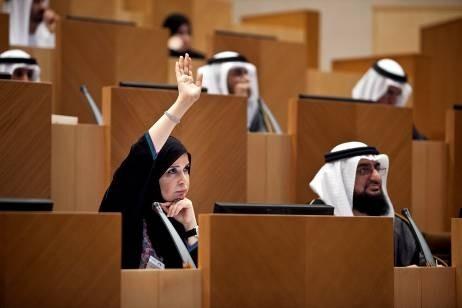
Women voters have been outnumbering male voters in Mizoram for the past few years, but paradoxically there are no women representatives in the state legislature for years together.
Parliaments and Representatives
Democracy and the equal participation of men and women in the political arena are closely intertwined. No parliament or any decision-making body can claim to be representative without the participation of both men and women. As stated in the Universal Declaration on Democracy adopted by the Inter-Parliamentary Union’s Member Parliaments in 1997, "The achievement of democracy presupposes a genuine partnership between men and women in the conduct of the affairs of society in which they work in equality and complementarity, drawing mutual enrichment from their differences."
Recent years have seen a steady increase in the number of women in parliament, though the world average of less than 22 percent remains far from the goal of parity between women and men. The election of women to the highest positions of state and government in several countries has also contributed to the changing face of politics.
While the road to election is a difficult one, the challenges for women do not stop there. Once women enter parliament or other bodies, they are faced with many new challenges. Parliament is traditionally a male-oriented domain where the rules and practices have been written by men. It is, therefore, an ongoing challenge to transform parliament into a gender-sensitive environment, to ensure that actions are gender-sensitive and to guarantee that gender is mainstreamed throughout the legislature.
Hajiya Zainab Maina, Minister of Women Affairs and Social Development, on Tuesday advised women to adopt strategies to increase their participation in decision making processes.
Thirty-six states will hold governor’s elections next year, and Democrats have top female recruits in at least five states who are poised to be their party’s nominee and competitive in the general election.
The National Council of Women in Fiji is embarking on a project that aims to increase the representation of women in politics in the lead-up to the elections promised for next year.
Due to the government shutdown and debt ceiling debate, Americans have paid particularly close attention to Congress and its members. This new attentiveness to the legislative branch has raised a valid observation: most members of Congress are men. That is why on Wednesday, Oct.
No less than 35 percent of the newly elected MPs in Zimbabwe are women, thanks to a special electoral quota system to increase women's representation in Parliament. At age 29, Tionei Melody Dziva is the youngest of them.
The Cook Islands finance minister says interventions may be needed to fast track greater participation by women in politics.
Mark Brown is chairing the 12th Triennial Conference of Pacific Women, being held in the Cook Islands capital, Rarotonga, this week.
No less than 35 percent of the newly elected MPs in Zimbabwe are women, thanks to a special electoral quota system to increase women's representation in Parliament. At age 29, Tionei Melody Dziva is the youngest of them.
As Ontario's first female and first lesbian premier, Kathleen Wynne was an obvious choice for keynote speaker at the Leadership Summit for Women.
Pagination
- Previous page
- Page 283
- Next page