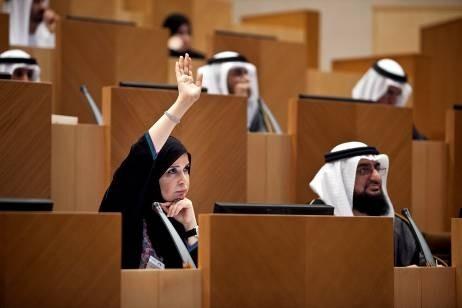
Jordanian female parliamentarians have come a long way in the ten years since the quota system was first introduced for the 2003 elections.
Parliaments and Representatives
Democracy and the equal participation of men and women in the political arena are closely intertwined. No parliament or any decision-making body can claim to be representative without the participation of both men and women. As stated in the Universal Declaration on Democracy adopted by the Inter-Parliamentary Union’s Member Parliaments in 1997, "The achievement of democracy presupposes a genuine partnership between men and women in the conduct of the affairs of society in which they work in equality and complementarity, drawing mutual enrichment from their differences."
Recent years have seen a steady increase in the number of women in parliament, though the world average of less than 22 percent remains far from the goal of parity between women and men. The election of women to the highest positions of state and government in several countries has also contributed to the changing face of politics.
While the road to election is a difficult one, the challenges for women do not stop there. Once women enter parliament or other bodies, they are faced with many new challenges. Parliament is traditionally a male-oriented domain where the rules and practices have been written by men. It is, therefore, an ongoing challenge to transform parliament into a gender-sensitive environment, to ensure that actions are gender-sensitive and to guarantee that gender is mainstreamed throughout the legislature.
When Canada’s premiers sit down next July 25 for their semi-annual summit, they’ll be making history by changing the face of provincial and territorial leadership.
Do politics matter? Women in Swedish local elected assemblies 1970-2010 and gender equality in outcomes
Noorzia Atmar is the human face of women's rights in Afghanistan, her unbridled and open enthusiasm now bruised and sheltered from the public eye.
The NGO Lawyers for Justice in Libya (LFJL) has welcomed the decision by Congress to reserve seats on the 60-member Constitutional Commission for women and ethnic minorities but has criticized the amount set aside for the former.
When 2013 began, there was a fair amount of hope that women could make up for their relatively measly representation in local offices nationwide by capturing the mayoralty in three of the nation's five largest cities.
In a country where they have been playing second fiddle to men for centuries, women candidates outnumber men in the ongoing polls to the West Bengal village councils, the third tier of India's electoral democracy.
What is it about the “woman question” that drives so many pundits and politicians to despair in New Zealand? To call the all-women shortlist a “man ban” shows how clearly many of them see politics as being all about them, men.
Event
Building stronger legislatures: NDI strategies for supporting women's leadership in parliament
The National Democratic Institute
cordially invites you to a
World Affairs Briefing
Pagination
- Previous page
- Page 297
- Next page