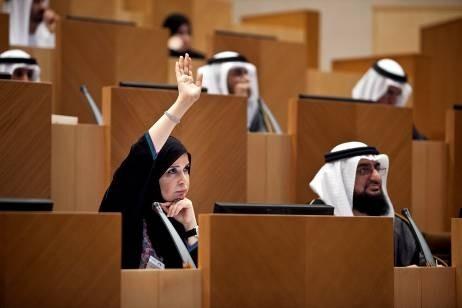
Parliaments and Representatives

Democracy and the equal participation of men and women in the political arena are closely intertwined. No parliament or any decision-making body can claim to be representative without the participation of both men and women. As stated in the Universal Declaration on Democracy adopted by the Inter-Parliamentary Union’s Member Parliaments in 1997, "The achievement of democracy presupposes a genuine partnership between men and women in the conduct of the affairs of society in which they work in equality and complementarity, drawing mutual enrichment from their differences."

Recent years have seen a steady increase in the number of women in parliament, though the world average of less than 22 percent remains far from the goal of parity between women and men. The election of women to the highest positions of state and government in several countries has also contributed to the changing face of politics.

While the road to election is a difficult one, the challenges for women do not stop there. Once women enter parliament or other bodies, they are faced with many new challenges. Parliament is traditionally a male-oriented domain where the rules and practices have been written by men. It is, therefore, an ongoing challenge to transform parliament into a gender-sensitive environment, to ensure that actions are gender-sensitive and to guarantee that gender is mainstreamed throughout the legislature.

July 9, 2013
Women in National Parliaments, Classification by IPU

The data been compiled by the Inter-Parliamentary Union on the basis of information provided by National Parliaments by 1st July 2013.189 countries are classified by descending order of

Are parliaments favourable conduits for gender equality? IPU Opinion Piece

Back
July 8, 2013

Are parliaments favourable conduits for gender equality? IPU Opinion Piece

By posing this question to parliamentarians from all over the world, the Inter-Parliamentary Union (IPU) caused something of a stir.

By posing this question to parliamentarians from all over the world, the Inter-Parliamentary Union (IPU) caused something of a stir.

July 5, 2013
Why women win elections, Canada

North American experiments are showing that women have an electoral advantage. In one study in which only the names of a candidate were changed, participants rated the candidate they thought was female as stronger, more honest, and more compassionate than the male candidate.

July 5, 2013
Rwanda: Women Urged to Participate in Forthcoming Parliamentary Polls

The National Electoral Commission (NEC) has urged women to participate in the forthcoming parliamentary elections by turning up in large numbers on Election Day.

The polls are slated for September.

July 2, 2013
NDI staffer seeks to connect Somali women in parliament, civil society

Hodan Ahmed and her family were forced to flee Somalia in 1991. The civil war that drove them from their home would go on for two decades.

June 28, 2013
The Sole Chart That Explains Why So Many Policies Are Hostile to Women

In 2011, there was one important seat missing from the House of Representatives: a toilet seat.

Report of the Sub-Regional Forum on Women's Participation in Post-Revolution Parliamentary Elections

Back
June 27, 2013

Report of the Sub-Regional Forum on Women's Participation in Post-Revolution Parliamentary Elections

This report aims at documenting the proceedings of the Sub-Regional Forum on Women’s Participation in Parliamentary Elections in Tunisia, Egypt and Libya; the three Arab countries which are going through a transition period to build democracy, since 2011, following the Arab Spring revolutions.

This report aims at documenting the proceedings of the Sub-Regional Forum on Women’s Participation in Parliamentary Elections in Tunisia, Egypt and Libya; the three Arab countries which are going through a transition period to build democracy, since 2011, following the Arab Spring revolutions.

June 26, 2013
Samoa parliament reserves seats for women

Samoa’s Parliament has decided to unanimously endorse an amendment to the constitution which will allow five parliamentary seats to be allotted to women cand